Huawei HCIA-Datacom H12-811 Practice Exam
Huawei Certified ICT Associate-Datacom (HCIA-Datacom) H12-811
The Huawei HCIA-Datacom H12-811 V2.0 exam validates the skills to deploy, maintain and troubleshoot small and medium-sized campus networks. It covers eight areas: data communication network basics, Ethernet technology (VLANs, STP and link aggregation), IP technology (addressing, routing, OSPF and IPv6), network security and services (ACL, AAA, NAT, FTP, Telnet and SSH), data center network basics, WLAN, network O&M and automation, and a typical campus network solution, with IP technology the largest. This practice exam uses the question formats Huawei lists, including multiple-answer, true/false and typed fill-in-the-blank questions, with VRP command output and topology exhibits.
Question bank updated : questions, answers, explanations and chapters.
Certification Overview
- Exam name: HCIA-Datacom H12-811
- Vendor: Huawei
- Exam code: H12-811
- Duration: 90 minutes
- Total questions: about 60
- Official passing score: 600 out of 1000 (source)
- Our practice exam pass mark: 60%
Who Should Take This Exam?
Network Engineer, Junior Datacom Engineer, Network Administrator, Network Operations and Maintenance Engineer, IT Support Engineer, and students starting a networking career on Huawei equipment
Prerequisites
No formal prerequisite; Huawei recommends being familiar with PC operations and having a basic understanding of IT and networking.
Topics Covered
- Data Communication Network Basics
- Ethernet Technology Basics
- IP Technology Basics
- Network Security and Services
- Data Center Network Basics
- WLAN Technology Basics
- Network O&M and Troubleshooting
- Typical Campus Networking Solution
Question Types
- Multiple Choice (Single Answer)
- Multiple Choice (Multiple Answers)
- True / False
- Drag and Drop
- Fill in the Blank
HCIA-Datacom H12-811 Practice Questions
Our question bank contains 600+ practice questions for this certification. Sample questions from each exam chapter. Expand a question to see the answer choices. With full access, you get unlimited practice exams with randomised questions from our full question bank.
Data Communication Network Basics
A captured IPv4 packet has the Protocol field set to 17. Which protocol does its payload belong to?
- A. TCP
- B. UDP Correct answer
- C. OSPF
- D. ICMP
Option B is correct because IPv4 Protocol value 17 identifies UDP. TCP is 6, ICMP is 1 and OSPF is 89, so the other options do not match the value 17.
Which protocols work at the transport layer of the TCP/IP model?
- A. ICMP
- B. DNS
- C. UDP Correct answer
- D. IP
- E. TCP Correct answer
Options C and E are correct because UDP and TCP are the transport layer protocols of the TCP/IP model. ICMP and IP work at the network layer, and DNS is an application layer protocol.
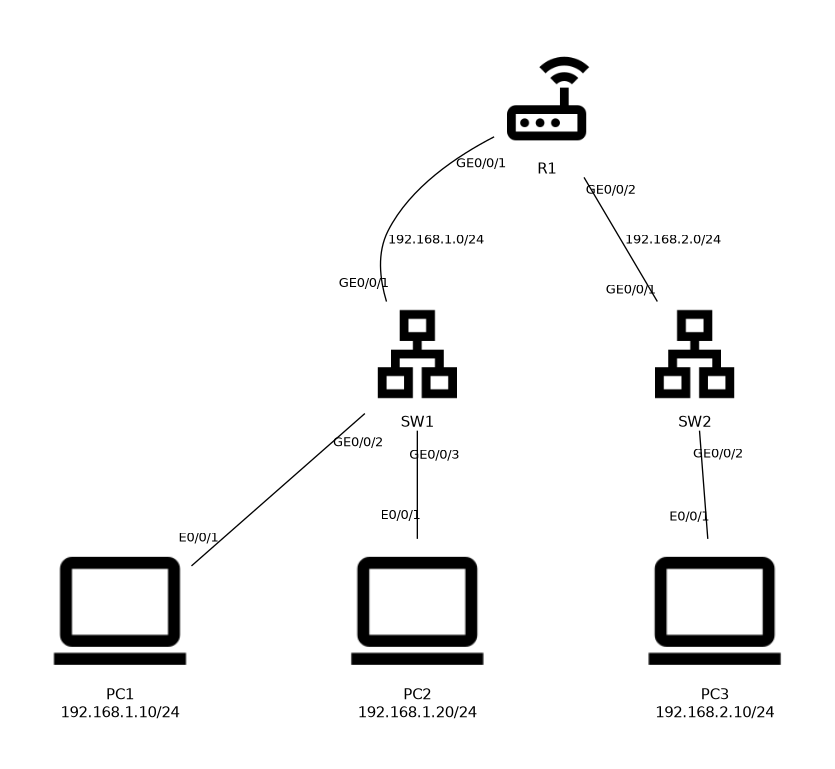
As shown in the figure, SW1 and SW2 are Layer 2 switches with default settings, and R1 uses 192.168.1.1/24 and 192.168.2.1/24 on its interfaces. PC1 pings PC3 for the first time with empty ARP caches. Which devices receive the first ARP Request broadcast that PC1 sends?
- A. SW1, PC2, R1 and SW2
- B. SW1 and PC2
- C. SW1, PC2, R1, SW2 and PC3
- D. SW1, PC2 and R1 Correct answer
Option D is correct because PC3 is in another subnet, so PC1 sends an ARP Request for its gateway 192.168.1.1. The broadcast is flooded by SW1 to all ports in the VLAN, reaching PC2 and R1 GE0/0/1, and R1 does not forward it to SW2 or PC3 because routers stop broadcasts. The options listing SW2 or PC3 are wrong for that reason, and option B misses the gateway R1.
Ethernet Technology Basics
Which payload type does a Type field value of 0x0800 identify in an Ethernet II frame?
- A. IPv4 packet Correct answer
- B. IPv6 packet
- C. MPLS unicast packet
- D. ARP packet
Option A is correct because the Type field value 0x0800 identifies an IPv4 packet in an Ethernet II frame. IPv6 uses 0x86DD (Option B), MPLS unicast uses 0x8847 (Option C) and ARP uses 0x0806 (Option D).
CSMA/CD operates on full-duplex Ethernet links.
- A. True
- B. False Correct answer
The statement is false. CSMA/CD exists to detect and resolve collisions on shared half-duplex media. A full-duplex link has separate transmit and receive paths and no collisions, so CSMA/CD is not used there.
Which problems can occur in a Layer 2 switched network that contains a loop and no loop-prevention protocol?
- A. Routing table entries aging out of the switch
- B. Duplicate copies of the same frame at the receiver Correct answer
- C. MAC address table flapping Correct answer
- D. Excessive fragmentation of IP packets
- E. Broadcast storms Correct answer
Options B, C and E are correct because a Layer 2 loop makes frames circulate endlessly: broadcasts multiply into a broadcast storm, receivers get duplicate copies of the same frame, and the same source MAC address is learned on different ports in turn, which causes MAC address table flapping. Switches do not hold routing table entries that age out because of a loop (option A), and loops do not cause IP fragmentation (option D).
IP Technology Basics
An ICMP Echo Request message carries type value 8.
- A. True Correct answer
- B. False
An ICMP Echo Request carries type value 8, and the matching Echo Reply carries type 0. Ping sends the request and waits for the reply, so the statement is true.
Which of the following fields belong to the IPv4 header?
- A. Time to Live Correct answer
- B. Fragment Offset Correct answer
- C. Flow Label
- D. Identification Correct answer
- E. Hop Limit
Options A, B and D are correct because Time to Live, Fragment Offset and Identification are all fields of the IPv4 header. Flow Label is an IPv6 header field, and Hop Limit is the IPv6 counterpart of TTL, so options C and E do not belong to IPv4.
How many bits does an IPv4 address contain?
- A. 32 Correct answer
- B. 48
- C. 64
- D. 128
Option A is correct because an IPv4 address is 32 bits long, written as four 8-bit octets in dotted decimal. 128 bits is the length of an IPv6 address, and 48 bits is the length of an Ethernet MAC address.
Network Security and Services
HWTACACS uses TCP to carry packets between a Huawei device and its server.
- A. True Correct answer
- B. False
True. HWTACACS runs over TCP (port 49), which gives it reliable delivery. RADIUS, by contrast, runs over UDP.
What number ranges identify ACL types on Huawei VRP devices?
- A. Layer 2 ACL: 5000 to 5999
- B. Basic ACL: 2000 to 2999 Correct answer
- C. Advanced ACL: 100 to 199
- D. Basic ACL: 1 to 99
- E. Advanced ACL: 3000 to 3999 Correct answer
Options B and E are correct because Huawei VRP uses 2000 to 2999 for basic ACLs and 3000 to 3999 for advanced ACLs. Layer 2 ACLs use 4000 to 4999, not 5000 to 5999, and the 1 to 99 and 100 to 199 ranges are Cisco numbering that VRP does not use for these types.
Which number range identifies a basic ACL on a Huawei device?
- A. 5000 to 5999
- B. 2000 to 2999 Correct answer
- C. 3000 to 3999
- D. 4000 to 4999
Option B is correct because basic ACLs on Huawei devices use numbers 2000 to 2999 and match only the source IP address. Advanced ACLs use 3000 to 3999, Layer 2 ACLs use 4000 to 4999, and 5000 to 5999 is the user-defined range.
Data Center Network Basics
In the traditional three-tier data center architecture, which layer connects directly to the servers?
- A. Aggregation layer
- B. Spine layer
- C. Core layer
- D. Access layer Correct answer
Option D is correct because the access layer is where servers physically attach in the three-tier design. The aggregation layer collects the access switches, the core layer provides high-speed transport between aggregation blocks, and the spine layer belongs to spine-leaf designs, not three-tier.
Which statements describe limitations of the traditional three-tier data center architecture?
- A. Server-to-server traffic often passes through the aggregation or core layer Correct answer
- B. Spanning Tree blocks redundant links, which leaves bandwidth idle Correct answer
- C. Every access switch connects to every core switch, which gives equal-cost paths
- D. The aggregation layer is removed, so access switches connect straight to the core layer
- E. Access switches cannot run link aggregation toward the aggregation layer
Options A and B are correct because in a three-tier design east-west traffic has to climb to the aggregation or core layer, and STP blocks redundant links so that bandwidth sits idle. Option C describes spine-leaf, option D describes a collapsed design that is not the traditional three-tier, and access switches can in fact run link aggregation toward aggregation, so option E is wrong.
WLAN Technology Basics
Which IEEE standard family defines the physical and MAC layers of WLAN?
- A. IEEE 802.3
- B. IEEE 802.11 Correct answer
- C. IEEE 802.1Q
- D. IEEE 802.16
Option B is correct because the IEEE 802.11 family defines the physical and MAC layers of WLAN. IEEE 802.3 is wired Ethernet, 802.1Q is VLAN tagging, and 802.16 is WiMAX.
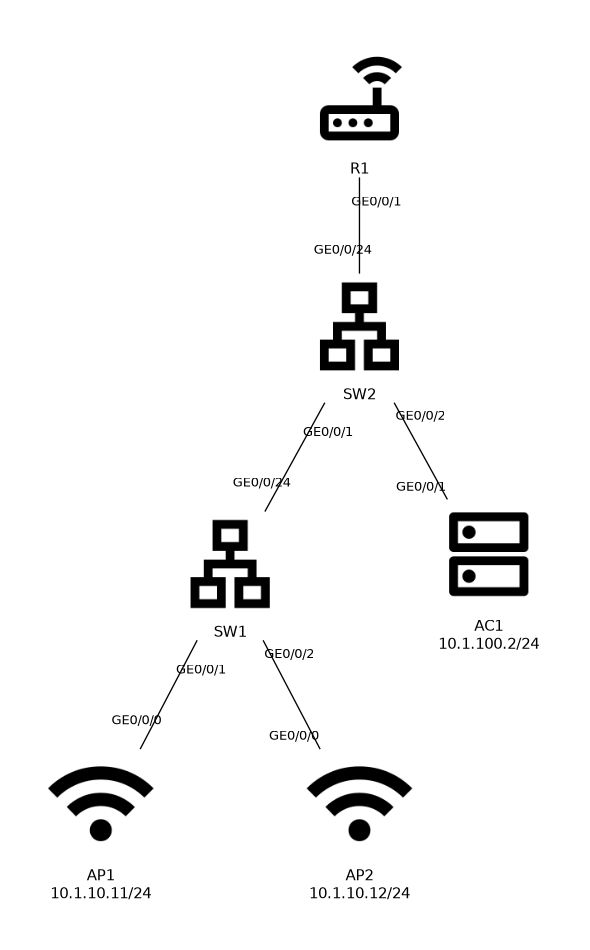
As shown in the figure, which AC networking mode connects the APs to the AC?
- A. Layer 2 networking, bypass mode
- B. Layer 2 networking, in-line mode
- C. Layer 3 networking, in-line mode
- D. Layer 3 networking, bypass mode Correct answer
Option D is correct because the APs (10.1.10.0/24) and AC1 (10.1.100.0/24) are in different subnets and are joined through the router R1, which is Layer 3 networking. AC1 hangs off SW2 beside the path between the APs and R1 instead of sitting on it, which is bypass mode. In-line mode would place the AC in the traffic path, and Layer 2 networking would put the APs and the AC in one subnet.
Network O&M and Troubleshooting
What method manages a Huawei S-series switch out-of-band?
- A. Logging in through the console port Correct answer
- B. Logging in with Telnet to a Vlanif address
- C. Polling the device with SNMP from an NMS
- D. Logging in with STelnet to a loopback address
Option D is correct because the console port is a dedicated physical management port that works without any IP configuration or network connectivity, so it is out-of-band. STelnet, Telnet and SNMP all travel over the IP network (in-band), whether they target a loopback or a Vlanif address.
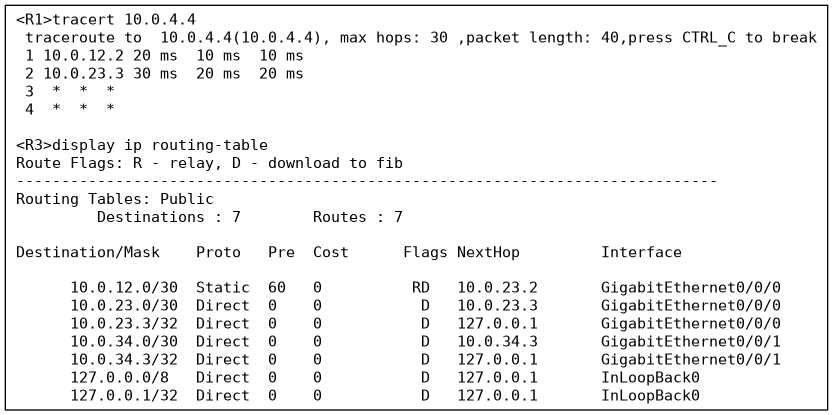
Refer to the output shown. R1 cannot reach 10.0.4.4 and the trace stops after two hops. What is the most likely cause?
- A. R3 has no route to 10.0.4.0/24 Correct answer
- B. R3 has no route back to 10.0.12.0/30
- C. R1 has no route to 10.0.23.0/30
- D. R2 has no route to 10.0.4.0/24
Option A is correct because the trace reaches R2 (10.0.12.2) and R3 (10.0.23.3) and then shows only asterisks, and the routing table of R3 has no entry for 10.0.4.0/24, only direct routes and a static route back to 10.0.12.0/30. Option B is wrong because R3 does have that return route, and options C and D are wrong because the packets already got through R1 and R2.
Typical Campus Networking Solution
Which functions are typical of the aggregation layer in a campus network?
- A. Aggregating uplink traffic from many access switches Correct answer
- B. Connecting terminals and supplying PoE power
- C. Forwarding backbone traffic at the highest speed
- D. Providing the NAT and firewall boundary to the Internet
- E. Serving as the Layer 3 gateway for access-layer VLANs Correct answer
Options A and E are correct because the aggregation layer collects uplink traffic from many access switches and usually acts as the Layer 3 gateway for the access-layer VLANs. Connecting terminals and PoE (B) belong to the access layer, highest-speed backbone forwarding (C) to the core layer, and NAT and firewall boundary functions (D) to the egress zone.
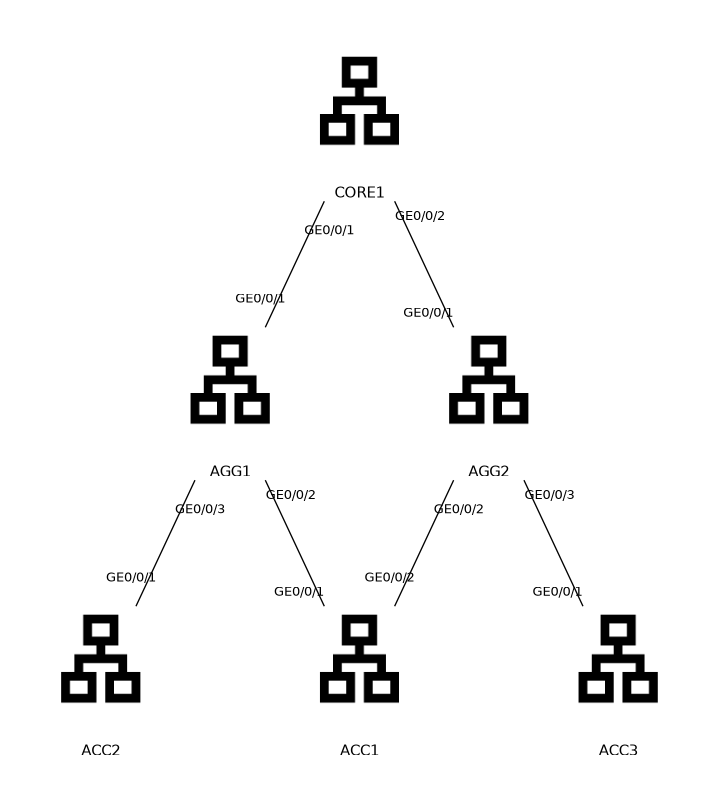
As shown in the figure, AGG1 fails. Which access switches lose all connectivity to CORE1?
- A. ACC1 only
- B. ACC1 and ACC2
- C. ACC2 and ACC3
- D. ACC2 only Correct answer
Option D is correct because in the figure ACC2 connects only to AGG1, so when AGG1 fails it has no path to CORE1. ACC1 also connects to AGG2 and ACC3 connects only to AGG2, so both keep a path through AGG2 to CORE1.
Free Study Guide
Read the free Huawei HCIA-Datacom H12-811 study guide: every exam topic explained in plain English, with diagrams, exam tips and the mistakes to avoid.
Practise with realistic mock exams to prepare for your Huawei certification.