Network Security · Topic 6 of 8
Secure Network Management with SNMPv3, NETCONF, RESTCONF, Syslog and NTP
Secure device management with SNMPv3 authentication and privacy, NETCONF, RESTCONF, APIs, secure syslog and authenticated NTP on Cisco devices.
- 5 min
- Includes a diagram
- SNMPv3
authPrivgives authentication and encryption. v1 and v2c use clear text community strings. - NETCONF uses SSH on TCP 830, with XML and YANG models.
- RESTCONF uses HTTPS with GET, POST, PUT, PATCH and DELETE, and JSON or XML.
What it is
Secure management means every protocol you use to monitor or change a device is authenticated, encrypted and restricted.
Management traffic is powerful. It can read configuration, change policy and report events. Older protocols such as SNMPv1, SNMPv2c, Telnet and plain syslog send data in clear text or with weak authentication.
How it works
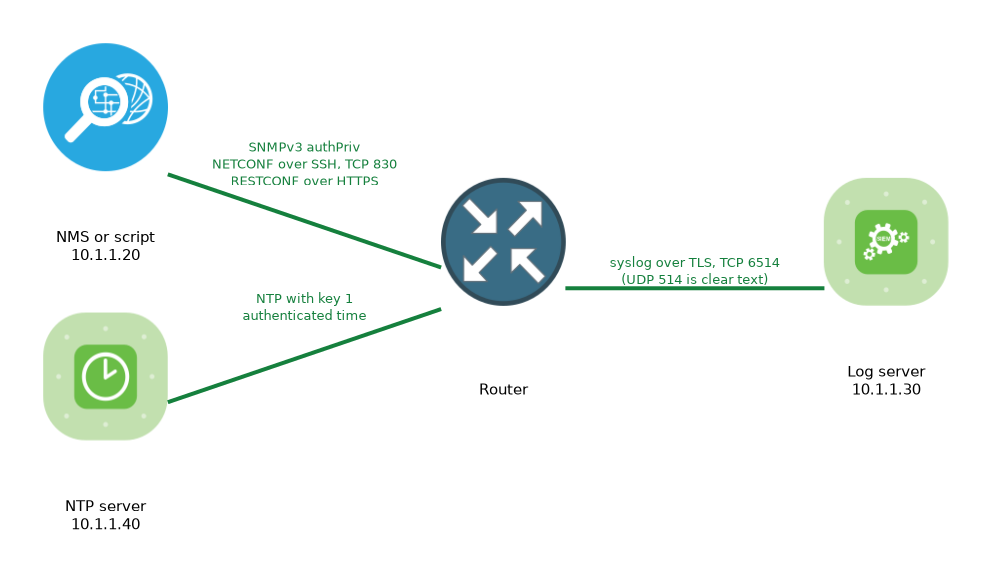 For each management function, pick the protocol variant that adds authentication and encryption.
SNMPv3
SNMPv1 and v2c use a community string, which is a clear text password. SNMPv3 adds real user authentication and optional encryption. It has three security levels.
| Level | Authentication | Encryption |
|---|---|---|
| noAuthNoPriv | Username only | No |
| authNoPriv | Yes, with MD5 or SHA | No |
| authPriv | Yes | Yes, such as AES |
The priv level gives both integrity and confidentiality, so it is the best choice.
Router(config)# snmp-server group MONGROUP v3 priv
Router(config)# snmp-server user MONUSER MONGROUP v3 auth sha AUTHPASS priv aes 128 PRIVPASS
Router(config)# snmp-server host 10.1.1.20 version 3 priv MONUSER
Router# show snmp user
Router# show snmp groupAn ACL on the group limits which managers may query the device. Use SHA rather than MD5 where the platform allows it.
NETCONF
NETCONF is a network management protocol that runs over SSH, and it uses TCP port 830. It exchanges XML messages, and the data structure is described by YANG models. Operations such as get-config and edit-config read and change the configuration.
Depending on the platform, NETCONF can use a candidate configuration and a commit, so a change is applied as one unit. On IOS XE you enable it with the netconf-yang command. Access is checked by the same AAA system as other management access.
RESTCONF
RESTCONF offers a REST style interface to the same YANG data, over HTTPS. It uses standard methods and can return JSON or XML. A request path names a YANG resource, for example GET /restconf/data/ietf-interfaces:interfaces.
| Method | Action |
|---|---|
| GET | Read data |
| POST | Create a resource |
| PUT | Replace a resource |
| PATCH | Merge changes into a resource |
| DELETE | Remove a resource |
Router(config)# ip http secure-server
Router(config)# restconf
RESTCONF needs the secure HTTP server, so the traffic is protected by TLS. Use AAA based accounts and avoid shared default credentials.
Other APIs
Many security platforms, such as Cisco Secure Firewall Management Center and ISE, expose REST APIs. Protect them in the same way: use HTTPS, use least privilege accounts, restrict source addresses, and protect tokens. A script is only as safe as the secret it holds, so keep secrets in a vault.
Secure syslog
Classic syslog sends messages in clear text over UDP port 514, with no guarantee of delivery. Messages can be read, altered or dropped on the way. Syslog over TLS uses TCP, commonly port 6514, and protects confidentiality and integrity, but support depends on the platform and release.
Router(config)# logging host 10.1.1.30
Router(config)# logging trap informational
Router(config)# logging source-interface Loopback0
Send logs to a central server on a protected network, so an attacker who takes over a device cannot erase the evidence. Set a severity level so that the volume stays useful.
NTP with authentication
Accurate time is vital for correlating logs and validating certificates. An attacker who feeds false time can break certificates and hide events. NTP authentication uses a key so that a client accepts time only from a trusted server.
Router(config)# ntp authenticate
Router(config)# ntp authentication-key 1 md5 NTPKEYSTRING
Router(config)# ntp trusted-key 1
Router(config)# ntp server 10.1.1.40 key 1
Router# show ntp status
Router# show ntp associationsThe key number and string must match on the client and the server. The trusted-key command tells the client which keys it will accept.
What to remember for the exam
Seven facts cover most questions on this topic.
- SNMPv3
authPrivgives authentication and encryption. v1 and v2c use clear text community strings. - NETCONF uses SSH on TCP 830, with XML and YANG models.
- RESTCONF uses HTTPS with GET, POST, PUT, PATCH and DELETE, and JSON or XML.
- RESTCONF on IOS XE needs the secure HTTP server enabled.
- Classic syslog is UDP 514 and clear text. TLS syslog protects it.
- NTP authentication needs
ntp authenticate, a key, a trusted key and a key on the server line. - Restrict management to trusted sources, and send logs to a central server.
When a question asks for the most secure SNMP option, choose SNMPv3 with authentication and privacy.
Common mistakes
These four mistakes appear often.
Using a community string and calling it secure. Community strings travel in clear text.
Forgetting ntp trusted-key. Without it the client does not accept the authenticated server.
Enabling RESTCONF with plain HTTP. Use the secure server so credentials and data are encrypted.
Keeping logs only on the device. An attacker can wipe them, so use a remote log server.
Do not reuse the same password for the SNMPv3 authentication and privacy keys, or for other accounts.
Check yourself
Work through these three questions.
What does SNMPv3
authPrivadd overauthNoPriv?It adds encryption of the message, so the data has confidentiality as well as authentication.
Which port and transport does NETCONF use?
NETCONF runs over SSH on TCP port 830, and exchanges XML described by YANG models.
Why authenticate NTP?
So that clients accept time only from a trusted server, because false time breaks log correlation and certificate checks.
Topic 6 of 8 in Network Security
Test yourself on Network Security
The full Cisco CCNP 350-701 SCOR question bank has 822 questions, with timed practice exams and an explanation for every answer.
This study guide is independent and is not affiliated with, endorsed by, or sponsored by Cisco. Vendor names, certification names and exam codes are trademarks of their respective owners and are used for identification only.