Cloud Security · Topic 3 of 6
Cloud Network, Application and Data Security with Multicloud Defense and Secure Workload
Describe cloud network, application and data security, and how Cisco Multicloud Defense and Cisco Secure Workload give inspection and microsegmentation.
- 5 min
- Includes a diagram
- In common cloud usage, security groups are stateful and network ACLs are stateless and work at subnet level, though terms vary by provider.
- Native cloud controls filter by address and port and do not inspect content.
- Multicloud Defense uses a controller plus gateways for ingress, egress and east and west traffic.
What it is
Cloud security covers the network, the application and the data, and two Cisco products address the first two in different ways.
Cisco Multicloud Defense places inspection gateways in your cloud networks, and applies one policy across several cloud providers. Cisco Secure Workload studies the traffic between workloads, and enforces microsegmentation on them. Data security then uses encryption and access controls, which the cloud platform provides.
How it works
Treat each layer separately, then see how the products fit.
Network security in the cloud
The cloud network is software defined, and uses constructs that map to familiar ideas.
| Cloud control | Purpose |
|---|---|
| Virtual network, subnets | Divide the environment into segments |
| Security group | A stateful allow list attached to a workload or interface |
| Network ACL | A stateless filter at the subnet level |
| Route tables | Decide where traffic goes |
| Private connectivity | VPN or dedicated links between the cloud and sites |
Native controls are basic. They filter on addresses and ports, but they do not inspect content. For deeper inspection, such as intrusion prevention and web filtering, you add a firewall service or a virtual firewall.
Application and data security
Application security protects the app itself. A web application firewall (WAF) blocks attacks such as injection and cross-site scripting at the HTTP level, and API protection checks authentication, schema and rate. Secrets belong in a managed vault, not in code.
Data security protects the data wherever it sits. Encrypt data at rest and in transit, and manage keys in a key management service. Control who can read the data with least privilege, and use DLP to find sensitive data in storage and in transit.
Cisco Multicloud Defense
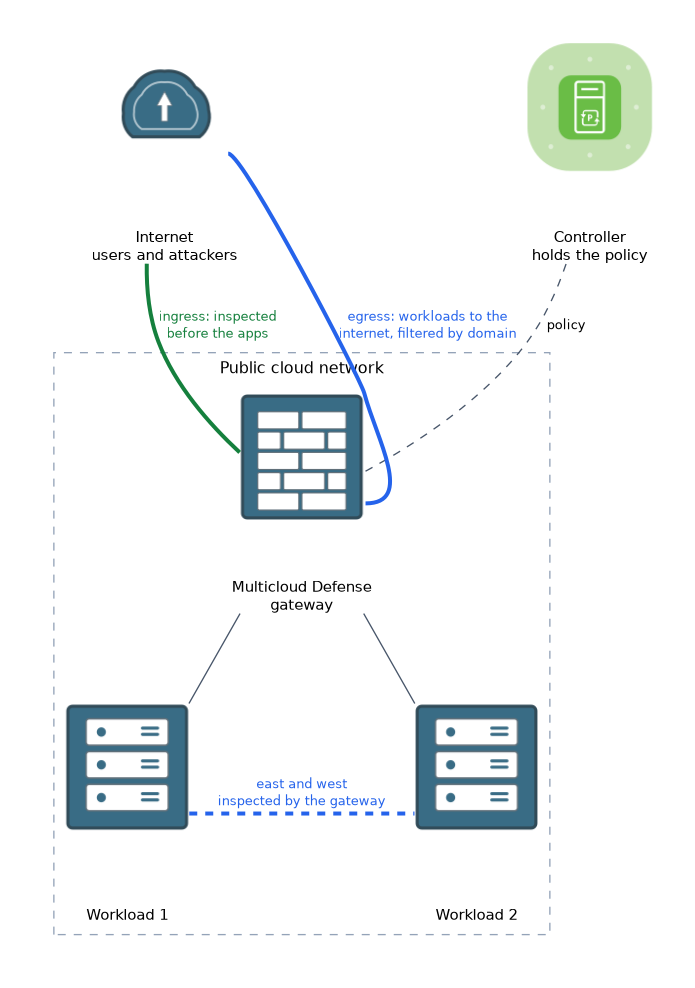 Multicloud Defense is a cloud delivered security service for public cloud environments. It has a management controller, delivered as a service, and gateways that you deploy into your cloud networks. The controller holds policy, and the gateways enforce it.
Gateways handle traffic in different directions.
- Ingress: inspects traffic from the internet into your applications.
- Egress: controls and inspects traffic that leaves your workloads for the internet.
- East and west: inspects traffic that moves between workloads and networks inside the cloud.
The service can apply intrusion prevention, TLS decryption, web application protection, FQDN filtering and data loss prevention. Policy is written once, and can use tags, so it follows workloads as they change. It supports the major public clouds, so you use one policy model rather than a different tool for each.
| Need | Multicloud Defense capability |
|---|---|
| Protect a public web app | Ingress inspection and application protection |
| Stop data theft and call backs | Egress filtering by domain and category |
| Control lateral movement in the cloud | East and west inspection |
| One policy for many clouds | Central controller with consistent policy |
Cisco Secure Workload
Secure Workload focuses on the workloads themselves, in data centres and clouds. It collects telemetry from software agents on servers, and from network and cloud flow data. It then builds a map of which applications talk to which.
That map is called application dependency mapping. It shows real flows, so you can write policy that matches how the application behaves.
Secure Workload then supports microsegmentation. Microsegmentation applies allow rules between small groups of workloads, so a compromise cannot spread freely. The agents enforce policy using the host's own firewall, so enforcement works wherever the workload runs.
Other uses include:
- Vulnerability visibility: shows software and known weaknesses on workloads.
- Behaviour monitoring: detects processes or flows that deviate from the baseline.
- Policy testing: lets you see what a policy would block before enforcing it.
Choosing between them
Use Multicloud Defense when you need inspection at the edges of the cloud network, such as internet entry and exit. Use Secure Workload when you need fine grained control of east and west flows between workloads. They complement each other, since one works at the network boundaries and the other at the workload.
What to remember for the exam
Six facts cover most questions on this topic.
- In common cloud usage, security groups are stateful and network ACLs are stateless and work at subnet level, though terms vary by provider.
- Native cloud controls filter by address and port and do not inspect content.
- Multicloud Defense uses a controller plus gateways for ingress, egress and east and west traffic.
- Multicloud Defense gives one policy model across several public clouds.
- Secure Workload uses agents, application dependency mapping and microsegmentation.
- Encrypt data at rest and in transit, and protect keys.
For a question about lateral movement between workloads, look for microsegmentation and Secure Workload.
Common mistakes
These four mistakes appear often.
Relying only on security groups. They cannot do intrusion prevention or content inspection.
Confusing ingress and egress. Ingress is inbound from the internet, and egress is outbound from your workloads.
Enforcing a new segmentation policy at once. Test it first, or you may break the application.
Forgetting egress control. Attackers often use outbound connections for command and control and data theft.
Software agents have to be deployed and kept current on every workload. A workload without an agent is not covered by agent based enforcement.
Check yourself
Work through these three questions.
What is the difference between a security group and a network ACL?
A security group is stateful and attached to a workload or interface, while a network ACL is stateless and applies at the subnet level.
What traffic directions can Multicloud Defense gateways inspect?
Ingress from the internet, egress to the internet and east and west traffic between workloads.
What does Secure Workload use to build microsegmentation policy?
It uses telemetry from agents and flows to map application dependencies, and then enforces allow rules between workload groups.
Topic 3 of 6 in Cloud Security
Test yourself on Cloud Security
The full Cisco CCNP 350-701 SCOR question bank has 822 questions, with timed practice exams and an explanation for every answer.
This study guide is independent and is not affiliated with, endorsed by, or sponsored by Cisco. Vendor names, certification names and exam codes are trademarks of their respective owners and are used for identification only.