Networking · Topic 1 of 8
IS-IS for IPv4 and IPv6
Implement IS-IS for IPv4 and IPv6 with NET addressing, levels, route advertisement, wide metrics and multitopology, with IOS XR examples and show commands.
- 6 min
- Includes a diagram
- A NET has an area address, a 6 byte system ID and a final 00.
- Level 1 adjacency needs the same area. Level 2 does not.
- A level 1/2 router sets the attached bit, and level 1 routers default to it.
What it is
IS-IS is a link state routing protocol that many service providers use as the IGP in the core.
It floods link state packets inside an area, and every router builds the same map and runs SPF. It does not run over IP. It runs directly over Layer 2, so one process can carry both IPv4 and IPv6 routes.
How it works
IS-IS identifies routers by an address called a NET, joins them in levels, and advertises prefixes inside link state packets.
Area addressing with the NET
A NET (network entity title) has three parts: the area address, a 6 byte system ID, and a final selector of 00. In 49.0001.0000.0000.0001.00 the area is 49.0001 and the system ID is 0000.0000.0001.
The system ID must be unique in the domain. The leading 49 is the private address range. Routers in the same area share the area address.
Levels
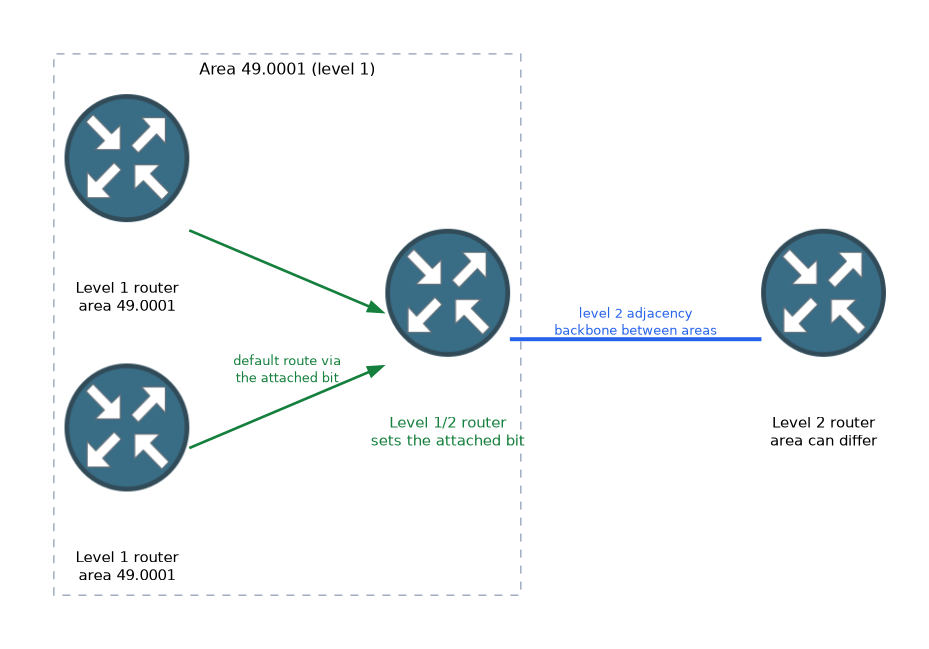
| Level | Role | Adjacency needs |
|---|---|---|
| Level 1 | Routing inside one area | Same area address |
| Level 2 | Routing between areas, the backbone | Area can differ |
| Level 1/2 | Joins both levels | Forms both kinds |
A level 1/2 router sets the attached bit in its level 1 LSP. Level 1 routers use that bit to build a default route to the nearest level 1/2 router. Many provider cores simply run level 2 only.
Configuring IS-IS on IOS XR
RP/0/RP0/CPU0:R1(config)# router isis CORE
RP/0/RP0/CPU0:R1(config-isis)# is-type level-2-only
RP/0/RP0/CPU0:R1(config-isis)# net 49.0001.0000.0000.0001.00
RP/0/RP0/CPU0:R1(config-isis)# address-family ipv4 unicast
RP/0/RP0/CPU0:R1(config-isis-af)# metric-style wide
RP/0/RP0/CPU0:R1(config-isis-af)# exit
RP/0/RP0/CPU0:R1(config-isis)# address-family ipv6 unicast
RP/0/RP0/CPU0:R1(config-isis-af)# metric-style wide
RP/0/RP0/CPU0:R1(config-isis-af)# multi-topology
RP/0/RP0/CPU0:R1(config-isis-af)# exit
RP/0/RP0/CPU0:R1(config-isis)# interface GigabitEthernet0/0/0/0
RP/0/RP0/CPU0:R1(config-isis-if)# point-to-point
RP/0/RP0/CPU0:R1(config-isis-if)# address-family ipv4 unicast
RP/0/RP0/CPU0:R1(config-isis-if-af)# exit
RP/0/RP0/CPU0:R1(config-isis-if)# address-family ipv6 unicast
RP/0/RP0/CPU0:R1(config-isis-if-af)# commit
On IOS XE the process is enabled on each interface instead:
R1(config)# router isis CORE
R1(config-router)# net 49.0001.0000.0000.0001.00
R1(config-router)# is-type level-2-only
R1(config-router)# metric-style wide
R1(config)# interface GigabitEthernet0/0/0
R1(config-if)# ip router isis CORE
R1(config-if)# ipv6 router isis CORE
R1(config-if)# isis network point-to-point
Route advertisement
Every router floods an LSP that lists its neighbours and its connected prefixes. A prefix appears when its interface is enabled for IS-IS.
A loopback is usually made passive, so that its address is advertised but no adjacency forms on it. Routes from other protocols can be added by redistribution. Level 2 routes do not enter level 1 on their own, but route leaking can be configured.
Metrics
Every interface has a metric, and the SPF cost is the sum along the path. The default interface metric is 10.
| Style | Interface metric | Path metric |
|---|---|---|
| Narrow | 6 bits, up to 63 | Up to 1023 |
| Wide | 24 bits, up to 16777214 | Much larger |
Narrow is the default. Set metric-style wide on every router, because routers with mismatched styles may not see each other's routes. Features such as traffic engineering and segment routing need wide metrics.
Multitopology
On IOS XE, IS-IS uses a single topology for IPv4 and IPv6 by default. Both protocols must then be enabled on the same links, or traffic can be lost where one is missing. IOS XR also offers a single-topology option in the IPv6 address family, so its default behaviour differs, and the XR example above sets multi-topology explicitly.
With multitopology, IPv4 and IPv6 each have their own SPF. A link can then carry only IPv6 without breaking IPv4 routing. Configure multi-topology in the IPv6 address family, keep it consistent on all routers, and use wide metrics.
Verifying
RP/0/RP0/CPU0:R1# show isis neighbors
RP/0/RP0/CPU0:R1# show isis database
RP/0/RP0/CPU0:R1# show isis topology
RP/0/RP0/CPU0:R1# show route isis
On a broadcast link, a designated router called the DIS is elected, by highest priority and then highest MAC address. A point to point setting avoids the election.
What to remember for the exam
Eight facts cover most questions on this topic.
- A NET has an area address, a 6 byte system ID and a final 00.
- Level 1 adjacency needs the same area. Level 2 does not.
- A level 1/2 router sets the attached bit, and level 1 routers default to it.
- Narrow metrics are 6 bit. Wide metrics are 24 bit and are set with
metric-style wide. - Traffic engineering and segment routing need wide metrics.
- Single topology needs IPv4 and IPv6 on the same links. Multitopology gives each its own SPF.
- Make loopbacks passive so that they are advertised without an adjacency.
- Use point to point on provider links to avoid the DIS.
If routes disappear after one router is changed, check that all routers use the same metric style.
Common mistakes
These four mistakes appear often.
Duplicate system IDs. Two routers with the same system ID cause unstable LSP flooding.
Mismatched metric styles. A router that uses narrow metrics can fail to learn wide metric routes.
Expecting level 2 routes in level 1. They are not leaked unless you configure it.
Running single topology with uneven IPv6 coverage. Traffic can be sent along a path where IPv6 is not enabled.
The same IS-IS ideas apply on IOS XR and IOS XE, but XR configures each interface inside the process and XE configures it on the interface.
Check yourself
Work through these three questions.
Which part of a NET must be unique in the domain?
The 6 byte system ID must be unique to each router.
Why set
metric-style wide?Wide metrics allow larger values and are needed by features such as traffic engineering and segment routing.
What does multitopology change?
IPv4 and IPv6 each get their own SPF, so a link can carry only IPv6 without breaking IPv4 routing.
Topic 1 of 8 in Networking
Test yourself on Networking
The full Cisco CCNP 350-501 SPCOR question bank has 738 questions, with timed practice exams and an explanation for every answer.
This study guide is independent and is not affiliated with, endorsed by, or sponsored by Cisco. Vendor names, certification names and exam codes are trademarks of their respective owners and are used for identification only.