Layer 3 Technologies · Topic 3 of 8
Redistribution and Summarization
Learn how to redistribute routes between OSPF, EIGRP, RIP and BGP, set seed metrics, avoid loops, and use manual and automatic summarization on IOS XE.
- 5 min
- Includes a diagram
- Redistribution needs a seed metric for EIGRP and RIP.
- OSPF redistribution needs
subnetsto include subnetted networks. - Routes redistributed into OSPF are E2 by default, with a default metric of 20.
What it is
Redistribution copies routes from one routing source into another, and summarization replaces many specific routes with one shorter prefix.
A routing protocol only knows its own routes. When a network runs two protocols, such as after a merger, a router in the middle must redistribute so each side learns the other's prefixes.
Summarization keeps routing tables small and hides instability. A flapping subnet inside a summary does not trigger updates outside it.
How it works
Redistribution needs a command, a seed metric the target protocol understands, and often a filter.
Redistribution commands
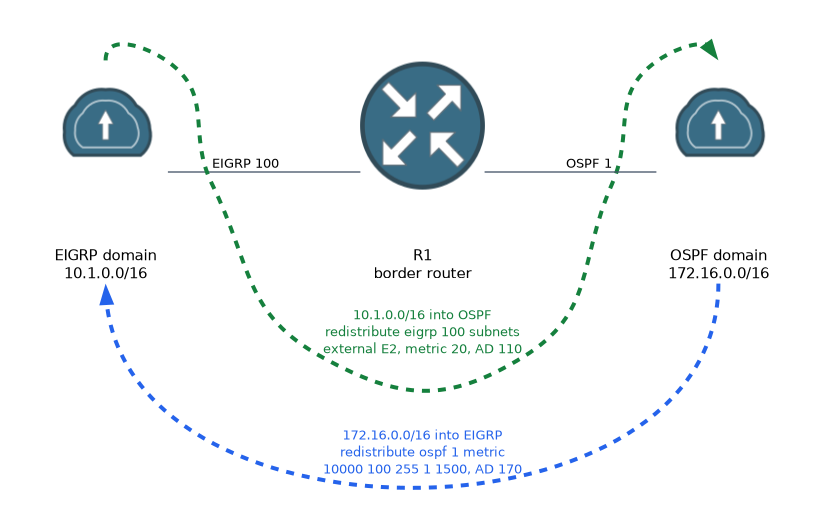 Each protocol has its own metric type, so a seed metric is needed.
R1(config)# router ospf 1
R1(config-router)# redistribute eigrp 100 subnets
R1(config-router)# router eigrp 100
R1(config-router)# redistribute ospf 1 metric 10000 100 255 1 1500
R1(config-router)# router rip
R1(config-router)# redistribute ospf 1 metric 3
The EIGRP metric values are bandwidth in Kbps, delay in tens of microseconds, reliability, load and MTU. In named mode, the same redistribute command sits under topology base inside the address family.
| Into | Seed metric behaviour |
|---|---|
| OSPF | Default is 20, type E2. Use subnets or classless networks are skipped |
| EIGRP | Needs a metric, or default-metric. Without it, the routes are not advertised |
| RIP | Needs a metric, or default-metric. Without it, the routes are not advertised |
Connected and static routes redistributed into EIGRP get a metric derived from the interface or next hop, so those usually work without a metric.
Routes redistributed into OSPF appear as E2 by default. An E2 route keeps the same cost across the domain. An E1 route adds the internal cost to reach the ASBR.
R1(config-router)# redistribute eigrp 100 subnets metric-type 1 metric 50Administrative distance and loops
Redistributed routes get the AD of their new protocol. External EIGRP routes use 170 and OSPF routes use 110.
If you redistribute in two directions at two routers, a route can return and win because of its AD. This is suboptimal routing or a loop. Use route tags, as the previous page describes, and filter with route maps.
Troubleshooting redistribution
Work through these checks in order.
- Is the route in the source table?
- Is the
redistributecommand present, and for OSPF issubnetspresent? - Does the target protocol have a seed metric?
- Does a route map or distribute list drop the route?
- Is a lower AD route from another source winning?
R1# show ip route eigrp
R1# show ip protocols
R1# show ip ospf database external
R1# show ip eigrp topology
show ip protocols lists which sources are redistributed into each process.
Manual and automatic summarization
Manual summaries are configured per protocol, and each creates a discard route to Null0 on the router that originates it.
| Protocol | Command | Where |
|---|---|---|
| EIGRP | ip summary-address eigrp 100 10.1.0.0 255.255.0.0 | Interface |
| OSPF inter area | area 1 range 10.1.0.0 255.255.0.0 | ABR, router mode |
| OSPF external | summary-address 10.1.0.0 255.255.0.0 | ASBR, router mode |
| BGP | aggregate-address 10.1.0.0 255.255.0.0 summary-only | Router mode |
The EIGRP summary route toward Null0 has an AD of 5. This stops traffic for missing subnets from looping.
Auto-summarization summarizes at classful network boundaries. It was on by default in older EIGRP releases, and the default differs by protocol and software version, so check show ip protocols. It breaks discontiguous networks, where the same classful network exists on two sides of another network.
R1(config)# router eigrp 100
R1(config-router)# no auto-summary
The BGP summary-only keyword suppresses the more specific routes. Without it, both the aggregate and the specifics are advertised.
After adding a summary, check that the summarizing router still holds all the specific routes it needs to forward traffic correctly.
What to remember for the exam
Seven facts cover most questions on this topic.
- Redistribution needs a seed metric for EIGRP and RIP.
- OSPF redistribution needs
subnetsto include subnetted networks. - Routes redistributed into OSPF are E2 by default, with a default metric of 20.
- External EIGRP routes have AD 170.
- EIGRP
ip summary-addressis set on an interface. - OSPF uses
area rangeon an ABR andsummary-addresson an ASBR. - Auto-summary breaks discontiguous networks.
Two way redistribution at more than one router is a classic cause of loops. Filter or tag at each redistribution point.
Common mistakes
These five mistakes appear often.
Missing seed metric. Routes redistributed into EIGRP or RIP without a metric are not advertised.
Forgetting subnets. Only classful networks enter OSPF without it.
Summarizing in the wrong place. An EIGRP summary on the wrong interface does not reach the neighbour you intended.
Leaving auto-summary on. Discontiguous subnets disappear or are misrouted.
Ignoring AD after redistribution. A route that returns with a lower AD replaces the better original.
Check yourself
Work through these three questions.
Why are redistributed routes missing from the EIGRP domain?
A seed metric may be missing, so add
metricto theredistributecommand or setdefault-metric.Which command summarizes OSPF routes at an ABR?
Use
area NUMBER range ADDRESS MASKin OSPF router mode, for examplearea 1 range 10.1.0.0 255.255.0.0.What is the AD of an EIGRP summary discard route to Null0?
It is 5.
Topic 3 of 8 in Layer 3 Technologies
Test yourself on Layer 3 Technologies
The full Cisco CCNP 300-410 ENARSI question bank has 857 questions, with timed practice exams and an explanation for every answer.
This study guide is independent and is not affiliated with, endorsed by, or sponsored by Cisco. Vendor names, certification names and exam codes are trademarks of their respective owners and are used for identification only.