Understanding and Using APIs · Topic 6 of 7
API Styles: REST, RPC, Synchronous and Asynchronous
Compare REST and RPC API styles and the difference between synchronous and asynchronous calls, with the REST constraints and an asynchronous task example.
- 5 min
- Includes a diagram
- REST is resource oriented and uses HTTP methods on resource addresses.
- REST is stateless, so each request carries everything the server needs.
- RPC is action oriented and calls a named procedure.
What it is
An API style is the design approach that decides how a client asks for work and how the answer comes back.
Two styles dominate: REST, which is built around resources, and RPC, which is built around actions. Separately, a call can be synchronous or asynchronous, depending on whether the client waits.
Knowing the difference helps you read API documentation and predict how a call will behave.
How it works
REST and RPC describe what you ask for, and sync or async describes when you get the answer.
REST
REST stands for Representational State Transfer. It models the system as resources, each with its own address, and it uses standard HTTP methods to act on them.
REST follows a set of constraints:
- Client and server are separate. Each can change without breaking the other.
- Stateless. Every request carries all the information needed, and the server keeps no client session between calls.
- Cacheable. Responses can say whether a client may reuse them.
- Uniform interface. Resources have addresses and are handled with the same few methods.
- Layered. Proxies and load balancers can sit between client and server.
A REST call to read a device looks like this.
GET /v1/devices/42 HTTP/1.1
Accept: application/json
RPC
RPC stands for Remote Procedure Call. The client calls a named function on the server, as if it were a local function, and passes arguments.
RPC endpoints are named after actions, such as getDevice or restartInterface. Familiar RPC forms are XML-RPC, JSON-RPC and gRPC. SOAP is a related XML based protocol that sends structured messages, and the Unified Communications Manager AXL interface uses it.
A JSON-RPC style request names a method and its parameters in the body. Cisco NX-OS can accept commands this way through NX-API.
[
  {
    "jsonrpc": "2.0",
    "method": "cli",
    "params": {"cmd": "show version", "version": 1},
    "id": 1
  }
]
For this form NX-API expects the content type application/json-rpc.
REST compared with RPC
| Feature | REST | RPC |
|---|---|---|
| Focus | Resources (nouns) | Actions (verbs) |
| Address | Many, one per resource | Often one endpoint |
| Methods | GET, POST, PUT, PATCH, DELETE | Mostly POST with a named method |
| Format | Usually JSON | JSON, XML or a binary format |
| Strength | Simple, cacheable, widely understood | Direct and efficient for actions |
Synchronous calls
In a synchronous call, the client sends a request and waits for the response before it does anything else. The result comes back on the same connection.
This is simple and works well when the server answers quickly. A slow operation blocks the client until it finishes or times out.
Asynchronous calls
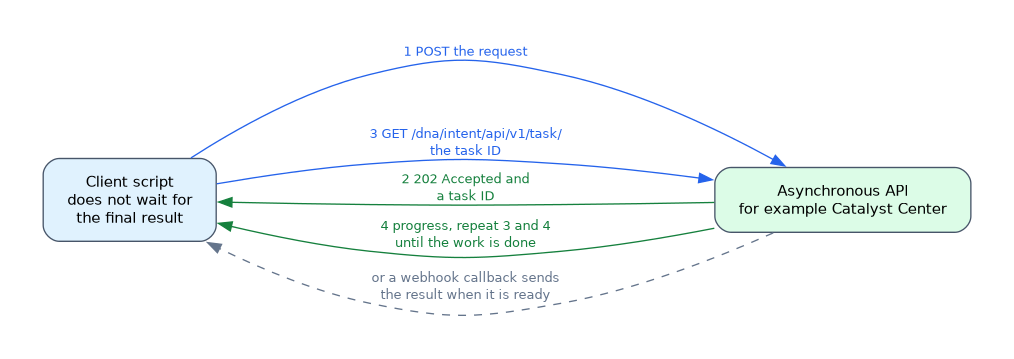 In an asynchronous call, the client does not wait for the final result. The server accepts the request, says that it is working on it, and the result comes later.
There are two common ways to get the result:
- Polling. The server returns a task ID, often with status 202. The client checks a task address until the work is done.
- Callback. The client registers a webhook, and the server sends the result when it is ready.
Cisco Catalyst Center works in this way for many write operations. It returns a task ID, and you read the task to learn whether it succeeded.
response = requests.post(url, headers=headers, json=payload)
task_id = response.json()["response"]["taskId"]

task = requests.get(
    BASE_URL + "/dna/intent/api/v1/task/" + task_id,
    headers=headers,
)
print(task.json()["response"]["progress"])
Asynchronous design suits long running work, such as a software upgrade on many devices.
Asynchronous code in Python
The word asynchronous is also used for program design. Python's asyncio library and the async and await keywords let one program start several slow calls and wait for them together. That is a separate idea from an API that returns a task ID, though the goal is similar.
A 202 Accepted response with a task ID is the signature of an asynchronous API. Poll the task or wait for a webhook.
What to remember for the exam
Seven facts cover this topic.
- REST is resource oriented and uses HTTP methods on resource addresses.
- REST is stateless, so each request carries everything the server needs.
- RPC is action oriented and calls a named procedure.
- JSON-RPC, XML-RPC, gRPC and SOAP are RPC style approaches.
- A synchronous call waits for the answer. An asynchronous call returns before the work is done.
- An asynchronous API often returns a task ID that you poll, or sends a webhook.
- Asynchronous design suits long running operations.
Common mistakes
Four mistakes are typical.
Assuming every HTTP API is REST. An API that sends commands to one endpoint is closer to RPC even though it uses HTTP.
Thinking stateless means no data is stored. It means that the server keeps no client session between requests. The resources themselves are stored.
Reading a 202 as finished. The work is accepted only. Check the task for the result.
Mixing up async programming and async APIs. One is about how a program runs, and the other is about how a service answers.
If you read the result before an asynchronous task finishes, you may see old data or an incomplete state. Wait for the task to complete.
Check yourself
Work through these three questions.
What is the main difference between REST and RPC?
REST is built around resources and HTTP methods, while RPC is built around calling named actions.
What does stateless mean in REST?
Each request carries all the information the server needs, and the server keeps no client session between calls.
How does a client get the result of an asynchronous API call?
It polls a task using a task ID, or it receives the result through a webhook.
Topic 6 of 7 in Understanding and Using APIs
Test yourself on Understanding and Using APIs
The full Cisco CCNA 200-901 DEVASC question bank has 808 questions, with timed practice exams and an explanation for every answer.
This study guide is independent and is not affiliated with, endorsed by, or sponsored by Cisco. Vendor names, certification names and exam codes are trademarks of their respective owners and are used for identification only.