Network Access · Topic 7 of 9
Physical Connections for WLAN Components
See how access points and wireless controllers connect to switches, which links are access or trunk ports, and how link aggregation joins controller ports.
- 6 min
- Exam objective 2.7
- Includes a diagram
- APs connect with one Ethernet cable, which usually also carries PoE.
- A lightweight AP in local mode uses an access port, because client traffic is tunnelled to the WLC.
- A FlexConnect AP with local switching needs a trunk port.
What it is
Every access point and controller connects to the wired network, and each link needs the right switch configuration.
A wireless LAN is not only radio. Behind every access point there is cabling, a switch port and a controller.
This topic describes how access points (APs) and wireless LAN controllers (WLCs) are physically connected to the wired network, and which type of switch port to use for each.
How it works
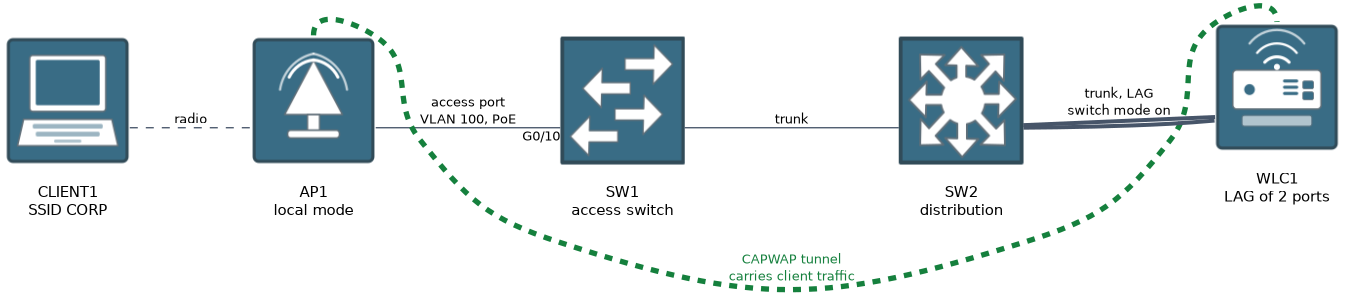 The AP port type depends on the AP mode, and the controller usually connects through trunks or a LAG.
The AP connection
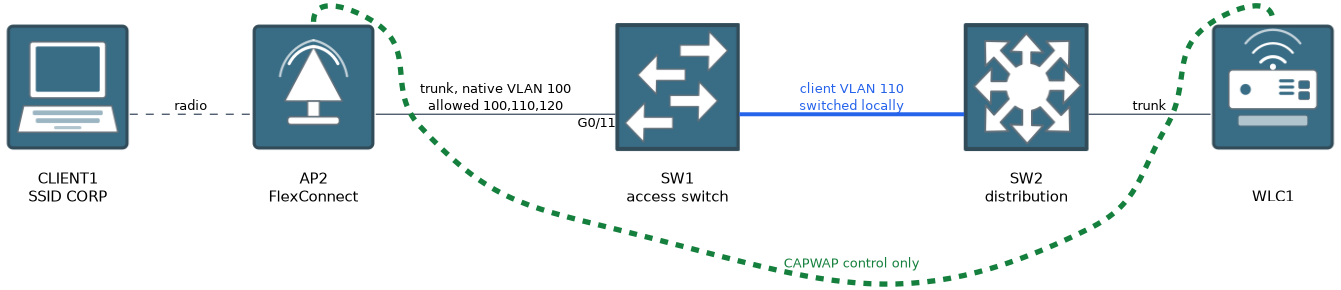 An AP plugs into a switch with a single Ethernet cable. The same cable usually also powers the AP through Power over Ethernet (PoE), so no separate power outlet is needed at the ceiling.
The right switch port type depends on the AP's mode.
| AP type | Switch port | Why |
|---|---|---|
| Lightweight, local mode | Access port in the AP management VLAN | All client traffic is inside CAPWAP tunnels |
| Lightweight, FlexConnect with local switching | Trunk port, AP's own VLAN as native | Client traffic is dropped locally, tagged per WLAN VLAN |
| Autonomous | Trunk if several VLANs, otherwise access | The AP bridges client traffic itself |
In local mode, the AP builds CAPWAP tunnels to the controller, and all client traffic travels inside them. The switch only sees traffic between the AP and the controller, all in one VLAN.
An access port example for a lightweight AP in local mode:
interface GigabitEthernet0/10
 switchport mode access
 switchport access vlan 100
 power inline auto
A trunk port example for a FlexConnect AP:
interface GigabitEthernet0/11
 switchport mode trunk
 switchport trunk native vlan 100
 switchport trunk allowed vlan 100,110,120
An autonomous AP that carries more than one SSID mapped to different VLANs needs a trunk. With one VLAN, an access port is enough.
The controller connection
A WLC can be a physical appliance, a virtual machine or software on a switch. A physical controller has several kinds of port:
- Distribution system ports: carry traffic between the controller and the network, including the CAPWAP tunnels from the APs. They normally connect to the switch as trunk ports, because the controller handles many VLANs.
- Service port: a separate out-of-band port for management and recovery.
- Redundancy port: connects a pair of controllers for high availability.
- Console port: for direct, local access.
The controller also has logical interfaces. The management interface is used for management and for CAPWAP communication with the APs. Dynamic interfaces connect WLANs to VLANs, so client traffic can be put in the right VLAN.
The names above follow AireOS controllers. On the IOS XE based Catalyst 9800, VLANs and SVIs play the part of dynamic interfaces.
Link aggregation on the controller
The controller carries the traffic from many APs, so a single link may become a bottleneck or a point of failure.
Several of the controller's ports can be combined into a link aggregation group (LAG), which acts as one logical link. This increases bandwidth and gives redundancy, because the bundle keeps working if one port fails.
The connected switch must be set up to match, using EtherChannel on its side. On AireOS controllers, the LAG is static with no negotiation protocol, so the switch ports use mode on. The Catalyst 9800 also supports LACP.
A mismatch in the bundling mode causes the link to fail.
What to remember for the exam
Eight facts cover most questions on this topic.
- APs connect with one Ethernet cable, which usually also carries PoE.
- A lightweight AP in local mode uses an access port, because client traffic is tunnelled to the WLC.
- A FlexConnect AP with local switching needs a trunk port.
- An autonomous AP carrying several VLANs needs a trunk port.
- WLC distribution ports usually connect to the switch as trunks.
- The service port is for out-of-band management. The redundancy port links a controller pair.
- A LAG combines controller ports into one logical link.
- The switch bundle must be configured to match the controller LAG.
Ask where client traffic is switched. If it is tunnelled to the WLC, the AP port is access. If it is dropped locally into several VLANs, the AP port is a trunk.
Common mistakes
These five mistakes are common.
Using a trunk where an access port is enough. A local-mode lightweight AP does not need a trunk. It sends everything in CAPWAP.
Using an access port for a FlexConnect AP. If client traffic is switched locally into several VLANs, an access port cannot carry them.
Forgetting PoE. An AP plugged into a port with PoE disabled will not power on.
Mismatching the LAG. If the controller bundles its ports statically and the switch uses LACP, the bundle will not come up. The switch and controller must use the same mode.
Mixing up the service port and the distribution ports. The service port is only for management and is not used for client traffic.
A FlexConnect AP on an access port loses all but one VLAN. Check the mode before choosing the port type.
Check yourself
Work through these three prompts.
Why does a local-mode lightweight AP connect to an access port while a FlexConnect AP often needs a trunk?
In local mode all client traffic travels inside CAPWAP tunnels in one VLAN, so an access port is enough. A FlexConnect AP with local switching drops client traffic locally, tagged per WLAN VLAN, so it needs a trunk.
What are the roles of the controller's distribution ports and its service port?
Distribution ports carry traffic between the controller and the network, including the CAPWAP tunnels, and normally connect as trunk ports. The service port is a separate out-of-band port for management and recovery.
What benefit does a LAG on the controller give, and what must the switch side do to match?
A LAG combines controller ports into one logical link, giving more bandwidth and redundancy. The switch must use EtherChannel with a matching mode, which is
onfor a static AireOS LAG.
Topic 7 of 9 in Network Access
Test yourself on Network Access
The full Cisco CCNA 200-301 question bank has 1,206 questions, with timed practice exams and an explanation for every answer.
This study guide is independent and is not affiliated with, endorsed by, or sponsored by Cisco. Vendor names, certification names and exam codes are trademarks of their respective owners and are used for identification only.