Snowflake Architecture · Topic 3 of 18
Sharing to Non-Snowflake Customers and Cross-Cloud Auto-Fulfillment
Share data with customers who have no Snowflake account using reader accounts, and reach other clouds and regions with Cross-Cloud Auto-Fulfillment.
- 5 min
- Includes a diagram
- Reader account: provider created, provider managed, provider pays compute, read only, same region and edition, up to 75 by default.
- Reader accounts cannot load or modify data, and consume only from their creating provider.
- Cross-Cloud Auto-Fulfillment is configured on listings and replicates the data product to other regions and clouds for you.
What it is
Two sharing problems come up again and again in architect scenarios. The first is a consumer who has no Snowflake account at all. The second is a consumer who is on a different cloud platform or in a different region from the provider.
Snowflake answers the first with reader accounts and the second with Cross-Cloud Auto-Fulfillment on listings. Both keep the principle that the provider owns the data and the consumer gets read-only access.
How it works
Reader accounts for non-Snowflake customers
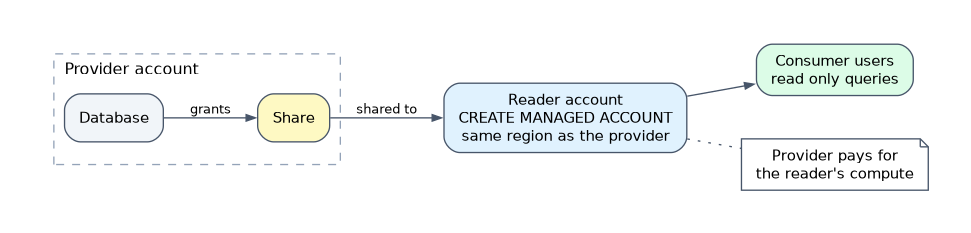 A reader account is a Snowflake account that the provider creates, owns and manages for a consumer who is not a Snowflake customer. The consumer logs in with a URL and a user the provider sets up and can query only the data shared by that provider.
CREATE MANAGED ACCOUNT partner_reader
  ADMIN_NAME = 'partner_admin',
  ADMIN_PASSWORD = '<strong password>',
  TYPE = READER;
ALTER SHARE sales_share ADD ACCOUNTS = <reader_account_locator>;
Key properties of a reader account:
| Property | Behavior |
|---|---|
| Who pays compute | The provider pays all credits used by warehouses in the reader account |
| Data loading | Not allowed: no INSERT, UPDATE, DELETE, MERGE or COPY INTO on tables |
| Edition and region | Same edition and region as the provider account |
| Consumes from | Only the provider that created it |
| Support | The provider supports its users; Snowflake does not support them directly |
| Creation | ACCOUNTADMIN or a role with the CREATE ACCOUNT privilege; Snowsight or CREATE MANAGED ACCOUNT |
| Default limit | 75 reader accounts per provider, and a dropped one still counts for 7 days |
Because reader account warehouses have no built-in credit cap, set a resource monitor on them. Otherwise a consumer can run up the provider's bill.
A reader account cannot load its own data, create shares, stages or masking and row access policies, or unload data through a storage integration. If the customer needs to combine your data with their own, they need their own full Snowflake account.
If the consumer already has a full account, use a normal share or listing instead. Reader accounts are the answer only for "customer without Snowflake" with a read-only, provider-paid model.
Sharing across cloud providers and regions
A direct share works only inside one region on one cloud platform. To reach a consumer on another cloud (for example the provider is on AWS and the consumer on Azure), the data must exist in the consumer's region.
Historically providers did this with database replication and a second share in the target region. Cross-Cloud Auto-Fulfillment automates this: Snowflake replicates the data product attached to a listing to the regions where consumers are, and keeps it refreshed.
How auto-fulfillment behaves
- It is configured on a listing (a share or an application package), whether in draft or published state.
- It is not available on trial accounts.
- Private listings are fulfilled after the chosen consumers get the listing. Marketplace public listings are fulfilled after a consumer in that region gets the listing.
- Paid listings must use auto-fulfillment. Manual replication is only an option for free or limited trial Marketplace listings.
- The provider pays for fulfillment, and larger data products cost more.
- If the data product already exists in the consumer's region, access is immediate.
Refresh can be triggered on demand, run on an interval, or follow a schedule:
| Refresh style | How |
|---|---|
| Trigger based | Provider calls SYSTEM$TRIGGER_LISTING_REFRESH |
| Interval based | Every 1 minute to 8 days |
| Schedule based | A set timestamp or cron schedule |
Interval and schedule based refresh cannot be used together. There is a default 10 TB size limit on the initial refresh, which an account administrator can raise with the LISTING_AUTO_FULFILLMENT_INITIAL_REFRESH_SIZE_LIMIT_IN_TB parameter. Account-level masking policies are not applied during fulfillment, so protect sensitive columns with policies on the shared objects themselves. Failed refreshes are summarized in a daily email to the address on the listing.
Wording such as "no manual replication", "consumers in several clouds" or "paid listing" points to auto-fulfillment.
Common mistakes
Choosing a reader account for a customer who already has Snowflake. They should receive a normal share or listing and pay for their own compute.
Forgetting who pays. Reader account compute and fulfillment costs are the provider's. Add a resource monitor and plan for the replication cost.
Assuming a direct share crosses clouds. It does not. Use a listing with auto-fulfillment or replicate to the target region first.
Expecting instant changes in remote regions. Remote copies change when the refresh runs, so the refresh interval sets the data freshness.
What to remember for the exam
- Reader account: provider created, provider managed, provider pays compute, read only, same region and edition, up to 75 by default.
- Reader accounts cannot load or modify data, and consume only from their creating provider.
- Cross-Cloud Auto-Fulfillment is configured on listings and replicates the data product to other regions and clouds for you.
- Paid listings require auto-fulfillment; the provider pays; trial accounts cannot use it.
- Refresh by trigger, interval (1 minute to 8 days) or schedule; initial refresh limit is 10 TB by default.
Check yourself
A customer has no Snowflake account and needs read-only access. Who pays for their queries?
The provider, through a reader account it creates and manages. A resource monitor should cap the credits.
Which sharing option replicates a data product to other clouds without manual replication work?
A listing with Cross-Cloud Auto-Fulfillment.
Can a paid Marketplace listing use manual replication?
No. Paid listings must use auto-fulfillment.
Topic 3 of 18 in Snowflake Architecture
Test yourself on Snowflake Architecture
The full Snowflake ARA-C01 question bank has 687 questions, with timed practice exams and an explanation for every answer.
This study guide is independent and is not affiliated with, endorsed by, or sponsored by Snowflake. Vendor names, certification names and exam codes are trademarks of their respective owners and are used for identification only.