Self Service & Automation · Topic 2 of 4
Service Catalog
ServiceNow Service Catalog: catalog items, variables, variable sets, order guides, record producers, fulfillment and catalog scripts for the CSA exam.
- 4 min
- Includes a diagram
- A request holds requested items (RITMs), and fulfillment work is done in catalog tasks.
- Categories organize items; user criteria control who can see them.
- Variable sets are reusable groups of variables.
What it is
The Service Catalog is the storefront where users request goods and services, such as a new laptop, software access or a new hire setup. Administrators define what can be ordered, who can see it, what the user is asked, and how the request is fulfilled.
The key point for the exam is the chain of records a request creates, and which catalog tool fits which requirement.
How it works
Request records
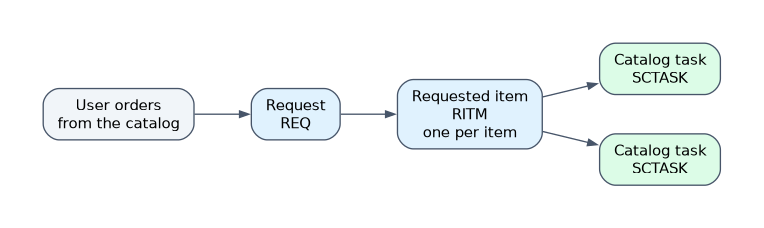
| Record | Table | Meaning |
|---|---|---|
| Request | sc_request | The whole order; one request per checkout |
| Requested Item (RITM) | sc_req_item | One line for each item ordered |
| Catalog Task | sc_task | Work assigned to a fulfillment group |
One checkout with three items gives one request, three requested items, and the tasks each item needs.
Catalog structure
A catalog contains categories, and categories contain catalog items. You manage these under Service Catalog > Catalog Definitions, for example Maintain Items. Each item has a name, description, picture and the variables the user fills in.
Visibility is controlled with user criteria. An item can be made available to some users and not available to others, so a contractor may not see an item that employees do.
Variables and variable sets
Variables are the questions on an item form, such as a text field, a select box, a checkbox or a reference to another record. The answers are stored with the requested item.
A variable set is a reusable group of variables shared by many items. Use it when several items ask the same questions, such as a business justification, so you maintain them in one place.
Catalog item, record producer and order guide
| Tool | Use it when |
|---|---|
| Catalog item | The user orders something that is fulfilled through a request |
| Record producer | The user fills a simple form that creates a record in another table, such as an incident, without creating a request |
| Order guide | Several items are commonly ordered together, such as a new employee bundle, and should be offered in one checkout |
A record producer looks like a catalog item but writes straight to the target table. It does not create a requested item.
Catalog client scripts and UI policies
Forms for catalog items have their own client-side tools. A catalog client script runs in the browser on the item form (on load, on change, on submit). A catalog UI policy shows, hides, or requires variables without code.
These are separate from the ordinary client scripts and UI policies on tables. Catalog versions act on variables, not on table fields.
Fulfillment and approvals
An item can attach a flow from Workflow Studio, which can ask for approval, create catalog tasks, update records and notify the user. The flow reads what the user entered by using the item's variables.
The catalog item or flow decides whether approval is needed. A request does not reach fulfillment until its approval is granted.
How the exam asks about this
- "Users should report a problem through a simple form that creates an incident." Use a record producer.
- "New hires need a laptop, an account and a badge from one order." Use an order guide.
- "Five items ask for the same cost center and justification." Create a variable set.
What to remember for the exam
- A request holds requested items (RITMs), and fulfillment work is done in catalog tasks.
- Categories organize items; user criteria control who can see them.
- Variable sets are reusable groups of variables.
- Record producers create records in any table and bypass the request chain.
- Order guides bundle items into a single checkout.
- Catalog client scripts and catalog UI policies work on variables on the item form.
If an item does not appear for a user, check the item's availability user criteria and whether the item and its category are active before suspecting the form.
Common mistakes
Choosing a catalog item when a record producer fits. If the requirement is "create an incident from a form," a request and RITM are not wanted.
Copying the same variables onto many items. A variable set avoids duplicate work and keeps the questions consistent.
Forgetting that the catalog has its own scripting tools. To hide a variable based on another variable, use a catalog UI policy or catalog client script, not a table UI policy.
Check yourself
Which record represents one line of an order in the Service Catalog?
The requested item (RITM) in sc_req_item; the request is the whole order.
Which tool lets a user fill a form that creates an incident directly?
A record producer, which writes to the target table without creating a requested item.
How do you reuse the same questions on many catalog items?
Put the variables in a variable set and attach it to each item.
Topic 2 of 4 in Self Service & Automation
Test yourself on Self Service & Automation
The full ServiceNow CSA question bank has 600 questions, with timed practice exams and an explanation for every answer.
This study guide is independent and is not affiliated with, endorsed by, or sponsored by ServiceNow. Vendor names, certification names and exam codes are trademarks of their respective owners and are used for identification only.