Ingest · Topic 1 of 3
Choosing and Automating Data Ingestion
CMDB data ingestion for the CIS-DF exam: Discovery, Service Graph Connectors, IntegrationHub ETL, import sets, the IRE API, automation and technical debt.
- 5 min
- Includes a diagram
- Every CI ingestion path should end at the IRE.
- Connector first, then IntegrationHub ETL, then a custom IRE API integration.
- Service Graph Connectors use the Robust Transform Engine and the IRE, and come from the Store.
What it is
Data ingestion is how CI data reaches the CMDB. ServiceNow offers several paths, and the exam asks you to pick the one that fits the source while keeping the data clean and the instance upgradeable.
The rule behind every right answer: CI data should pass through the Identification and Reconciliation Engine (IRE). A method that writes straight to CMDB tables skips identification and reconciliation, and duplicates follow.
How it works
The ingestion methods
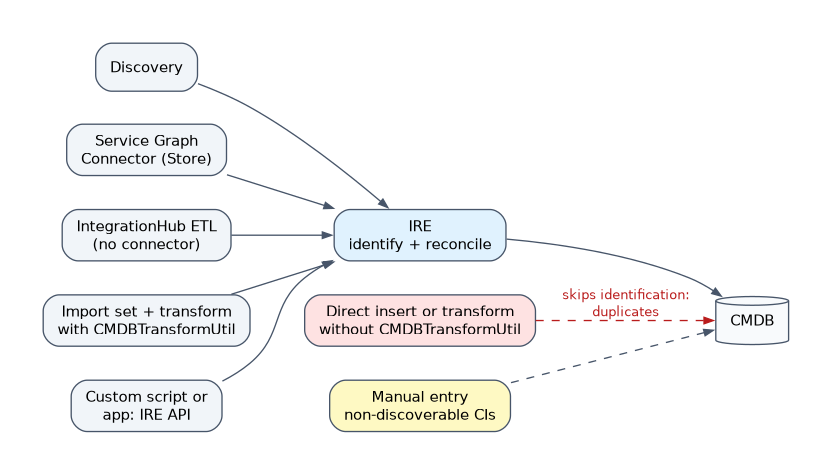
| Method | Use it when | Reaches the IRE |
|---|---|---|
| Discovery | Infrastructure on your networks or in cloud accounts must be found and kept current | Yes |
| Service Graph Connector | A common third-party tool already holds the data and ServiceNow offers a connector for it | Yes |
| IntegrationHub ETL | A source has no connector and you need a guided, repeatable mapping into CMDB classes | Yes |
| Import set with CMDBTransformUtil | A legacy or file-based import must run through a transform map | Yes, when the transform calls the IRE |
| IRE API | A custom integration or script sends CI payloads | Yes |
| Manual entry | Non discoverable CIs and attributes no tool knows | No identification step |
Service Graph Connectors are delivered from the ServiceNow Store. They use the Robust Transform Engine to map source data into IRE payloads, and the IRE then inserts or updates the CIs. Their mappings can be viewed in IntegrationHub ETL.
IntegrationHub ETL builds that same pipeline for a source with no connector. It maps staging data into CMDB classes, lets you test on a small sample, and processes the result through the IRE automatically.
A standard transform map writes straight to the target table. For CMDB targets it must call the IRE through CMDBTransformUtil, otherwise identification is skipped.
Automation opportunities
Once a method is chosen, run it without people:
- Schedules. Discovery schedules and scheduled connector or ETL imports keep data current on a timer.
- Connector setup. Service Graph Connectors come with guided setup, prebuilt mappings and scheduled imports, so less is built by hand.
- Monitoring. Integration Commons for CMDB provides a dashboard to monitor installed Service Graph Connectors and custom IntegrationHub ETL integrations. It is usually installed with a CMDB integration.
- Lifecycle. CMDB Data Manager policies retire, archive or delete CIs that match a condition, such as CIs no source has updated for a long time, and attestation policies send owners regular verification tasks for CIs that tools cannot confirm.
Minimizing technical debt
Technical debt in the CMDB is custom work that the platform no longer maintains for you. Each of these reduces it:
| Choose | Instead of |
|---|---|
| Store-delivered Service Graph Connector | Custom integration for the same tool |
| IntegrationHub ETL or the IRE API | Scripts that insert directly into CMDB tables |
| Out-of-box classes and attributes | Custom classes or fields that duplicate them |
| Out-of-box identification rules, tuned where needed | Rewritten rules on many classes |
| CSDM-aligned tables for services and applications | Home-grown service tables |
Store connectors are updated by ServiceNow, so a new release or connector version reaches you without rework. Out-of-box classes are what Discovery, connectors and CMDB Health already expect.
How the exam asks about this
- "The customer uses a well-known endpoint tool that has a Service Graph Connector in the Store." Install and configure the Service Graph Connector.
- "An in-house inventory database has no connector and must load nightly into server classes." Build an IntegrationHub ETL integration and schedule it.
- "A developer wrote a script that inserts servers straight into the server table, and duplicates appear." Replace it with the IRE API or an IRE-based integration.
What to remember for the exam
- Every CI ingestion path should end at the IRE.
- Connector first, then IntegrationHub ETL, then a custom IRE API integration.
- Service Graph Connectors use the Robust Transform Engine and the IRE, and come from the Store.
- Import sets for CMDB targets must call the IRE through CMDBTransformUtil.
- Integration Commons for CMDB monitors connectors and custom ETL integrations.
- Avoid custom classes, fields and rules that duplicate out-of-box ones.
"It is only a small script" is still a bypass. Any direct insert into a CMDB table skips identification and reconciliation, so it creates duplicates and overwrites authoritative values.
Common mistakes
Building a custom integration when a connector exists. The custom build works on day one but must be maintained forever. The Store connector is maintained by ServiceNow and already maps to the right classes.
Treating every import set as safe. A transform map is fine for non-CMDB tables. For CIs it must go through the IRE, or it writes around identification.
Adding custom fields for convenience. A custom field that copies an out-of-box attribute splits the data, confuses reconciliation and adds upgrade work. Use the existing attribute.
Check yourself
Which ingestion method fits a common third-party tool with a ServiceNow Store connector?
The Service Graph Connector for that tool. It maps the data with the Robust Transform Engine and loads it through the IRE.
How does an import set avoid creating duplicate CIs?
Its transform must call the IRE through CMDBTransformUtil, so identification and reconciliation run for each row.
What tool monitors installed Service Graph Connectors and custom ETL integrations?
Integration Commons for CMDB, which provides a dashboard for those CMDB integrations.
Topic 1 of 3 in Ingest
Test yourself on Ingest
The full ServiceNow CIS-DF question bank has 769 questions, with timed practice exams and an explanation for every answer.
This study guide is independent and is not affiliated with, endorsed by, or sponsored by ServiceNow. Vendor names, certification names and exam codes are trademarks of their respective owners and are used for identification only.