Govern · Topic 2 of 6
CMDB Health Metrics and Dashboard
CIS-DF CMDB Health: the six metrics under completeness, correctness and compliance, health preferences, KPIs versus CSFs, and validating data quality.
- 5 min
- Includes a diagram
- Six metrics: required and recommended (completeness); duplicate, orphan and stale (correctness); audit (compliance).
- Recommended fields, orphan rules, staleness rules and audits are set per class in CI Class Manager.
- Health Preferences turns KPIs and metrics on or off, sets thresholds and controls task creation.
What it is
CMDB Health scores the quality of CMDB data and shows the results on the CMDB Health Dashboard, which now lives in CMDB Workspace. It runs health tests against CIs and rolls the results up into scores by class and by service.
The score is built from three KPIs, and each KPI is made of metrics. Six metrics make up the classic health score, and the exam expects you to know which KPI each belongs to and what lowers it.
How it works
The six metrics
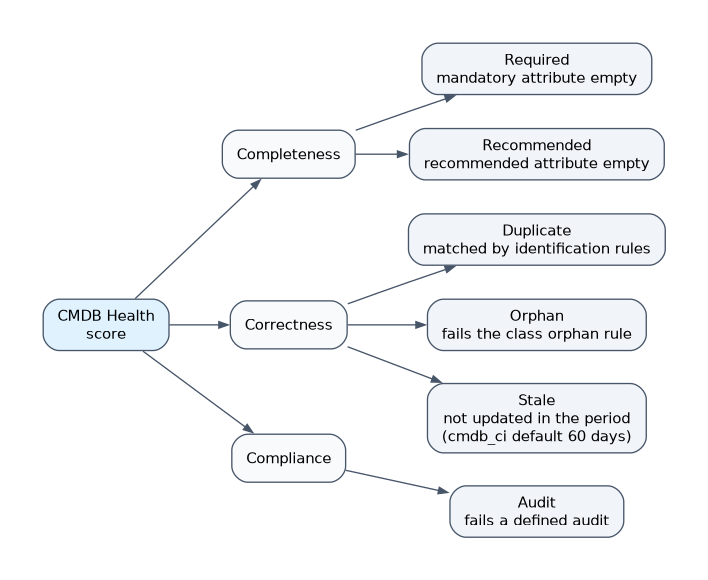
| KPI | Metric | A CI fails when |
|---|---|---|
| Completeness | Required | A required attribute is empty |
| Completeness | Recommended | A recommended attribute is empty |
| Correctness | Duplicate | It is a duplicate of another CI, found with identification rules |
| Correctness | Orphan | It matches an orphan rule, for example it lacks a relationship it should have |
| Correctness | Stale | It has not been updated within the staleness period |
| Compliance | Audit | It does not meet an audit you have defined |
A few characteristics come up often:
- Required attributes are the fields marked mandatory in the dictionary; recommended attributes are set per class in CI Class Manager.
- Duplicate results depend on identification rules: the same rules the IRE uses decide what counts as a duplicate.
- Orphan rules are defined per class in CI Class Manager, because what makes a CI orphaned differs by class.
- Stale uses a staleness rule; the rule on the base Configuration Item [cmdb_ci] class defaults to 60 days, and child classes can define their own.
- Audit scores stay empty until you activate and maintain audits; there is no compliance score without them.
CMDB Health also reports relationship health (duplicate, orphan and stale relationships) separately; it is not part of the three KPI score.
Configuring CMDB Health
Configuration happens in two places:
| Where | What you set |
|---|---|
| CI Class Manager | Recommended fields, orphan rules, staleness rules and audits for each class |
| CMDB Health Preferences | Which KPIs and metrics are active, maximum failure thresholds, task creation for failed CIs, and the health jobs |
The CMDB Health Dashboard jobs must be enabled before any health data is collected. In the base system all KPIs and metrics are included, so you deactivate the ones you do not want to score.
When a CI fails a test, CMDB Health can raise a task for it. A CMDB remediation rule can be linked to that task type and run a remediation workflow, automatically or on demand, such as handling stale CIs.
KPIs and CSFs
A critical success factor (CSF) is a condition the CMDB must meet for the business to succeed, such as "change managers can trust impact analysis for production services". A key performance indicator (KPI) is the number that shows whether you are meeting it, such as the correctness score for the server classes those services run on.
| CSF | KPI | |
|---|---|---|
| Nature | A goal statement | A measured value |
| Example | Accurate data for change impact | Duplicate and stale results for in scope classes |
| Owner | Process owner and governance forum | Configuration manager and class owners |
To gain value from the dashboard, choose the classes and services that support each CSF, track their KPI scores over time, set thresholds that trigger action, and review the trend at the governance forum.
Validating data quality and compliance
- Data quality is mostly completeness and correctness: drill into a class to see which CIs fail which metric, then route fixes to owners.
- Data compliance is the audit metric: define audits for the rules your organization must follow, such as production servers carrying a support group, and the compliance score shows the CIs that break them.
Scores are only as good as the rules behind them. A class with no recommended fields or orphan rules can score well while still holding poor data.
How the exam asks about this
- "Servers that were decommissioned months ago still look active." The stale metric under correctness catches them.
- "The compliance score is blank." No audits are defined or active; compliance depends on them.
- "Leadership wants proof the CMDB supports change impact analysis." Define the CSF, then track KPI scores for the classes and services behind it.
What to remember for the exam
- Six metrics: required and recommended (completeness); duplicate, orphan and stale (correctness); audit (compliance).
- Recommended fields, orphan rules, staleness rules and audits are set per class in CI Class Manager.
- Health Preferences turns KPIs and metrics on or off, sets thresholds and controls task creation.
- Health jobs must be enabled before any score appears.
- The cmdb_ci staleness rule defaults to 60 days.
- A CSF is the goal; a KPI is the measurement that shows progress toward it.
Duplicate and orphan are both correctness metrics, not completeness. A CI with every field filled in can still fail correctness.
Common mistakes
Treating a high score as proof of good data. If no recommended fields, orphan rules or audits are defined, those metrics have little to fail. Configure the rules before trusting the score.
Expecting compliance without audits. The audit metric measures your own definitions. With no audits, there is nothing to measure.
Confusing KPI and CSF. A question that asks for something measurable wants the KPI. A question that asks what must be true for success wants the CSF.
Check yourself
Which three metrics make up the correctness KPI?
Duplicate, orphan and stale.
Where are orphan rules and recommended fields defined?
In CI Class Manager, per class, and CMDB Health uses them when it tests CIs.
What is the difference between a CSF and a KPI?
A CSF is a condition the CMDB must meet for success; a KPI is the measured value that shows whether it is being met.
Topic 2 of 6 in Govern
Test yourself on Govern
The full ServiceNow CIS-DF question bank has 769 questions, with timed practice exams and an explanation for every answer.
This study guide is independent and is not affiliated with, endorsed by, or sponsored by ServiceNow. Vendor names, certification names and exam codes are trademarks of their respective owners and are used for identification only.