CSM Foundational Data Model · Topic 1 of 3
Business Models, Accounts and Contacts
CIS-CSM business models: B2B, B2C and B2B2C, accounts, contacts, consumers, account hierarchy, partner accounts and Account From and Account To links.
- 6 min
- Includes a diagram
- B2B uses accounts and contacts; B2C uses consumers; B2B2C relates consumers to business accounts.
- An account can be a customer, a partner, or both.
- Account relationships have a source (Account From), a target (Account To) and a type with an automatic reverse.
What it is
A business model in Customer Service Management (CSM) describes who the customer is. A company that sells to other companies serves accounts and their contacts. A company that sells to individual people serves consumers.
The model you choose decides which records hold the customer, which roles agents and customers need, and which portal the customer uses. Every case, product and entitlement points back to these records.
How it works
The three models
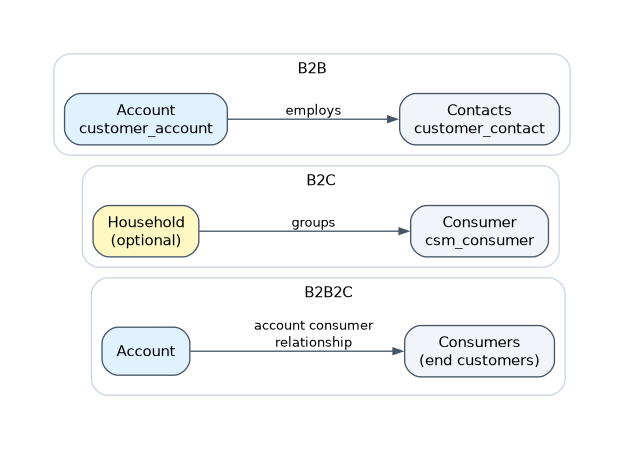
| Model | Who the customer is | Main records |
|---|---|---|
| B2B | A business | Account [customer_account] and its Contacts [customer_contact] |
| B2C | An individual person | Consumer [csm_consumer], with optional households |
| B2B2C | A business and that business's own end customers | Accounts plus consumers linked to the account |
A single instance can run more than one model. A manufacturer can support corporate buyers as accounts and home buyers as consumers at the same time.
Accounts and contacts
An account is a customer or partner organization. It can act as a customer, a partner, or both. Each account has a unique account code.
A contact is an individual employee of an account. A contact belongs to an account, can be linked to assets and service contracts, and can log in to the Customer Service Portal to open and follow cases.
Contacts get external roles. The sn_customerservice.customer role lets a contact create and edit their own cases and view the account's assets. The sn_customerservice.customer_admin role makes the contact the administrator for the account, with access to data within that account.
Consumers and households
A consumer is an individual B2C customer who does not belong to a business account. The sn_customerservice.consumer role lets a consumer research issues, create cases for products they bought and view their product list.
A household groups consumers who share an address or products, with a head of household. Agents who serve consumers use the sn_customerservice.consumer_agent role, while B2B agents use sn_customerservice_agent.
B2B2C
B2B2C covers a provider that supports partner businesses and their end consumers. It is delivered by the Customer Data Models for B2B2C plugin (com.sn_csm_b2b_consumers), activated by an admin.
Employees or customers of a business are modeled as consumers related to the account through an account consumer relationship. Sold products and install base items can then be tied to those account consumers.
Account hierarchy
Accounts form parent and child structures that mirror legal or operational organization, such as a head office with regional subsidiaries. The hierarchy is tracked through account paths built from the account codes.
A parent account gives visibility and management across its child accounts. The sn_customerservice.customer_case_manager role lets a contact manage cases for an account and its child accounts, including creating cases for other contacts.
Partner accounts and account relationships
Partners are modeled as accounts and are listed under Customer Service > Customer > Partners. A partner can create and edit cases for its own account or for the customer accounts it serves, using the sn_customerservice.partner role. The sn_customerservice.partner_admin role manages the partner's users and sees all cases the partner created.
An account relationship record links two accounts. The source account is in Account From and the target account is in Account To, with a relationship type. Each type has an automatic reverse, so "Partner of" on the source shows as "Customer of" on the target.
Relationships are created from the Account Relationships related list on the account, by users with the customer service manager role. They can link two customer accounts or a partner account and a customer account.
Choosing the right structure
| Requirement | Fit |
|---|---|
| Corporate customer with many employees who log cases | Account with contacts (B2B) |
| A bank's business clients and their own end customers | B2B2C account consumers |
| Head office must see cases of all subsidiaries | Account hierarchy with a parent account |
| Reseller logs cases for the customers it sells to | Partner account plus account relationship |
How the exam asks about this
- "A record shows Partner of on one account and Customer of on the other." This is one account relationship; the source is in Account From and the target in Account To.
- "The parent company wants its admin to see every case raised by its subsidiaries." Build an account hierarchy and give that contact a role scoped to the account and its children, such as customer case manager.
- "The company sells to individual people who have no employer account." Use the B2C model with consumer records.
What to remember for the exam
- B2B uses accounts and contacts; B2C uses consumers; B2B2C relates consumers to business accounts.
- An account can be a customer, a partner, or both.
- Account relationships have a source (Account From), a target (Account To) and a type with an automatic reverse.
- Account hierarchy uses parent and child accounts; a parent gives visibility across its children.
- Contacts and consumers hold external roles such as sn_customerservice.customer and sn_customerservice.consumer.
- B2B2C is enabled by the Customer Data Models for B2B2C plugin.
Do not give one user both internal agent roles and external customer roles. Internal roles are for employees and external roles are for customers and partners, and the data separation between them depends on keeping them apart.
Common mistakes
Modeling a partner with the account hierarchy. The hierarchy describes ownership, such as a parent company and subsidiaries. A reseller or service partner is linked with an account relationship instead.
Treating a contact like a consumer. A contact always works for an account and sees that account's data. A consumer is a private individual with no business account.
Building a custom table for end customers. B2B2C already models a business's own customers as account consumers. A custom table loses the roles, portal access and product links that come with it.
Check yourself
Which fields on an account relationship hold the source and the target account?
Account From holds the source account and Account To holds the target account. The relationship type adds an automatic reverse description on the target.
A company sells to both businesses and private individuals. Which customer records does it need?
Accounts and contacts for the business customers, and consumers for the private individuals. One instance can support both models.
How does a head office see cases from its subsidiaries?
The subsidiaries are child accounts under the head office in the account hierarchy. A parent account gives visibility and management across its child accounts.
Topic 1 of 3 in CSM Foundational Data Model
Test yourself on CSM Foundational Data Model
The full ServiceNow CIS-CSM question bank has 590 questions, with timed practice exams and an explanation for every answer.
This study guide is independent and is not affiliated with, endorsed by, or sponsored by ServiceNow. Vendor names, certification names and exam codes are trademarks of their respective owners and are used for identification only.