Case Management · Topic 2 of 3
Major Issue Management
CIS-CSM major issue management: proposing major case candidates, approving them, child cases, proactive cases from Targeted Communications and closure.
- 5 min
- Includes a diagram
- Major issue management uses a major case with one child case per affected customer.
- Only cases in New, Open or Awaiting Info can be proposed as candidates.
- A candidate from an existing case becomes a child of a new major case; a directly created candidate becomes the major case.
What it is
Major issue management handles one problem that affects many customers at once, such as a service outage or a product defect. Instead of each agent working the same issue on separate cases, one major case carries the investigation and the communication.
Each affected customer keeps their own child case with their own details. Updates on the major case reach the child cases, and closing the major case closes them all.
How it works
The application
Major issue management is the Major Issue Management application (com.sn_majorissue_mgt), installed from the ServiceNow Store by an admin. Its menu is available in the core interface and in the agent workspace.
| Role | What it does |
|---|---|
| Customer service agent | Helps spot the issue, proposes candidates and creates child cases |
| Major issue manager (sn_majorissue_mgt.major_issue_manager) | Reviews and promotes major case candidates |
| Customer service manager (sn_customerservice_manager) | Creates major cases directly or promotes candidates |
Proposing a candidate
An agent who notices that a case looks like part of something bigger proposes it as a major case candidate. Only a case in New, Open or Awaiting Info can be proposed. A work note records the proposal, and users with the major issue manager role get an email.
A candidate can also be created directly, without a customer report, for example when monitoring shows a problem before customers call. Both paths need approval.
Approving or rejecting
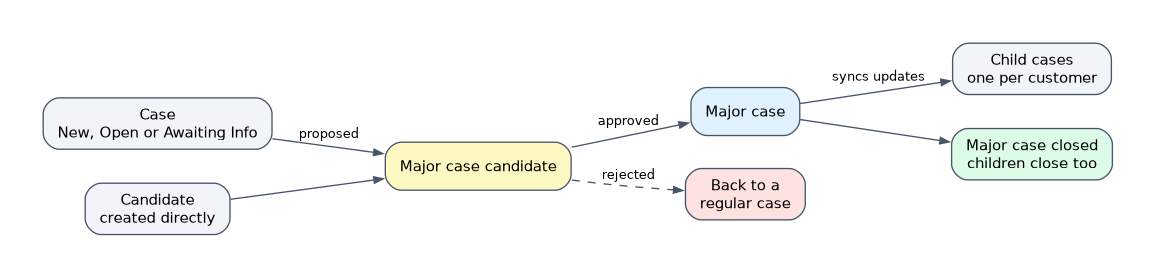 Approvers review candidates under Major Issue Management > Candidates. What happens on approval depends on where the candidate came from.
| Candidate came from | On approval |
|---|---|
| An existing customer case | A new major case is created and the original case becomes its child |
| Created directly | The candidate itself becomes the major case |
When the candidate is rejected, the Major Case State field is set to Rejected, a work note is added, and the candidate goes back to being a regular case.
Child cases and synchronization
Each affected customer gets one child case that holds their customer specific information. Other cases reported for the same issue are associated with the major case as children, and the Child Cases related list on the major case shows them all.
Properties enable automatic synchronization from the major case to its child cases and set which fields are synchronized. Communications are managed on the major case, and the changes flow down to every child.
Proactive child cases
Some customers are affected but have not called yet. A recipients list built in the Targeted Communications application, using dynamic conditions, a script or imported customer data, can be attached to the major case.
Attaching the list creates a child case for each listed customer, including customers who have not reported the issue. This lets the business tell them about the problem before they find it themselves.
Closing
Closing the major case automatically closes all the child cases. Agents do not have to close dozens of cases by hand, and every customer gets the outcome at the same time.
Major issue or parent and child case?
| Situation | Better fit |
|---|---|
| Many customers hit by the same outage or defect | Major issue management |
| Need approval before declaring something major | Major case candidate |
| Notify customers who have not reported it yet | Major case with a recipients list |
| One customer's case split into pieces of work | Case tasks |
A major case adds approval, customer specific child cases, synchronization and proactive outreach. A plain parent field link has none of these.
How the exam asks about this
- "Fifty customers report the same login failure in an hour." Propose a case as a major case candidate; after approval, link the other cases as children.
- "Monitoring shows a fault before any customer calls." Create a candidate directly; on approval it becomes the major case.
- "All customers on an affected service must be informed, including those who have not called." Attach a Targeted Communications recipients list to the major case to create child cases for them.
What to remember for the exam
- Major issue management uses a major case with one child case per affected customer.
- Only cases in New, Open or Awaiting Info can be proposed as candidates.
- A candidate from an existing case becomes a child of a new major case; a directly created candidate becomes the major case.
- A rejected candidate gets Major Case State Rejected and returns to a regular case.
- Properties synchronize fields from the major case to its child cases.
- Closing the major case closes all child cases.
An agent proposes a candidate but cannot declare a major case alone. Promotion is done by a major issue manager or customer service manager, after review.
Common mistakes
Linking cases with a parent field only. That groups records but gives no approval, synchronization or proactive outreach. Use major issue management when many customers share one issue.
Closing child cases one at a time. Closing the major case closes the child cases automatically, so the customer updates stay consistent.
Forgetting customers who have not called. A recipients list from Targeted Communications creates child cases for affected customers before they report the issue.
Check yourself
Which case states allow an agent to propose a case as a major case candidate?
New, Open and Awaiting Info. Resolved and closed cases cannot be proposed.
What happens to the original case when a candidate proposed from it is approved?
A new major case is created and the original case becomes one of its child cases.
How can an implementer create child cases for customers who have not reported the issue?
Attach a recipients list from Targeted Communications to the major case. The platform creates a child case for each customer on the list.
Topic 2 of 3 in Case Management
Test yourself on Case Management
The full ServiceNow CIS-CSM question bank has 590 questions, with timed practice exams and an explanation for every answer.
This study guide is independent and is not affiliated with, endorsed by, or sponsored by ServiceNow. Vendor names, certification names and exam codes are trademarks of their respective owners and are used for identification only.