Understanding and Applying the Scrum Framework · Topic 2 of 5
The Product Owner in the Scrum Team
The Product Owner accountability for PSPO I: one person maximizing value, Product Backlog management, and how the Developers and Scrum Master work with them.
- 5 min
- Includes a diagram
- The Product Owner is one person, not a committee.
- Accountable for maximizing value and for effective Product Backlog management.
- Can delegate the work but remains accountable.
What it is
The fundamental unit of Scrum is a small team of people, a Scrum Team: one Scrum Master, one Product Owner and Developers. Within a Scrum Team there are no sub-teams or hierarchies. The Scrum Guide defines three accountabilities, not job titles.
The Product Owner is accountable for maximizing the value of the product resulting from the work of the Scrum Team. The Product Owner is one person, not a committee, and may represent the needs of many stakeholders in the Product Backlog.
How it works
The Scrum Team as a whole
- Cross-functional: the members have all the skills necessary to create value each Sprint.
- Self-managing: they internally decide who does what, when and how.
- Small: typically 10 or fewer people. If teams grow too large, they should consider reorganizing into multiple cohesive Scrum Teams focused on the same product, sharing the same Product Goal, Product Backlog and Product Owner.
- The entire Scrum Team is accountable for creating a valuable, useful Increment every Sprint.
The Product Owner accountability
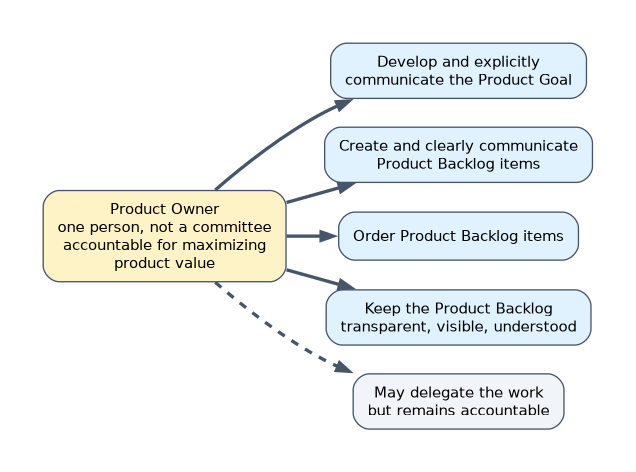 The Product Owner is also accountable for effective Product Backlog management, which includes:
- Developing and explicitly communicating the Product Goal.
- Creating and clearly communicating Product Backlog items.
- Ordering Product Backlog items.
- Ensuring that the Product Backlog is transparent, visible and understood.
The Product Owner may do this work or may delegate the responsibility to others. Regardless, the Product Owner remains accountable.
For Product Owners to succeed, the entire organization must respect their decisions. These decisions are visible in the content and ordering of the Product Backlog, and through the inspectable Increment at the Sprint Review. Those wanting to change the Product Backlog can do so by trying to convince the Product Owner.
Decisions that belong to the Product Owner
| Decision | Who | Notes |
|---|---|---|
| Order of the Product Backlog | Product Owner | May take advice from anyone, decides alone |
| Cancel a Sprint | Product Owner only | Only when the Sprint Goal becomes obsolete |
| Propose how the Sprint could increase value | Product Owner | At Sprint Planning |
| Define the Sprint Goal | Whole Scrum Team | Product Owner proposes value, team agrees the goal |
| Select items for the Sprint | Developers | Through discussion with the Product Owner |
| Plan how to do the work | Developers | Sole discretion of the Developers |
| Size Product Backlog items | Developers | The Product Owner may influence them by helping them understand trade-offs |
How the Developers work with the Product Owner
Developers are the people in the Scrum Team who are committed to creating any aspect of a usable Increment each Sprint. In their work with the Product Owner:
- At Sprint Planning they select items through discussion with the Product Owner.
- During the Sprint, scope may be clarified and renegotiated with the Product Owner as more is learned.
- If the work turns out to be different than expected, they collaborate with the Product Owner to negotiate the scope of the Sprint Backlog without affecting the Sprint Goal.
- They own the Sprint Backlog and the plan; the Product Owner does not tell them how to build the Increment.
If the Product Owner actively works on items in the Sprint Backlog, the Product Owner takes part in the Daily Scrum as a Developer.
How the Scrum Master serves the Product Owner
The Scrum Master serves the Product Owner in several ways, including:
- Helping find techniques for effective Product Goal definition and Product Backlog management.
- Helping the Scrum Team understand the need for clear and concise Product Backlog items.
- Helping establish empirical product planning for a complex environment.
- Facilitating stakeholder collaboration as requested or needed.
The Scrum Master helps the Product Owner but never takes over ordering the Product Backlog. Options that let the Scrum Master reorder items or accept work are distractors.
How the exam asks about this
- "Who is accountable for maximizing the value of the product?" The Product Owner.
- "Can the Product Owner delegate Product Backlog management?" Yes, but the Product Owner remains accountable.
- "Three Scrum Teams work on one product. How many Product Owners?" One.
- "A manager wants an item done first. What should happen?" The manager tries to convince the Product Owner, who decides the order.
What to remember for the exam
- The Product Owner is one person, not a committee.
- Accountable for maximizing value and for effective Product Backlog management.
- Can delegate the work but remains accountable.
- The organization must respect the Product Owner's decisions.
- Developers select items and plan the work; the whole Scrum Team defines the Sprint Goal.
- The Scrum Master helps the Product Owner with techniques, empirical planning and stakeholder collaboration.
A Product Owner who assigns tasks to Developers or tells them how to build an item breaks self-management. The Product Owner decides what and why; the Developers decide how.
Common mistakes
Product Owner as a committee or proxy chain. One person is accountable, even when representing many stakeholders.
Letting a manager override the order directly. Others try to convince the Product Owner.
Giving the Product Owner control of the Sprint Backlog. It belongs to the Developers.
Check yourself
How can someone change the order of the Product Backlog?
By trying to convince the Product Owner, who makes the decision.
Who selects the Product Backlog items for a Sprint?
The Developers, through discussion with the Product Owner.
Name one way the Scrum Master serves the Product Owner.
For example, helping find techniques for effective Product Goal definition and Product Backlog management.
Topic 2 of 5 in Understanding and Applying the Scrum Framework
Test yourself on Understanding and Applying the Scrum Framework
The full Scrum.org PSPO I question bank has 1,065 questions, with timed practice exams and an explanation for every answer.
This study guide is independent and is not affiliated with, endorsed by, or sponsored by Scrum.org. Vendor names, certification names and exam codes are trademarks of their respective owners and are used for identification only.