Understanding and Applying the Scrum Framework · Topic 5 of 5
Artifacts, Commitments and the Definition of Done
Scrum artifacts for PSPO I: the Product Backlog and Product Goal, Sprint Backlog and Sprint Goal, the Increment and the Definition of Done.
- 5 min
- Includes a diagram
- Product Backlog: Product Goal. Sprint Backlog: Sprint Goal. Increment: Definition of Done.
- The Product Backlog is the single source of work; the Product Owner is accountable for it.
- One Product Goal at a time.
What it is
Scrum's artifacts represent work or value. They are designed to maximize transparency of key information, so everyone inspecting them has the same basis for adaptation. Each artifact contains a commitment that provides focus and a way to measure progress.
The Product Owner is accountable for the Product Backlog and the Product Goal. The Developers own the Sprint Backlog. The whole Scrum Team creates the Increment, which must meet the Definition of Done.
How it works
The three artifacts
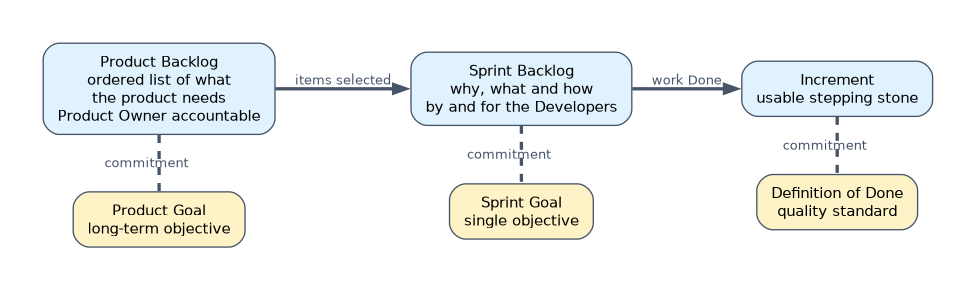
| Artifact | What it is | Commitment | Accountable |
|---|---|---|---|
| Product Backlog | An emergent, ordered list of what is needed to improve the product; the single source of work undertaken by the Scrum Team | Product Goal | Product Owner |
| Sprint Backlog | The Sprint Goal (why), the items selected for the Sprint (what) and an actionable plan (how) | Sprint Goal | Developers |
| Increment | A concrete stepping stone toward the Product Goal | Definition of Done | Whole Scrum Team |
Product Backlog and Product Goal
- The Product Goal describes a future state of the product which can serve as a target for the Scrum Team to plan against.
- It is in the Product Backlog; the rest of the Product Backlog emerges to define "what" will fulfil the Product Goal.
- The Product Goal is the long-term objective for the Scrum Team. They must fulfil (or abandon) one objective before taking on the next.
- A product is a vehicle to deliver value. It has a clear boundary, known stakeholders and well-defined users or customers. It could be a service, a physical product or something more abstract.
Sprint Backlog and Sprint Goal
- The Sprint Backlog is a plan by and for the Developers: a highly visible, real-time picture of the work they plan to do in the Sprint.
- The Sprint Goal is the single objective for the Sprint. It is created during Sprint Planning and added to the Sprint Backlog.
- The Sprint Goal creates coherence and focus and gives flexibility in terms of the exact work needed to achieve it.
- If the work turns out to be different than expected, the Developers collaborate with the Product Owner to negotiate the scope of the Sprint Backlog without affecting the Sprint Goal.
Increment
- Each Increment is additive to all prior Increments and thoroughly verified, ensuring that all Increments work together.
- In order to provide value, the Increment must be usable.
- Multiple Increments may be created within a Sprint.
- The sum of the Increments is presented at the Sprint Review, but an Increment may be delivered to stakeholders before the end of the Sprint.
The Definition of Done
- A formal description of the state of the Increment when it meets the quality measures required for the product.
- The moment a Product Backlog item meets the Definition of Done, an Increment is born.
- It creates transparency by giving everyone a shared understanding of what work was completed as part of the Increment.
- If an item does not meet the Definition of Done, it cannot be released or even presented at the Sprint Review. It returns to the Product Backlog for future consideration.
- If the organization has a Definition of Done as a standard, all Scrum Teams must follow it as a minimum. Otherwise, the Scrum Team must create one appropriate for the product.
- Multiple Scrum Teams working on the same product must mutually define and comply with the same Definition of Done.
| Situation at the end of the Sprint | What happens |
|---|---|
| Item meets the Definition of Done | Part of the Increment; can be released |
| Item is almost Done | Not part of the Increment; returns to the Product Backlog |
| Product Owner wants to release undone work | Not allowed; it does not meet the quality measures |
Work that is not Done does not roll over automatically into the next Sprint. It goes back to the Product Backlog, where the Product Owner orders it again.
How the exam asks about this
- "What is the commitment for the Product Backlog?" The Product Goal.
- "How many Product Goals does a Scrum Team pursue at once?" One; it is fulfilled or abandoned before the next.
- "An item is 90% complete at the end of the Sprint. What happens?" It returns to the Product Backlog.
- "Who creates the Definition of Done if the organization has none?" The Scrum Team.
What to remember for the exam
- Product Backlog: Product Goal. Sprint Backlog: Sprint Goal. Increment: Definition of Done.
- The Product Backlog is the single source of work; the Product Owner is accountable for it.
- One Product Goal at a time.
- The Sprint Backlog belongs to the Developers; scope can be negotiated, the Sprint Goal stays.
- An Increment must be usable and may be released before the Sprint ends.
- Undone work is not released or shown at the Sprint Review.
Lowering the Definition of Done to show more features breaks the rule that quality does not decrease. Not even the Product Owner can release an item that is not Done.
Common mistakes
Calling the Sprint Backlog the Product Owner's plan. It is by and for the Developers.
Releasing "almost done" items. Only work that meets the Definition of Done is part of an Increment.
Running several Product Goals in parallel. The team pursues one at a time.
Check yourself
What is the Product Goal?
A future state of the product that serves as a target for the Scrum Team to plan against; the commitment for the Product Backlog.
What is the commitment for the Increment?
The Definition of Done.
What must several Scrum Teams on one product share about Done?
They must mutually define and comply with the same Definition of Done.
Topic 5 of 5 in Understanding and Applying the Scrum Framework
Test yourself on Understanding and Applying the Scrum Framework
The full Scrum.org PSPO I question bank has 1,065 questions, with timed practice exams and an explanation for every answer.
This study guide is independent and is not affiliated with, endorsed by, or sponsored by Scrum.org. Vendor names, certification names and exam codes are trademarks of their respective owners and are used for identification only.