Process · Topic 2 of 12
Scope, Requirements and the WBS
Collect requirements, write the scope statement, build a work breakdown structure and scope baseline, then validate and control scope in predictive work.
- 4 min
- Includes a diagram
- Product scope is the features of the product, and project scope is the work to deliver it.
- Requirements must be clear, testable and traceable, and the traceability matrix links them to deliverables.
- The scope statement lists deliverables, acceptance criteria, exclusions, assumptions and constraints.
What it is
Project scope is all the work needed to deliver the product, service or result with the agreed features. Product scope describes what the product is like, and project scope describes the work needed to produce it. Managing scope means defining it clearly, breaking it down, getting it accepted and controlling changes.
This page covers the predictive view, where scope is defined in detail early. The next page covers the agile view, where scope is held in a backlog.
How it works
Collecting requirements
Requirements describe needs and conditions that the product or project must meet. They come from interviews, workshops, focus groups, surveys, observation, prototypes and document analysis. A requirements traceability matrix links each requirement to its source and to the deliverables, tests and design elements that satisfy it.
Requirements should be clear, testable and agreed. A requirement nobody can test is not ready.
The scope statement
The project scope statement describes the deliverables, the acceptance criteria, what is in scope and what is explicitly out of scope. It also records assumptions and constraints. The exclusions are as important as the inclusions, because they stop misunderstanding.
The work breakdown structure
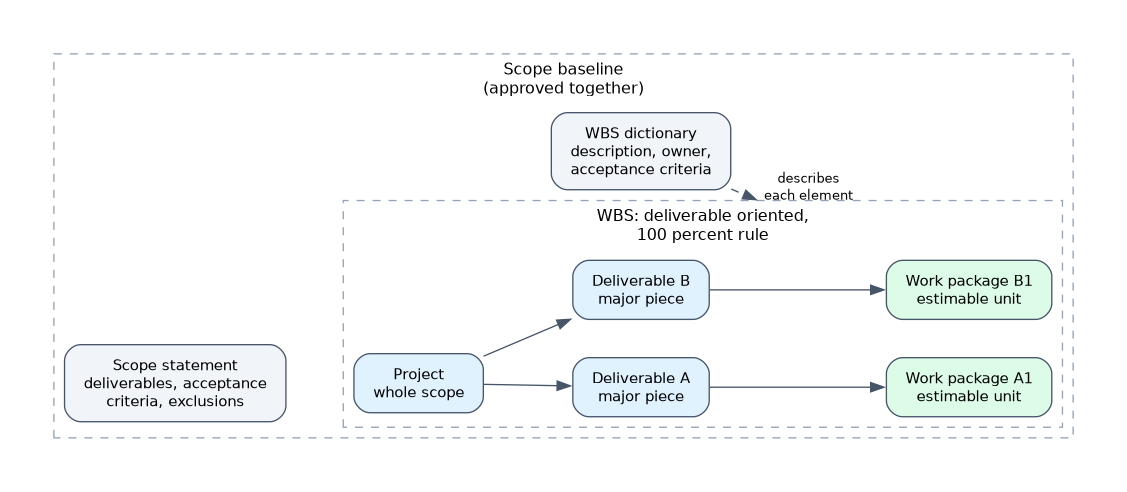 The work breakdown structure (WBS) divides the total scope into smaller, manageable pieces. It is deliverable oriented, meaning it breaks down what must be produced, not what people will do day to day. The lowest level items are called work packages, which can be estimated, scheduled and assigned.
The 100 percent rule says the WBS must include all the work in scope, and nothing outside it. Each level must add up to the level above it.
| Element | What it holds |
|---|---|
| Scope statement | Deliverables, acceptance criteria, exclusions |
| WBS | Hierarchy of deliverables down to work packages |
| WBS dictionary | Details of each element, such as description, owner and acceptance criteria |
| Scope baseline | The approved scope statement, WBS and WBS dictionary together |
Validate scope and control quality
Two checks are easy to confuse. Control quality verifies that deliverables are correct against the requirements, and it is usually done first, inside the team. Validate scope is the formal acceptance of completed deliverables by the customer or sponsor.
A deliverable that fails control quality should not be presented for validation.
Controlling scope
Control scope compares the work with the baseline and manages changes. Scope creep occurs when scope grows without control. Any approved change goes through integrated change control, and the baseline is then updated.
Variance analysis helps. If the work produced differs from the baseline, the project manager decides whether to correct the work or raise a change request.
Scope in hybrid projects
A hybrid project can freeze a high level scope baseline, for example for a contract or budget, while the team refines detailed requirements in a backlog. The key idea is to know which level of scope is fixed and which is flexible, and to say so openly.
In scenario questions that mention the customer formally signing off completed deliverables, the process is validate scope, not control quality.
What to remember for the exam
- Product scope is the features of the product, and project scope is the work to deliver it.
- Requirements must be clear, testable and traceable, and the traceability matrix links them to deliverables.
- The scope statement lists deliverables, acceptance criteria, exclusions, assumptions and constraints.
- The WBS is deliverable oriented and follows the 100 percent rule.
- A work package is the lowest WBS level and can be estimated and assigned.
- The WBS dictionary describes each WBS element in detail.
- The scope baseline is the approved scope statement, WBS and WBS dictionary.
- Validate scope is customer acceptance, and control quality checks correctness first.
- Scope creep is uncontrolled growth, so manage changes through change control.
Common mistakes
Writing the WBS as a list of activities. The WBS shows deliverables. Activities appear later in the schedule.
Mixing up validate scope and control quality. One is acceptance by the customer, the other is internal checking of correctness.
Leaving out exclusions. What is not included needs saying, otherwise stakeholders assume it is.
Accepting small extras. Small unapproved additions accumulate, and the team adds risk without agreement.
Breaking down too far or not far enough. Stop at work packages that can be estimated and managed.
Never add scope on the customer's informal request, because every addition must be assessed and approved through change control.
Check yourself
What does the scope baseline consist of?
The approved scope statement, WBS and WBS dictionary.
What is a work package?
The lowest level item in the WBS, small enough to estimate, schedule and assign.
Who performs validate scope?
The customer or sponsor formally accepts the completed deliverables, after control quality has confirmed they are correct.
Topic 2 of 12 in Process
Test yourself on Process
The full PMI PMP question bank has 1,463 questions, with timed practice exams and an explanation for every answer.
This study guide is independent and is not affiliated with, endorsed by, or sponsored by PMI. Vendor names, certification names and exam codes are trademarks of their respective owners and are used for identification only.