Process · Topic 10 of 12
Critical Path and Float
Sequence activities, run forward and backward passes, find the critical path and float, and compress a schedule using crashing or fast tracking.
- 5 min
- Includes a diagram
- The critical path is the longest path and defines the shortest project duration.
- Activities on the critical path have zero total float in a normal network.
- EF = ES + duration, and LS = LF - duration.
What it is
A predictive schedule shows which activities are done, in what order, by whom and by when. The critical path method (CPM) finds the longest chain of dependent activities. That chain sets the shortest possible project duration, so any delay on it delays the finish.
Float tells you how much an activity can slip without causing trouble. These two ideas are the core of schedule questions.
How it works
Sequencing
Activities are linked by dependencies in a precedence diagram. The most common relationship is finish to start (FS), where the successor starts after the predecessor finishes. Others are start to start (SS), finish to finish (FF) and rarely start to finish (SF).
A lead lets a successor start early, and a lag adds a delay. Dependencies may be mandatory (hard logic), discretionary (preferred logic), external (outside the project) or internal.
Forward and backward pass
A forward pass starts at the beginning and calculates the earliest start (ES) and earliest finish (EF). A backward pass starts at the end and calculates the latest finish (LF) and latest start (LS).
| Rule | Formula |
|---|---|
| Earliest finish | EF = ES + duration |
| Earliest start with several predecessors | The largest EF among them |
| Latest start | LS = LF - duration |
| Latest finish with several successors | The smallest LS among them |
| Total float | LS - ES, or LF - EF |
These formulas use the convention that the first activity starts at time 0. Some books start at 1 and subtract one, so check the question.
A worked example
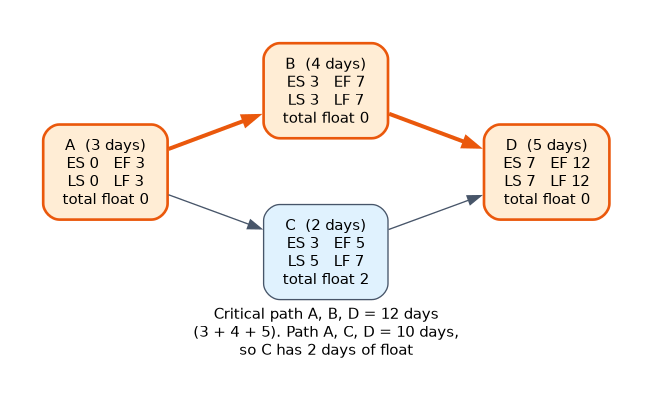 Activity A takes 3 days. B (4 days) and C (2 days) both follow A. D (5 days) follows both B and C.
| Activity | Duration | ES | EF | LS | LF | Total float |
|---|---|---|---|---|---|---|
| A | 3 | 0 | 3 | 0 | 3 | 0 |
| B | 4 | 3 | 7 | 3 | 7 | 0 |
| C | 2 | 3 | 5 | 5 | 7 | 2 |
| D | 5 | 7 | 12 | 7 | 12 | 0 |
The path A, B, D has 3 + 4 + 5 = 12 days, and A, C, D has 10 days. So the critical path is A, B, D with a duration of 12 days, and C has 2 days of float.
Float
Total float is how long an activity can be delayed without delaying the project end date. Free float is how long it can be delayed without delaying the early start of any successor. Activities on the critical path have zero total float, unless the schedule has a constraint.
A schedule may have more than one critical path, and near critical paths with little float carry risk. Delaying a critical activity by one day delays the finish by a day.
Schedule compression
When the schedule must be shortened, two main techniques apply to critical path activities.
| Technique | What it does | Trade off |
|---|---|---|
| Crashing | Adds resources to shorten duration | Raises cost, and may not always work |
| Fast tracking | Runs activities in parallel that were planned in sequence | Raises risk and may cause rework |
Compare options and choose the one that shortens the path at the least cost or risk. Resource leveling can then lengthen the schedule again if resources are overloaded.
Estimating and controlling
Duration estimates use the same techniques as costs, including analogous, parametric, bottom up and three point methods. Schedule reserve, also called contingency, is added for uncertainty.
Control schedule compares progress with the baseline, uses trend and variance analysis, and applies compression or other corrective action when needed. Changes to the baseline go through change control.
To find the critical path, add durations along each route and pick the longest, then check that every activity on it has zero total float.
What to remember for the exam
- The critical path is the longest path and defines the shortest project duration.
- Activities on the critical path have zero total float in a normal network.
- EF = ES + duration, and LS = LF - duration.
- Total float = LS - ES = LF - EF.
- In a forward pass use the largest EF of predecessors, and in a backward pass use the smallest LS of successors.
- Free float affects only the next activity, and total float affects the project end.
- Crashing adds cost, and fast tracking adds risk.
- FS is the most common dependency, and leads and lags adjust timing.
- Apply compression to critical path activities only.
Common mistakes
Adding durations incorrectly. Only add along a path, not across parallel paths.
Compressing non critical activities. Shortening an activity with float does not shorten the project.
Using the wrong pass rule. Take the largest EF going forward and the smallest LS going backward.
Thinking the critical path never changes. After compression or delays, another path can become critical.
Confusing float with reserve. Float belongs to an activity, while schedule reserve is time held for uncertainty.
Check whether a question counts the first day as day 0 or day 1 before you finish the calculation, because the answer shifts by one.
Check yourself
What does zero total float tell you about an activity?
It lies on the critical path, so any delay moves the project end date.
What is the difference between crashing and fast tracking?
Crashing adds resources to shorten duration at higher cost, while fast tracking overlaps activities and adds risk.
How do you calculate total float?
Subtract earliest start from latest start (LS - ES), or earliest finish from latest finish (LF - EF).
Topic 10 of 12 in Process
Test yourself on Process
The full PMI PMP question bank has 1,463 questions, with timed practice exams and an explanation for every answer.
This study guide is independent and is not affiliated with, endorsed by, or sponsored by PMI. Vendor names, certification names and exam codes are trademarks of their respective owners and are used for identification only.