PRINCE2 Processes · Topic 1 of 4
Starting Up a Project and Directing a Project
PRINCE2 7 processes starting up a project and directing a project: purpose, objectives and context, from the project mandate to project board decisions.
- 6 min
- Includes a diagram
- Starting up a project is a short pre-project process triggered by the project mandate.
- It produces the project brief (with outline business case and project product description) and the initiation stage plan.
- The business layer appoints the executive; the executive normally appoints the project manager.
What it is
Starting up a project is the pre-project process. It checks whether there is a viable and worthwhile project before anyone commits to initiating it. Directing a project is the project board's process, running from the end of starting up a project until the project closes.
Together they cover how a project is born and how the people accountable for it make their decisions.
How it works
Starting up a project: purpose
The purpose of starting up a project is to ensure that the prerequisites for initiating a project are in place, by answering the question: do we have a viable and worthwhile project? It stops poorly conceived projects before they absorb time and money.
Starting up a project: objectives
| Objective | In plain words |
|---|---|
| There is a business justification for initiating the project | Documented in an outline business case |
| All necessary authorities exist for initiating the project | The right people can make the decision |
| Sufficient information is available to define and confirm the scope | The project brief describes what is wanted |
| The various ways the project can be delivered are evaluated and an approach selected | The delivery approach is chosen |
| Individuals are appointed to undertake the work of initiation or take significant roles | Executive, project manager and other key roles |
| The work required for initiation is planned | A stage plan for the initiation stage |
| Time is not wasted initiating a project based on unsound assumptions | Only worthwhile projects go forward |
Starting up a project: context
The trigger is a project mandate from the business layer. It can be anything from a short email to a detailed brief.
Starting up a project happens before the project formally starts, so it should be short. The business layer appoints the executive, and the executive appoints the project manager if the business layer has not already done so. The project manager does most of the work: reviewing previous lessons, designing and appointing the project management team, preparing the outline business case, the project product description and the project brief, choosing the delivery approach, and planning the initiation stage.
The process ends with a request to the project board to initiate the project.
Directing a project: purpose
The purpose of directing a project is to enable the project board to be accountable for the project's success by making key decisions and exercising overall control, while delegating day-to-day management of the project to the project manager.
Directing a project: objectives
| Objective | In plain words |
|---|---|
| There is authority to initiate the project | The board approves the initiation stage |
| There is authority to deliver the project's products | The board authorises the project after initiation |
| Management direction and control are provided throughout | The board guides, decides and responds to exceptions |
| The project remains viable | Business case checked at each decision point |
| The business layer has an interface to the project | The board links the project to the organization |
| There is authority to close the project | The board confirms closure |
| Plans for realising post-project benefits are managed and reviewed | Benefits reviews after closure are planned |
Directing a project: context
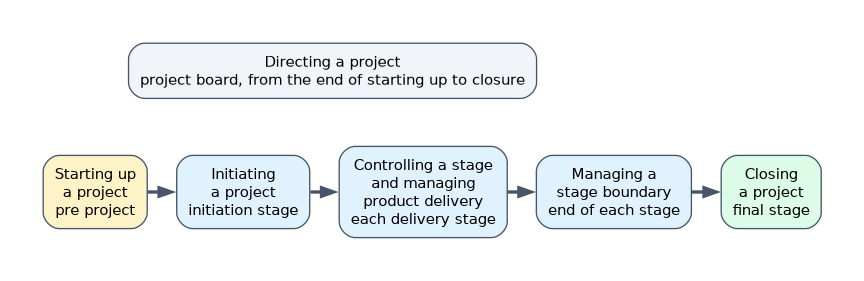 Directing a project starts when the board receives the request to initiate and continues until closure. It is not concerned with day-to-day activity; the board manages by exception through regular reports and decisions at key points.
| Board decision | When |
|---|---|
| Authorise initiation | After starting up a project |
| Authorise the project | After initiating a project, on approving the PID |
| Authorise a stage or exception plan | At each stage boundary, or after an exception |
| Give ad hoc direction | Any time, in response to reports, issues or requests |
| Authorise project closure | At the end of the project, or if it is closed early |
The board works within the limits set by the business layer, and escalates to it if project tolerances are forecast to be exceeded.
A worked example
The board of a regional bus company issues a mandate: "introduce contactless payment on all buses". The operations director is appointed executive and picks a project manager, who finds a lessons report from a ticketing project at another depot and builds the project brief in two weeks.
The project board reviews the brief and authorises initiation. During the project, it receives monthly highlight reports and only meets formally at stage boundaries, except once when the project manager asks for ad hoc direction on a supplier dispute.
How the exam asks about this
- "Which process answers the question 'do we have a viable and worthwhile project?'" Starting up a project.
- "What triggers starting up a project?" The project mandate from the business layer.
- "Which is an objective of directing a project?" To provide management direction and control throughout the project, or to give the business layer an interface to the project.
What to remember for the exam
- Starting up a project is a short pre-project process triggered by the project mandate.
- It produces the project brief (with outline business case and project product description) and the initiation stage plan.
- The business layer appoints the executive; the executive normally appoints the project manager.
- Directing a project starts on the request to initiate and runs until closure.
- The board is accountable and makes key decisions but does not manage day-to-day.
Directing a project does not cover starting up a project. The board's process begins only when the request to initiate is received.
Common mistakes
Treating starting up as part of the project. It happens before the project formally starts and should be short.
Making the board manage day-to-day. The board directs; the project manager manages.
Forgetting post-project benefits. Managing plans for post-project benefits reviews is an objective of directing a project.
Check yourself
Who appoints the project manager?
Normally the executive, during starting up a project, unless the business layer has already appointed one.
When does directing a project start?
When the project board receives the request to initiate the project at the end of starting up a project.
What is the purpose of directing a project?
To enable the project board to be accountable for the project's success by making key decisions and exercising overall control, while delegating day-to-day management to the project manager.
Topic 1 of 4 in PRINCE2 Processes
Test yourself on PRINCE2 Processes
The full PeopleCert PRINCE2 7 Foundation question bank has 564 questions, with timed practice exams and an explanation for every answer.
This study guide is independent and is not affiliated with, endorsed by, or sponsored by PeopleCert. Vendor names, certification names and exam codes are trademarks of their respective owners and are used for identification only.