MPLS · Topic 3 of 5
RSVP-Signaled LSPs
Learn RSVP-TE for the JN0-364: Path and Resv messages, CSPF and the TED, explicit paths, and how to configure, verify and troubleshoot RSVP LSPs on Junos.
- 6 min
- Includes a diagram
- RSVP signals with Path (downstream) and Resv (upstream, carries labels).
- The LSP is configured only on the ingress with
label-switched-path <name> to <address>. - RSVP route preference is 7; routes go into inet.3.
What it is
RSVP-TE (Resource Reservation Protocol with traffic engineering extensions) signals an LSP hop by hop from the ingress router to the egress. The ingress decides the path, can reserve bandwidth on every link and can steer traffic away from the IGP shortest path.
Each RSVP LSP is configured by name on the ingress router only. Transit and egress routers just need MPLS and RSVP enabled on their interfaces. RSVP routes are installed in inet.3 with preference 7.
How it works
Path and Resv messages
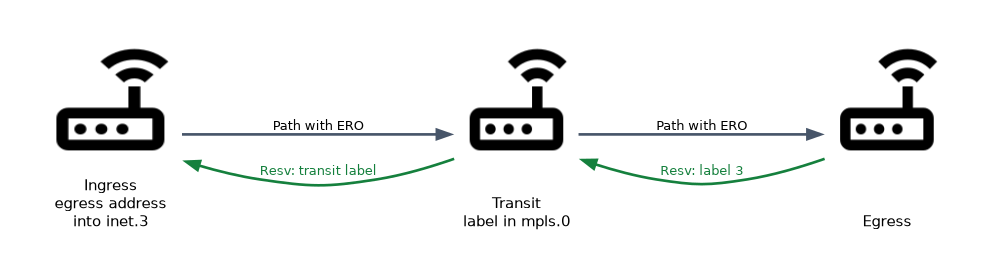
- The ingress sends a Path message toward the egress. It carries the Explicit Route Object (ERO), the list of hops to follow, and the requested bandwidth.
- Each router checks the request, stores Path state and forwards the Path message to the next hop in the ERO.
- The egress replies with a Resv message that travels back along the same path. The egress puts label 3 (implicit null) in it by default, requesting PHP.
- Each router going upstream allocates its own label, installs it in mpls.0, and puts it in the Resv sent upstream.
- When the Resv reaches the ingress, the LSP is up and the egress address is installed in inet.3.
RSVP is soft state: routers refresh Path and Resv state periodically. In current Junos releases the default refresh time is 1200 seconds, as RFC 8370 recommends, or 30 seconds with no-enhanced-frr-bypass. The keep multiplier defaults to 3, and RSVP hellos between neighbors default to every 9 seconds.
CSPF and the TED
By default a Junos LSP uses Constrained Shortest Path First (CSPF). CSPF runs on the ingress against the traffic engineering database (TED) and computes a full path that meets the LSP's constraints, such as bandwidth, administrative groups and explicit hops. The result becomes a strict ERO.
The TED is filled by the IGP's traffic engineering extensions.
| IGP | TE extensions |
|---|---|
| IS-IS | Enabled by default |
| OSPF | Must be enabled with set protocols ospf traffic-engineering |
With OSPF and no traffic-engineering, the TED is empty, CSPF fails and the LSP stays down. Fix it by enabling OSPF traffic engineering, or by adding no-cspf to the LSP, which makes RSVP follow the IGP route hop by hop.
Explicit paths
A named path lists hops as strict (must be the directly connected next hop) or loose (reach it by any route). The LSP references the path as primary or secondary. A secondary path takes over if the primary fails; with standby it is signaled in advance.
Configuration
All routers along the path:
user@R2# set interfaces ge-0/0/1 unit 0 family mpls
user@R2# set protocols mpls interface ge-0/0/1.0
user@R2# set protocols rsvp interface ge-0/0/1.0
The ingress also defines the LSP:
user@R1# set protocols ospf traffic-engineering
user@R1# set protocols mpls path VIA-R3 10.0.13.3 strict
user@R1# set protocols mpls label-switched-path R1-TO-R4 to 192.168.0.4
user@R1# set protocols mpls label-switched-path R1-TO-R4 primary VIA-R3
user@R1# set protocols mpls label-switched-path R1-TO-R4 bandwidth 100m
The to address is normally the egress router's loopback, so it matches the BGP next hop the egress advertises. Protection options include fast-reroute or node-link-protection on the LSP, and link-protection under protocols rsvp interface.
Monitoring
| Command | Shows |
|---|---|
show mpls lsp | Every LSP this router knows as ingress, transit or egress, with state Up or Dn |
show mpls lsp ingress extensive | Path history, ERO, CSPF results and failure reasons |
show rsvp session | RSVP sessions with labels in and out |
show rsvp neighbor | RSVP neighbors heard through hellos |
show rsvp interface | Interfaces with RSVP enabled and reserved bandwidth |
show ted database | Contents of the TED |
show route table inet.3 | The installed LSP route |
user@R1> show mpls lsp ingress
Ingress LSP: 1 sessions
To              From            State Rt P     ActivePath       LSPname
192.168.0.4     192.168.0.1     Up     0 *     VIA-R3           R1-TO-R4
Total 1 displayed, Up 1, Down 0
ping mpls rsvp R1-TO-R4 and traceroute mpls rsvp R1-TO-R4 test the LSP with MPLS echo packets.
Troubleshooting checklist
| Symptom | Likely cause |
|---|---|
| LSP down, CSPF failure in the extensive output | TED empty: OSPF without traffic-engineering, or IGP down |
| LSP down, no RSVP neighbor on a link | protocols rsvp interface missing on one side |
| LSP up but labeled traffic dropped | family mpls or protocols mpls interface missing on a transit link |
| LSP down with bandwidth set | Not enough reservable bandwidth on some link |
show mpls lsp extensive keeps a numbered history of state changes and errors. It is the first command to run when an LSP will not come up.
Common mistakes
Configuring the LSP on every router. The label-switched-path is configured only on the ingress. The other routers only need MPLS and RSVP on their interfaces.
Forgetting OSPF traffic engineering. IS-IS fills the TED by default, OSPF does not. A CSPF failure on an OSPF network almost always means traffic-engineering is missing.
Expecting a return path. An RSVP LSP is one way. The egress needs its own LSP back to the ingress.
Thinking no-cspf disables traffic engineering entirely. The LSP can still use explicit loose or strict hops and reserve bandwidth; only the CSPF calculation is skipped.
An interface listed under protocols rsvp but not under protocols mpls, or missing family mpls, can show an RSVP neighbor while labeled packets are still dropped. Check all three.
What to remember for the exam
- RSVP signals with Path (downstream) and Resv (upstream, carries labels).
- The LSP is configured only on the ingress with
label-switched-path <name> to <address>. - RSVP route preference is 7; routes go into inet.3.
- CSPF is on by default and needs the TED; IS-IS fills it by default, OSPF needs
traffic-engineering. no-cspfmakes the LSP follow the IGP path.- Defaults: refresh time 1200 seconds (30 with
no-enhanced-frr-bypass), keep multiplier 3, hello interval 9 seconds. - Verify with
show mpls lsp,show rsvp session,show rsvp neighborandshow ted database.
Check yourself
An RSVP LSP over an OSPF network stays down with a CSPF failure. What is the most likely fix?
Enable
set protocols ospf traffic-engineeringso the TED is filled, or addno-cspfto the LSP.Which RSVP message carries the labels?
The Resv message, sent from the egress back toward the ingress.
On which routers is the
label-switched-pathstatement configured?Only on the ingress router.
Topic 3 of 5 in MPLS
Test yourself on MPLS
The full Juniper JNCIS-SP JN0-364 question bank has 860 questions, with timed practice exams and an explanation for every answer.
This study guide is independent and is not affiliated with, endorsed by, or sponsored by Juniper. Vendor names, certification names and exam codes are trademarks of their respective owners and are used for identification only.