Juniper Mist Cloud Fundamentals · Topic 2 of 2
Cloud-Based Management and Mist Cloud Capabilities
Learn cloud-based management for the JN0-253: Mist microservices, regional clouds, ports to open, and the Mist assurance services and their use cases.
- 6 min
- Includes a diagram
- Mist is a microservices cloud with no on-site controllers; features arrive as cloud updates.
- Microservices are independent, so the platform scales and survives single-service failures.
- Only management and telemetry go to the cloud; devices forward user traffic locally.
What it is
Cloud-based management means the management plane of the network, the configuration, monitoring, analytics and AI, runs as a service in the cloud instead of on controllers and servers in your building. Devices keep forwarding traffic locally; they send telemetry to the cloud and receive configuration from it.
The Juniper Mist cloud is built from microservices: many small, independent services that each do one job and talk to each other through defined APIs. Juniper describes it as combining AI, machine learning and data science with microservices to create a scalable system, with no legacy wireless controllers.
How it works
Benefits of cloud-based management
| Benefit | What it means in practice |
|---|---|
| No controllers or management servers on site | Nothing to rack, patch, back up or size for growth |
| Elastic scale | The cloud adds capacity as the network and its telemetry grow |
| Continuous feature delivery | New features and fixes arrive as cloud updates, without a controller upgrade project |
| Resilience | Microservices are independent, so updating or restarting one service does not take the whole platform down |
| Data in one place | Telemetry from every device is stored together, which is what lets AI find patterns and root causes |
| Access from anywhere | Admins use a browser, the Mist AI mobile app or the APIs |
| Programmable | A REST API, WebSocket streams and webhooks give tools and scripts access to the same cloud |
The traffic between a device and the cloud is management and telemetry. User traffic is switched and routed locally by the devices themselves.
Microservices compared with a controller
| Controller model | Mist microservices cloud | |
|---|---|---|
| Where management runs | Appliance or virtual machine you own | Cloud service run by Juniper |
| Upgrades | Planned controller upgrade, often with a maintenance window | Cloud updates rolled out service by service |
| Scaling | Buy or license a bigger controller | Cloud scales out automatically |
| Failure impact | Controller outage affects every AP it manages | A single service failing is contained |
Regional clouds
Mist runs in several regional clouds. You create your account and organization in the region nearest you, and each region has its own portal URL.
| Region | Portal |
|---|---|
| Global 01 | manage.mist.com |
| Global 02 | manage.gc1.mist.com |
| Global 03 | manage.ac2.mist.com |
| Global 04 | manage.gc2.mist.com |
| EMEA 01 | manage.eu.mist.com |
| APAC 01 | manage.ac5.mist.com |
There are further Global, EMEA and APAC regions. A global account lets one user reach organizations on any regional cloud without signing in again.
An organization lives in one regional cloud. A user who cannot see an org that exists is often signed in to the wrong regional portal.
What a device needs to reach the cloud
Mist APs need only outbound access. The key requirements for an AP are:
| Port | Purpose | Status |
|---|---|---|
| TCP 443 | Connect to the Mist cloud | Required |
| UDP 53 | DNS lookups of the cloud host names | Required |
| UDP 67 and 68 | DHCP, at least for the first connection | Required |
| UDP 443 | Extra path for onboarding, telemetry and configuration | Recommended |
| TCP 80 | Backup channel | Recommended |
| UDP 123 | NTP in some environments | Conditional |
Switches and WAN edges use different host names, including outbound TCP 2200 for Junos devices. The details are covered with onboarding in the next chapter.
Mist cloud capabilities and use cases
The Mist cloud is one platform with several services. Each service is licensed by its own subscription.
| Service | What it covers | Typical use case |
|---|---|---|
| Wi-Fi Assurance | Mist access points, SLEs, AI-driven RRM | Proving and improving the wireless user experience |
| Wired Assurance | Juniper EX switches | Templated switch configuration and wired SLEs |
| WAN Assurance | SRX firewalls and Session Smart Routers | Branch WAN health and WAN SLEs |
| Routing Assurance | Juniper routers | Bringing the same assurance view to the routing layer |
| Access Assurance | Cloud-based network access control | 802.1X and policy-based access without an on-site NAC server |
| Marvis Virtual Network Assistant | Conversational interface, Marvis actions, Marvis Minis | Finding and fixing problems before users call |
| Location services | Virtual Bluetooth LE (vBLE) in Mist APs | Asset visibility and user engagement such as wayfinding |
| Premium Analytics | Long-term analytics and reports | Trend reporting across the network |
| Mist Edge | On-site appliance tied to the cloud | Tunneling user traffic to a central point in a campus |
Every service shares the same data and the same AI. That is why Marvis can answer a question about a client's bad experience by looking at the AP, the switch port and the WAN link together.
The client to cloud view
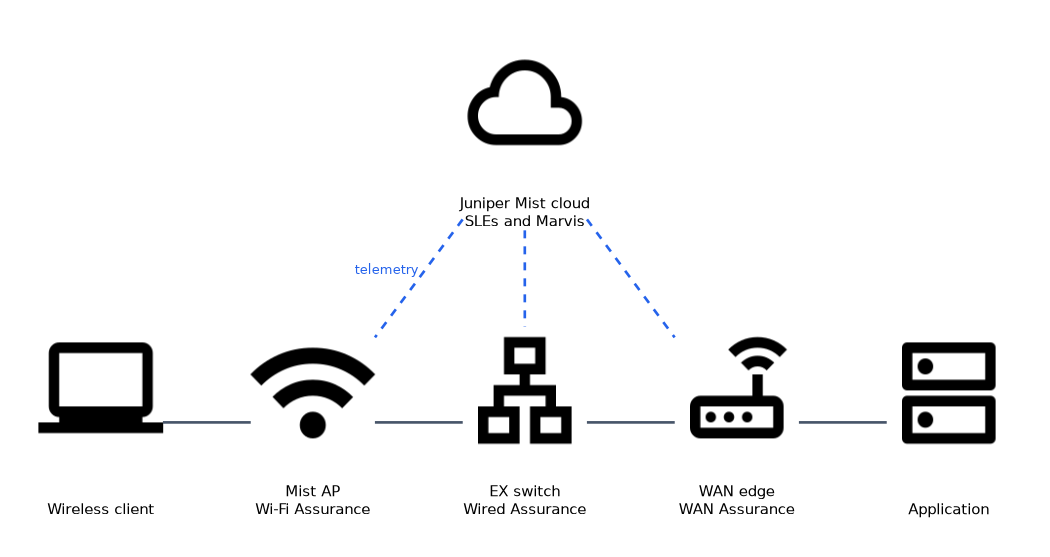 Juniper describes the goal as assurance from client to cloud: one view of the user's path through Wi-Fi, the switch, the WAN edge and on to the application. The services above are the parts of that path, and the subscriptions decide which parts you can see.
Common mistakes
Thinking user traffic goes through the cloud. Only management and telemetry go to Mist. If the cloud connection is lost, an AP generally keeps serving its WLANs; an AP that reboots during the outage needs config persistence enabled to bring them back.
Assuming the portal URL is always manage.mist.com. That is Global 01 only. Other regions have their own portal URLs, and an org exists in one region.
Believing the cloud needs inbound firewall rules. Devices open outbound connections to the cloud. You open outbound ports, not inbound ones.
Do not mix up services. Access Assurance is cloud-based network access control, while Wired Assurance is switch management and monitoring. Exam options often swap them.
What to remember for the exam
- Mist is a microservices cloud with no on-site controllers; features arrive as cloud updates.
- Microservices are independent, so the platform scales and survives single-service failures.
- Only management and telemetry go to the cloud; devices forward user traffic locally.
- Global 01 is manage.mist.com; EMEA 01 is manage.eu.mist.com; each region has its own portal.
- APs need outbound TCP 443, DNS and DHCP; UDP 443 and TCP 80 are recommended.
- Services: Wi-Fi, Wired, WAN, Routing and Access Assurance, Marvis, location services, Premium Analytics, Mist Edge.
- Shared data across services is what lets Mist AI give one client to cloud answer.
Check yourself
Why does a microservices architecture let Mist add features without a controller upgrade?
Each service is updated independently in the cloud, so new features roll out service by service without a maintenance project on site.
An AP loses its connection to the Mist cloud. What happens to the clients on it?
They generally keep passing traffic, because the cloud carries only management and telemetry, not user traffic.
Which Mist service provides cloud-based network access control?
Access Assurance, which handles 802.1X and access policy from the Mist cloud.
Topic 2 of 2 in Juniper Mist Cloud Fundamentals
Test yourself on Juniper Mist Cloud Fundamentals
The full Juniper JNCIA-MistAI JN0-253 question bank has 668 questions, with timed practice exams and an explanation for every answer.
This study guide is independent and is not affiliated with, endorsed by, or sponsored by Juniper. Vendor names, certification names and exam codes are trademarks of their respective owners and are used for identification only.