Basics of Deep Learning and Foundation Models · Topic 3 of 3
Transformer and Foundation Model Infrastructure
Learn self-attention, multi-head attention, positional encoding, BERT and GPT, pre-training, fine tuning and LoRA, and compute behind foundation models.
- 6 min
- Includes a diagram
- Attention = softmax(QK^T / sqrt(d_k)) V; self-attention cost grows with the square of sequence length.
- Multi-head attention runs several heads in parallel; positional encoding supplies word order.
- BERT is encoder-only, GPT is decoder-only, T5 is encoder-decoder.
What it is
The Transformer is a neural network architecture, introduced in the 2017 paper "Attention Is All You Need", that processes a whole sequence at once using self-attention instead of recurrence. It trains in parallel and captures long-range dependencies well.
Foundation models are very large Transformers pre-trained on huge data and then adapted to many tasks. Their infrastructure is the compute, storage, networking and distributed training methods needed to build and serve them.
How it works
Self-attention
Each token's vector is projected into a query (Q), a key (K) and a value (V). A token's query is compared with every token's key to decide how much attention to pay to each one.
Attention(Q, K, V) = softmax(Q K^T / sqrt(d_k)) V
Dividing by sqrt(d_k) keeps scores from growing too large, which would push softmax into tiny gradients. With d_k = 64 the scores are divided by 8.
Every token attends to every other token, so cost grows with the square of the sequence length. This is why long context windows are expensive.
Multi-head attention
Multi-head attention runs several attention operations in parallel, each with its own Q, K and V projections, then concatenates them. Different heads can learn different relations, such as syntax or reference.
The original Transformer used a model width of 512 with 8 heads, so each head works in 512 / 8 = 64 dimensions.
from torch import nn

attn = nn.MultiheadAttention(embed_dim=512, num_heads=8, batch_first=True)
out, weights = attn(x, x, x)             # self-attention: query, key, value all x
Positional encoding
Attention by itself ignores word order. Positional encoding adds position information to each token embedding; the original paper used fixed sine and cosine functions, and many later models use learned or rotary position methods.
Transformer block
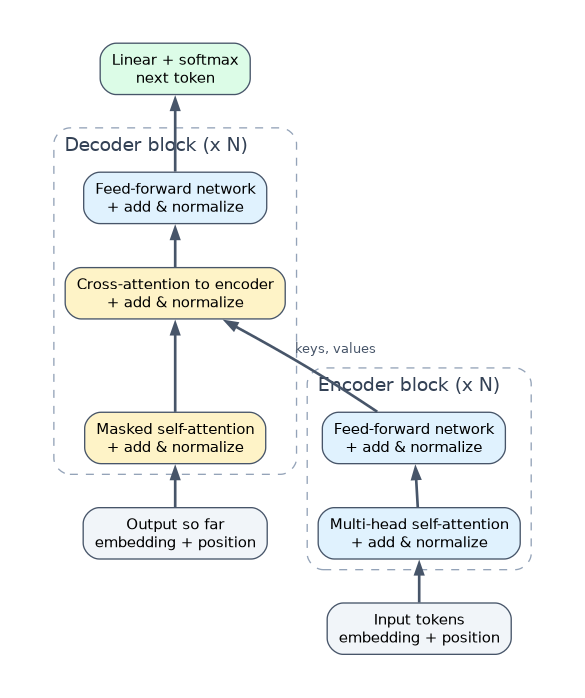
| Part | Role |
|---|---|
| Multi-head self-attention | Mixes information between tokens |
| Feed-forward network | Processes each token independently |
| Residual connection plus layer normalization | Around each sublayer; keeps deep stacks trainable |
| Masked self-attention (decoder) | Each token sees only earlier tokens, for generation |
| Cross-attention (decoder) | Decoder attends to encoder outputs |
Three model families
| Family | Example | Typical use |
|---|---|---|
| Encoder-only | BERT | Understanding: classification, entity recognition; trained by masked language modeling |
| Decoder-only | GPT series, most chat LLMs | Generation; trained to predict the next token |
| Encoder-decoder | T5, the original Transformer | Sequence to sequence, such as translation and summarization |
From pre-training to use
Pre-training is self-supervised: the labels come from the text itself, such as the next token. Fine tuning adapts the model to tasks with much less data.
| Fine tuning approach | What changes |
|---|---|
| Full fine tuning | All weights updated; highest cost |
| Parameter-efficient fine tuning (PEFT) | Only a small set of added or chosen parameters updated |
| LoRA | Freezes W and learns a low-rank update B x A, with rank r much smaller than the layer width |
Large models are often reported to show emergent abilities, and they support in-context learning: they follow examples given in the prompt without any weight change.
Infrastructure for foundation models
| Layer | What it provides |
|---|---|
| Compute | Large clusters of AI accelerators, such as GPUs or Huawei Ascend NPUs |
| Interconnect | High-bandwidth links between accelerators and servers, because parallel training exchanges huge amounts of data |
| Storage | Fast, large storage for training data and checkpoints |
| Software | Frameworks (PyTorch, MindSpore), distributed training libraries, inference engines |
| Data | Collected, cleaned and deduplicated corpora |
A model too large for one device needs distributed training.
| Parallelism | What is split |
|---|---|
| Data parallelism | Each device holds a full model copy and processes different batches; gradients are averaged |
| Tensor (model) parallelism | A single layer's matrices are split across devices |
| Pipeline parallelism | Different layers run on different devices, with micro-batches flowing through |
| Expert parallelism | Experts of an MoE model placed on different devices |
Mixed precision (FP16, BF16, even FP8) cuts memory and speeds training. For inference, quantization, distillation and the KV cache reduce cost and latency.
A worked example
A 7 billion parameter model stored in FP16 uses 2 bytes per parameter: 7 x 10^9 x 2 = 14 GB for the weights alone. Training needs far more, for gradients, optimizer states and activations, so it is spread across many devices.
With LoRA on a 4096 x 4096 weight matrix, full tuning would update 16,777,216 values. LoRA with r = 8 learns A (8 x 4096) and B (4096 x 8), which is 65,536 values, about 0.39%.
How the exam asks about this
- "Why does the Transformer train faster than an RNN?" → Self-attention processes all tokens in parallel instead of one step at a time.
- "Which model family is BERT?" → Encoder-only, pre-trained with masked language modeling.
- "In which parallelism does each device hold a full copy of the model?" → Data parallelism.
What to remember for the exam
- Attention = softmax(QK^T / sqrt(d_k)) V; self-attention cost grows with the square of sequence length.
- Multi-head attention runs several heads in parallel; positional encoding supplies word order.
- BERT is encoder-only, GPT is decoder-only, T5 is encoder-decoder.
- Pre-training is self-supervised on large unlabeled data; fine tuning adapts it; LoRA trains a small low-rank update.
- Infrastructure: accelerator clusters, fast interconnect and storage; data, tensor, pipeline and expert parallelism.
The Transformer has no built-in sense of order. Without positional encoding, "dog bites man" and "man bites dog" look the same to self-attention.
Common mistakes
Thinking pre-training needs labeled data. Pre-training is self-supervised. The text itself provides the targets, such as the next or masked token.
Confusing data and model parallelism. Data parallelism copies the whole model and splits the batches. Model (tensor or pipeline) parallelism splits the model itself.
Thinking LoRA changes the original weights during training. The base weights stay frozen. Only the small A and B matrices are trained, and they can be merged afterward.
Check yourself
Why is the dot product divided by sqrt(d_k) in attention?
Large dot products push softmax toward extreme values with tiny gradients. Scaling by sqrt(d_k) keeps the scores in a stable range.
What does masked self-attention do in a decoder?
It stops each token from attending to later tokens, so the model can only use earlier context when predicting the next token.
How many bytes do the weights of a 7 billion parameter model take in FP16?
About 14 GB, since each parameter uses 2 bytes in FP16.
Topic 3 of 3 in Basics of Deep Learning and Foundation Models
Test yourself on Basics of Deep Learning and Foundation Models
The full Huawei HCIA-AI H13-311 question bank has 600 questions, with timed practice exams and an explanation for every answer.
This study guide is independent and is not affiliated with, endorsed by, or sponsored by Huawei. Vendor names, certification names and exam codes are trademarks of their respective owners and are used for identification only.