HCP Terraform / Enterprise Operations · Topic 3 of 3
Policy as Code in a Pipeline
Terraform Professional (002): store Sentinel and OPA policies in version control, connect policy sets, set enforcement levels and handle overrides.
- 6 min
- Includes a diagram
sentinel.hclfor Sentinel andpolicies.hclfor OPA; each set uses one framework.enforcement_levelbelongs in those files;enforce_modebelongs ontfe_policy.tfe_policydefaults tosoft-mandatoryfor Sentinel.
What it is
Policy as code treats compliance rules like application code: stored in version control, reviewed through pull requests, tested, and applied automatically. In HCP Terraform and Terraform Enterprise, the rules live in policy sets, and every run in scope is checked after its plan and before its apply.
Because the check belongs to the workspace, a run cannot avoid it by starting from a different tool. VCS, CLI and API runs are all evaluated.
How it works
The pipeline
Connecting a policy set to a VCS repository is the option HashiCorp calls best for automating enforcement. You choose the framework, the policies path (the directory holding the configuration file, by default the repository root), the branch, and the scope. HCP Terraform refreshes the policy set when relevant files change.
The framework cannot be changed after the set is created. Creating and connecting sets needs the manage policies permission.
Sentinel repository layout
sentinel.hcl lists each policy, and policy files that are not listed are ignored. It must sit in the same directory as its local policy files, and each policy is a separate .sentinel file.
policy "allowed-instance-types" {
  source            = "./allowed-instance-types.sentinel"
  enforcement_level = "hard-mandatory"
}

policy "approved-modules" {
  source            = "./approved-modules.sentinel"
  enforcement_level = "soft-mandatory"
}
A policy passes when its main rule is true. Imports give it data: for example tfplan/v2 for planned values, tfconfig/v2 for configuration such as module sources, and tfrun for run details.
OPA repository layout
policies.hcl sits at the root of the policies path. It names a Rego query for each policy, and enforcement_level defaults to advisory.
policy "public_ingress" {
  query             = "data.terraform.policies.public_ingress.deny"
  enforcement_level = "mandatory"
}
The query refers to the package declared in the .rego file and to the rule name. The result must be an array, and the policy passes when the array is empty. One Rego file can hold several rules, since the query picks the rule.
Managing policies as Terraform
The automated option creates a policy set through the API or the tfe provider rather than a VCS connection.
resource "tfe_policy" "public_ingress" {
  name         = "public-ingress"
  organization = "acme"
  kind         = "opa"
  policy       = file("${path.module}/public_ingress.rego")
  query        = "data.terraform.policies.public_ingress.deny"
  enforce_mode = "mandatory"
}| Setting | Values | Where |
|---|---|---|
enforcement_level | Sentinel: advisory, soft-mandatory, hard-mandatory; OPA: advisory, mandatory | sentinel.hcl, policies.hcl |
enforce_mode | Sentinel: same three, with soft-mandatory the default; OPA: advisory, mandatory | tfe_policy |
kind | sentinel (default) or opa | tfe_policy, tfe_policy_set |
query | The OPA rule to evaluate | tfe_policy |
overridable | true or false (default) | tfe_policy_set |
On tfe_policy_set, policy_ids cannot be combined with vcs_repo, and global cannot be combined with workspace_ids.
Testing before merge
Test policy changes in the policy repository's own pipeline, before they can block anyone.
sentinel test
opa test .
Roll out a new rule at advisory first to see what would fail, then raise the level once teams have fixed their code.
What happens during a run
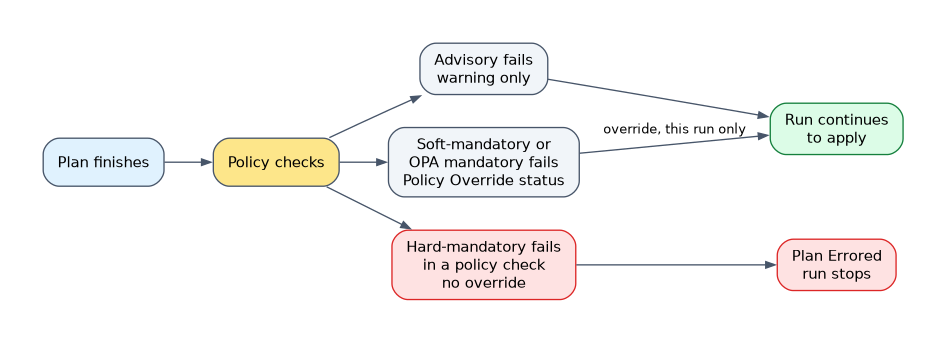
| Result | Effect | Run status |
|---|---|---|
| Sentinel or OPA advisory fails | Warning; run continues | Continues |
| Soft-mandatory fails | Stops for an override or discard | Policy Override |
| OPA mandatory fails | Stops for an override or discard | Policy Override |
| Hard-mandatory fails in a policy check | Stops; no override | Plan Errored |
A user with the manage policy overrides permission clicks Override and Continue. For soft-mandatory Sentinel policies, you can also run terraform apply and enter override at the prompt. An override covers that run only.
The CLI prints Sentinel results for CLI-driven runs but does not show OPA results, so read those in the UI. Speculative plans check Sentinel policies too, so an author can see a failure on the pull request before merging.
Two details that change the answer
A Sentinel policy set can run as a policy check or, with the agent type, as a policy evaluation. In a policy evaluation, soft-mandatory and hard-mandatory are converted to mandatory, which a user with the override permission can override when the set allows it.
That set-level option is "This policy set can be overridden in the event of mandatory failures" (overridable on tfe_policy_set). It applies to OPA sets and agent-type Sentinel sets, and it takes precedence over each policy's enforcement level.
How the exam asks about this
- "Policy changes must be reviewed like code and take effect automatically." Store them in a repository and connect a policy set to VCS.
- "An OPA policy never fails although a violation exists." Check that the
querymatches the package and rule name, and that the result is a non-empty array. - "A new Sentinel file in the repository is not being evaluated." Add it to
sentinel.hcl; unlisted files are ignored.
What to remember for the exam
sentinel.hclfor Sentinel andpolicies.hclfor OPA; each set uses one framework.enforcement_levelbelongs in those files;enforce_modebelongs ontfe_policy.tfe_policydefaults tosoft-mandatoryfor Sentinel.- An OPA policy passes when its query returns an empty array.
- Policies evaluate only after a successful plan and before apply.
- Overrides need the manage policy overrides permission and affect one run.
OPA has no hard-mandatory level. If a rule must not be bypassed, clear the policy set's override option and limit who holds the manage policy overrides permission.
Common mistakes
Mixing the argument names. Writing enforcement_level on tfe_policy or enforce_mode in sentinel.hcl is wrong. Each belongs to one place only.
Assuming hard-mandatory is always absolute. It cannot be overridden in policy checks, but agent-based policy evaluations convert it to mandatory, which can be overridden. Check the policy set type.
Forgetting the OPA query. Without a matching query, HCP Terraform is not evaluating the rule you intend. The query names the package and rule, not the file.
Check yourself
Where do you set the enforcement level for a Sentinel policy stored in a repository?
In the
policyblock ofsentinel.hcl, using theenforcement_levelargument.What must an OPA query return for the policy to pass?
An empty array, since each item in the array represents a violation found by the rule.
Can an API-driven run skip a policy set scoped to its workspace?
No. Policy sets apply to runs in their scope, so VCS, CLI and API runs are all evaluated after the plan.
Topic 3 of 3 in HCP Terraform / Enterprise Operations
Test yourself on HCP Terraform / Enterprise Operations
The full HashiCorp Terraform Infrastructure Engineer Professional question bank has 600 questions, with timed practice exams and an explanation for every answer.
This study guide is independent and is not affiliated with, endorsed by, or sponsored by HashiCorp. Vendor names, certification names and exam codes are trademarks of their respective owners and are used for identification only.