Designing and planning a cloud solution architecture · Topic 2 of 8
Technical Requirements, Availability and Recovery
The Well-Architected Framework pillars, high availability and failover, scalability, performance, backup and disaster recovery with RTO and RPO for the PCA exam.
- 4 min
- Includes a diagram
- Know the pillars: operational excellence, security, reliability, cost, performance, sustainability.
- Match redundancy to the failure the stem names: instance, zone or region.
- RTO is downtime; RPO is data loss. Backups give long RTO; replicas shorten both.
What it is
Technical requirements describe how the system must behave: how available, how fast, how far it must scale and how much data it may lose. The exam expects you to know the Google Cloud Well-Architected Framework and to turn numbers such as "99.9%" or "five minutes of data loss" into a concrete design.
How it works
The Well-Architected Framework
Google's framework groups best practices into pillars. The exam guide names them:
| Pillar | Focus |
|---|---|
| Operational excellence | Running, monitoring and improving workloads |
| Security, privacy and compliance | Protecting data and meeting rules |
| Reliability | Staying available and recovering from failure |
| Cost optimization | Spending only what delivers value |
| Performance optimization | Using resources efficiently for speed and scale |
| Sustainability | Reducing the environmental footprint |
Questions rarely name a pillar. They describe a goal ("reduce outages from manual changes") and expect the matching practice ("automate with infrastructure as code").
Failure domains and high availability
| Scope of failure | Survive it with |
|---|---|
| A single VM or pod | Managed instance groups, Kubernetes replicas, health checks |
| A zone | Regional resources: regional MIGs, regional GKE clusters, Cloud SQL high availability, regional Cloud Storage |
| A region | Resources in two regions: cross-region replicas, dual-region or multi-region storage, Spanner multi-region, a global load balancer |
Availability targets guide the scope. A single-zone design rarely meets 99.9% once maintenance and zone failures are counted. Region-level failures need a second region, which costs more, so check whether the stem asks for it.
"Survive a zone outage" means regional. "Survive a regional outage" means two regions. Do not pay for the second when only the first is asked.
Scalability and flexibility
| Need | Design choice |
|---|---|
| Unpredictable spikes | Autoscaling: MIG autoscaler, GKE cluster and pod autoscaling, Cloud Run instances |
| Fast spikes with no warm-up time | Minimum instances, pre-pulled images, keeping some capacity warm |
| Write scale beyond one server | Horizontally scaling databases such as Spanner or Bigtable |
| Read scale | Read replicas, caching with Memorystore, Cloud CDN |
Performance and latency
Latency falls when data and compute sit close to users. Use regions near users, a global external Application Load Balancer to route to the nearest healthy backend, Cloud CDN for cacheable content and in-memory caches for hot data. Check whether residency rules stop you from placing data near every user.
Backup and recovery: RTO and RPO
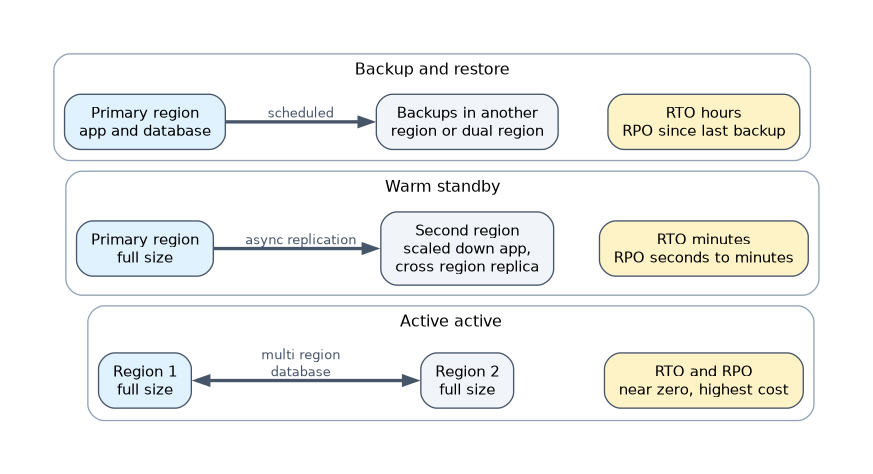
| Term | Meaning |
|---|---|
| RTO (recovery time objective) | How long the service may be down |
| RPO (recovery point objective) | How much recent data may be lost |
| Pattern | RTO / RPO | Cost |
|---|---|---|
| Backup and restore | Hours / since the last backup | Lowest |
| Pilot light / warm standby (scaled-down copy, replicated data) | Minutes / seconds to minutes | Medium |
| Active-active in two regions | Near zero / near zero | Highest |
Example: a Cloud SQL primary with a cross-region read replica plus a scaled-down GKE cluster in the second region gives minutes of RTO and small RPO without doubling the footprint. Backups alone cannot meet a 30-minute RTO for a large platform.
Gemini Cloud Assist
Gemini Cloud Assist is AI help inside the Google Cloud console. It can help design architectures, explain resources, investigate problems and suggest cost and performance improvements. Treat it as an assistant for architects and operators; it does not replace the design decisions the exam asks you to make.
How the exam asks about this
- "Recover within 30 minutes with at most five minutes of data loss, without doubling cost." Warm standby with asynchronous cross-region replication.
- "Stay available through a zone failure with no lost transactions." Synchronous zonal redundancy, such as Cloud SQL high availability.
- "Global users, low latency." Global load balancing, regional backends near users, CDN for static content.
What to remember for the exam
- Know the pillars: operational excellence, security, reliability, cost, performance, sustainability.
- Match redundancy to the failure the stem names: instance, zone or region.
- RTO is downtime; RPO is data loss. Backups give long RTO; replicas shorten both.
- Warm standby is the usual answer when cost rules out active-active.
- Autoscaling handles growth; minimum instances handle sudden spikes.
Read replicas in another region are asynchronous. They survive a regional loss but can lose the last few seconds of writes.
Common mistakes
Over-engineering. Multi-region active-active when the stem asks only for zone resilience.
Treating backups as high availability. Restores take time; they set RTO in hours.
Ignoring residency. Replicating to "the nearest region" outside the allowed geography.
Check yourself
What is the difference between RTO and RPO?
RTO is how long the service may be down; RPO is how much recent data may be lost.
Which design survives a zone failure for a MySQL database with no loss of committed transactions?
Cloud SQL for MySQL with high availability, which keeps a synchronous standby in a second zone.
Which Well-Architected pillar covers automating changes and monitoring workloads?
Operational excellence.
Topic 2 of 8 in Designing and planning a cloud solution architecture
Test yourself on Designing and planning a cloud solution architecture
The full Google Cloud Professional Cloud Architect question bank has 877 questions, with timed practice exams and an explanation for every answer.
This study guide is independent and is not affiliated with, endorsed by, or sponsored by Google Cloud. Vendor names, certification names and exam codes are trademarks of their respective owners and are used for identification only.