Fundamentals of gen AI · Topic 5 of 6
The Gen AI Landscape
The five layers of the gen AI landscape, infrastructure, models, platforms, agents and applications, their Google Cloud examples and business implications.
- 4 min
- Includes a diagram
- Five layers: infrastructure, models, platforms, agents, applications.
- Infrastructure is TPUs, GPUs and data centers; models are Gemini, Gemma, Imagen, Veo; the platform is Agent Platform.
- Agents reason and act; applications are what users touch.
What it is
The gen AI landscape can be seen as five stacked layers: infrastructure, models, platforms, agents and applications. Each layer depends on the one below it. Knowing the layers helps leaders decide where to buy, where to build, and which teams and partners they need.
How it works
The five layers
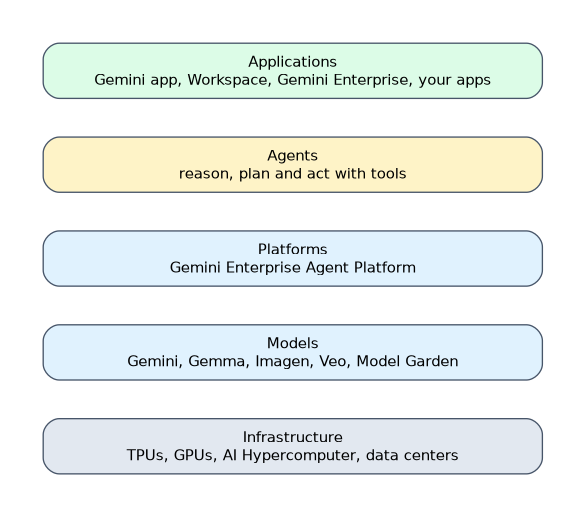
| Layer | What it is | Google Cloud examples | Who usually works here |
|---|---|---|---|
| Infrastructure | The compute, storage and networking that train and run models | TPUs, GPUs, AI Hypercomputer, Google data centers | Cloud providers, ML platform teams |
| Models | The foundation models and other ML models | Gemini, Gemma, Imagen, Veo, and third-party and open models in Model Garden | Model providers; data scientists who tune models |
| Platforms | Tools to access, customize, deploy, manage and govern models and agents | Gemini Enterprise Agent Platform | Developers, ML engineers |
| Agents | Systems that use models to reason, plan and take actions with tools | Agents built on Agent Platform; prebuilt agents in Gemini Enterprise | Developers and business teams designing workflows |
| Applications | The products end users interact with | Gemini app, Gemini for Google Workspace, Gemini Enterprise, customer-facing apps | Business users, customers |
Business implications of each layer
| Layer | Business decision | Implication |
|---|---|---|
| Infrastructure | Rarely build; consume from a cloud provider | Capital savings and access to specialized hardware |
| Models | Choose, do not train from scratch, for most needs | Model choice drives quality, cost and risk |
| Platforms | Standardize on one platform | Governance, security and reuse across teams |
| Agents | Build where processes are unique | Automation of multi-step work; needs guardrails |
| Applications | Buy for common needs, build for differentiation | Fast value from prebuilt apps; competitive edge from custom ones |
The higher the layer, the closer to business value and the faster to adopt. The lower the layer, the more control and the more expertise required.
Buy, build or both
Most organizations combine layers:
- Buy at the top for common productivity needs, such as Gemini for Google Workspace.
- Build in the middle where they have unique data and processes, using a platform and models to create custom agents and apps.
- Rely on the provider at the bottom for infrastructure.
Google offers every layer, which the exam presents as a strength: the layers are designed to work together, with consistent security and governance.
A worked scenario
A bank gives all employees Gemini for Google Workspace (application) to draft emails and summarize documents. Its developers use Gemini Enterprise Agent Platform (platform) with Gemini (model) to build a mortgage agent that gathers documents, checks them and updates the loan system. Everything runs on Google's TPUs and GPUs (infrastructure) without the bank buying hardware.
How the exam asks about this
- A product is named and you identify its layer (Gemini is a model; Agent Platform is a platform; Workspace with Gemini is an application).
- "Which layer takes actions using tools?" Agents.
- "Where should a company with no ML team start?" The application layer, with prebuilt solutions.
What to remember for the exam
- Five layers: infrastructure, models, platforms, agents, applications.
- Infrastructure is TPUs, GPUs and data centers; models are Gemini, Gemma, Imagen, Veo; the platform is Agent Platform.
- Agents reason and act; applications are what users touch.
- Higher layers deliver value fastest; lower layers give control but need expertise.
Do not confuse agents with applications. An application is the user-facing product; an agent is the component that plans and takes actions, which may sit inside an application.
Common mistakes
Calling Gemini a platform. Gemini is a family of models; Agent Platform is the platform.
Trying to build every layer. Most organizations buy infrastructure and many applications.
Ignoring governance at the platform layer. That is where security and reuse are controlled.
Check yourself
Name the five layers of the gen AI landscape.
Infrastructure, models, platforms, agents and applications.
Which layer does Gemini Enterprise Agent Platform belong to?
The platform layer.
Which layer is closest to end users?
The application layer.
Topic 5 of 6 in Fundamentals of gen AI
Test yourself on Fundamentals of gen AI
The full Google Cloud Generative AI Leader question bank has 512 questions, with timed practice exams and an explanation for every answer.
This study guide is independent and is not affiliated with, endorsed by, or sponsored by Google Cloud. Vendor names, certification names and exam codes are trademarks of their respective owners and are used for identification only.