Fundamentals of gen AI · Topic 6 of 6
Google's Foundation Models
Use cases and strengths of Google's foundation models for the Generative AI Leader exam: Gemini, the open Gemma models, Imagen for images and Veo for video.
- 4 min
- Includes a diagram
- Gemini: Google's most capable multimodal models, in several sizes (Pro, Flash, Nano).
- Gemma: lightweight open models for self-hosting and fine-tuning.
- Imagen: text-to-image. Veo: video generation.
What it is
Google builds several families of foundation models. The exam names four: Gemini (Google's most capable multimodal models), Gemma (lightweight open models), Imagen (image generation) and Veo (video generation). You need to match each to the use cases it suits.
How it works
The four model families
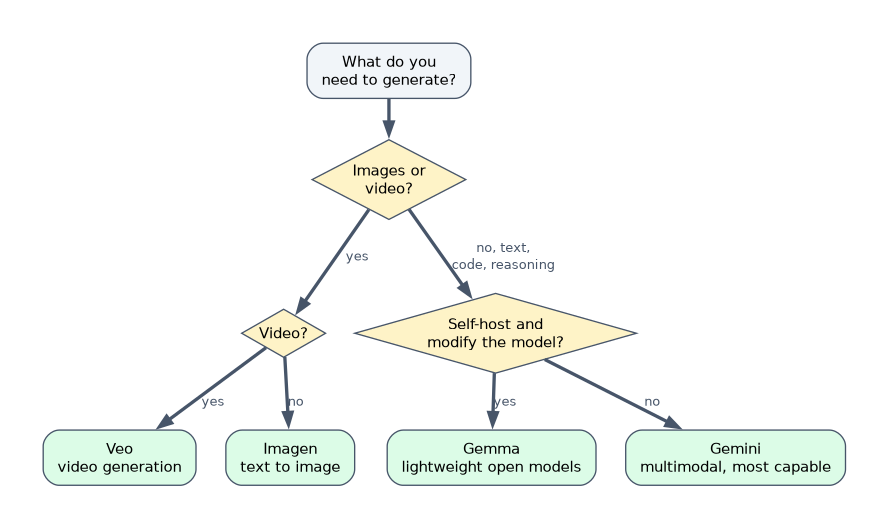
| Model | What it is | Strengths | Example use cases |
|---|---|---|---|
| Gemini | Google's family of multimodal foundation models | Understands and reasons across text, code, images, audio and video; long context; strong reasoning | Assistants, summarizing long documents, analyzing images and video, code generation, agents |
| Gemma | A family of lightweight open models built from the same research as Gemini | Open weights you can download, run in your own environment and fine-tune; smaller and cheaper to run | On-premises or edge deployments, specialized tuned models, research, strict data control |
| Imagen | Google's text-to-image model family | High-quality images from text prompts; image editing | Marketing visuals, product mockups, creative content |
| Veo | Google's video generation model family | Generates video from text or image prompts | Advertising clips, training and explainer videos, storyboards |
"Open model we can host and modify ourselves" is Gemma. "Most capable, multimodal, managed by Google" is Gemini.
Gemini in more detail
Gemini is offered in different sizes so organizations can trade capability against speed and cost. Larger versions (such as Pro) suit complex reasoning; faster, lower-cost versions (such as Flash) suit high-volume tasks; very small versions (such as Nano) are designed to run on devices. Gemini powers many Google products, including the Gemini app, Gemini for Google Workspace and Gemini Enterprise, and is available to developers through Gemini Enterprise Agent Platform.
Being natively multimodal means a single Gemini model can, for example, watch a product video, read its manual and answer a question that needs both.
Gemma in more detail
Gemma's value is openness and control. Because the weights are available, an organization can run Gemma on its own infrastructure, keep data fully in-house, and fine-tune it for a narrow task. The tradeoff is that the organization takes on hosting and operating the model, and smaller open models are generally less capable than the largest Gemini models.
Imagen and Veo for content
Imagen and Veo let marketing and creative teams produce visual content faster and test more ideas. Business considerations include brand consistency, review before publishing, and responsible use: Google applies safety filters and uses SynthID, a digital watermark embedded in AI-generated content, to help identify images and video created by its models.
Where to find them
On Google Cloud, these models are available through Model Garden in Gemini Enterprise Agent Platform, alongside partner and open models from other providers. That gives organizations choice: they can pick the right model for each task and switch as needs change.
A worked scenario
A travel company uses Gemini for a booking assistant that reads uploaded passport photos and answers itinerary questions, Imagen to create destination banners, and Veo to produce short promotional clips. Its data science team fine-tunes Gemma on its own servers to classify sensitive customer complaints without that data leaving its environment.
How the exam asks about this
- A use case is described and you choose the model family.
- "Which model can be downloaded and run on our own infrastructure?" Gemma.
- "Which model generates video?" Veo. "Which generates images?" Imagen.
- "Which model reasons across text, images, audio and video?" Gemini.
What to remember for the exam
- Gemini: Google's most capable multimodal models, in several sizes (Pro, Flash, Nano).
- Gemma: lightweight open models for self-hosting and fine-tuning.
- Imagen: text-to-image. Veo: video generation.
- All are available through Model Garden on Gemini Enterprise Agent Platform.
Gemma is not a smaller Gemini service in the cloud. It is an open model family you can run and modify yourself.
Common mistakes
Choosing Imagen for video. Veo generates video.
Picking Gemini when the requirement is to self-host an open model. That is Gemma.
Assuming one model size fits all. Gemini sizes trade capability for speed and cost.
Check yourself
Which Google model family is open and can be fine-tuned and run in your own environment?
Gemma.
Which model family generates video?
Veo.
What makes Gemini natively multimodal?
A single model understands and reasons across text, code, images, audio and video.
Topic 6 of 6 in Fundamentals of gen AI
Test yourself on Fundamentals of gen AI
The full Google Cloud Generative AI Leader question bank has 512 questions, with timed practice exams and an explanation for every answer.
This study guide is independent and is not affiliated with, endorsed by, or sponsored by Google Cloud. Vendor names, certification names and exam codes are trademarks of their respective owners and are used for identification only.