Exploring Data Transformation with Google Cloud · Topic 3 of 5
Choosing a Google Cloud Data Product
Match Cloud Storage, Cloud SQL, AlloyDB, Spanner, Bigtable, Firestore and BigQuery to business use cases, with relational, NoSQL and object storage terms.
- 4 min
- Includes a diagram
- Cloud Storage: objects and files.
- Cloud SQL: MySQL, PostgreSQL, SQL Server, managed.
- AlloyDB: high performance PostgreSQL compatible.
What it is
Google Cloud offers several data management products, each built for a different kind of data and workload. The exam gives a business use case and asks which product fits. To answer, you need a few key terms (relational, non-relational, object storage, SQL, NoSQL) and a clear picture of each product.
How it works
Key terms
| Term | Meaning |
|---|---|
| Relational database | Data in tables with rows and columns, linked by keys, with a fixed schema. Strong consistency for transactions |
| Structured query language (SQL) | The standard language to query and change relational data |
| Non-relational (NoSQL) database | Stores data in other models such as documents, key value pairs or wide columns; flexible schema and easy horizontal scaling |
| Object storage | Stores files as objects (data plus metadata) in buckets, accessed by name; ideal for unstructured data at any scale |
The products
| Product | Type | Best for | Example use case |
|---|---|---|---|
| Cloud Storage | Object storage | Unstructured data: images, video, backups, data lake files | Store product photos and nightly backups |
| Cloud SQL | Managed relational (MySQL, PostgreSQL, SQL Server) | Standard transactional apps with familiar engines | Move an existing MySQL app to the cloud |
| AlloyDB | Managed relational, PostgreSQL compatible | Demanding PostgreSQL workloads that need high performance, including analytics on live data | Modernize a busy PostgreSQL ordering system |
| Spanner | Managed relational, globally distributed | Relational data at very large or global scale with strong consistency and high availability | A global banking or gaming ledger used in many regions |
| Bigtable | NoSQL wide column | Very large volumes of data read and written at low latency | Time series from IoT sensors, ad tech, personalization |
| Firestore | NoSQL document database | Mobile and web apps with flexible data and real-time sync | A chat or to-do app that syncs across devices |
| BigQuery | Serverless data warehouse | Analytics with SQL over very large datasets | Analyze years of sales data for trends |
Spanner is the answer when a question needs relational, strongly consistent and global scale together. Cloud SQL is the answer for a standard database lift with a familiar engine.
Choosing quickly
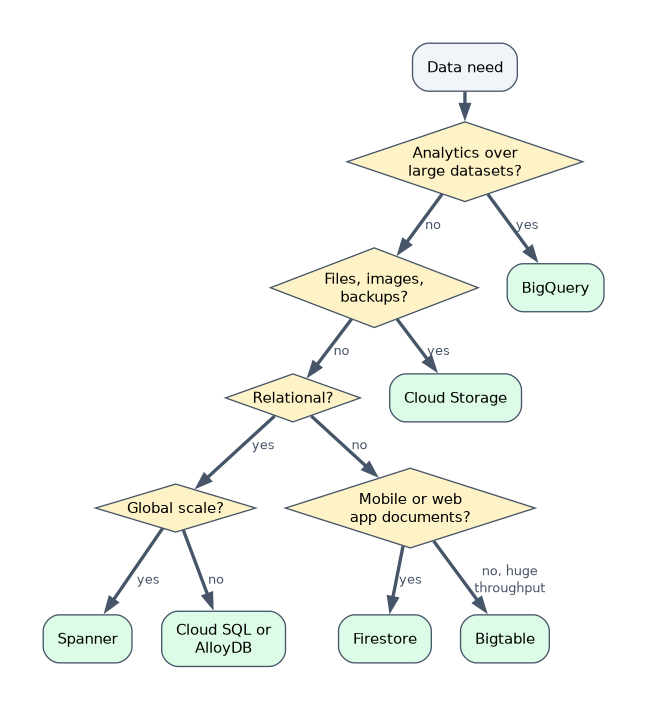 Ask three questions in order:
- Is it analytics or running an application? Analytics points to BigQuery.
- Is it files or records? Files, images, video and backups point to Cloud Storage.
- Relational or not?
- Relational with standard engines: Cloud SQL.
- Relational, PostgreSQL, high performance: AlloyDB.
- Relational at global scale: Spanner.
- Non-relational, huge throughput, low latency: Bigtable.
- Non-relational documents for mobile and web apps: Firestore.
Managed services
All of these are managed services: Google handles hardware, patching, backups (configurable) and much of the scaling. That is a core business value: database administrators spend less time on maintenance and more on data design and performance.
A worked scenario
A sports company has four needs. It stores match videos (Cloud Storage), runs its ticketing system on PostgreSQL that needs higher performance (AlloyDB), collects player tracking data from sensors at very high volume (Bigtable) and analyzes ticket sales across seasons (BigQuery). Its fan mobile app stores user profiles and syncs them in real time (Firestore).
How the exam asks about this
- "A global application needs a relational database with strong consistency across regions." Spanner.
- "An existing SQL Server application should move with minimal change." Cloud SQL.
- "Store petabytes of sensor readings with fast reads." Bigtable.
- "Serverless analytics over large datasets with SQL." BigQuery.
- "Store images and backups cheaply." Cloud Storage.
What to remember for the exam
- Cloud Storage: objects and files.
- Cloud SQL: MySQL, PostgreSQL, SQL Server, managed.
- AlloyDB: high performance PostgreSQL compatible.
- Spanner: relational and globally scalable with strong consistency.
- Bigtable: NoSQL wide column for huge, low latency workloads.
- Firestore: NoSQL documents for mobile and web apps.
- BigQuery: serverless data warehouse for analytics.
BigQuery is not a transactional database for an application's day-to-day writes. Choose it for analysis.
Common mistakes
Picking Bigtable for relational data. Bigtable is NoSQL; relational needs Cloud SQL, AlloyDB or Spanner.
Picking Spanner for a small, single region app. Cloud SQL is simpler for standard workloads.
Storing video in a database. Use Cloud Storage for large files.
Check yourself
Which product is a NoSQL document database for mobile and web apps?
Firestore.
Which relational database scales globally with strong consistency?
Spanner.
Which product should store images, video and backups?
Cloud Storage.
Topic 3 of 5 in Exploring Data Transformation with Google Cloud
Test yourself on Exploring Data Transformation with Google Cloud
The full Google Cloud Digital Leader question bank has 512 questions, with timed practice exams and an explanation for every answer.
This study guide is independent and is not affiliated with, endorsed by, or sponsored by Google Cloud. Vendor names, certification names and exam codes are trademarks of their respective owners and are used for identification only.