Digital Transformation with Google Cloud · Topic 3 of 4
Cloud Architectures and Service Models
Private cloud, hybrid cloud and multicloud use cases, plus the benefits and tradeoffs of IaaS, PaaS and SaaS, explained for the Cloud Digital Leader exam.
- 4 min
- Includes a diagram
- Private: one organization. Hybrid: on premises plus public cloud. Multicloud: several public clouds.
- IaaS gives most control and most management work; SaaS gives least of both.
- PaaS lets developers focus on code and data.
What it is
A cloud architecture describes where an organization's workloads run: in its own private cloud, in a public cloud, in a mix of on premises and cloud (hybrid), or across more than one public cloud (multicloud). A service model describes how much of the stack the provider manages: IaaS, PaaS or SaaS.
The exam gives a business situation and asks which architecture or service model fits, and what you gain or give up.
How it works
Cloud architectures
| Architecture | What it is | Typical business reason |
|---|---|---|
| Public cloud | Shared provider infrastructure, rented on demand | Speed, scale and paying only for use |
| Private cloud | Cloud-style infrastructure used by one organization, often in its own data center | Strict control, specific regulation, or existing investment |
| Hybrid cloud | On premises (or private cloud) and public cloud working together | Keep some systems or data on premises while using cloud for the rest, or move in stages |
| Multicloud | Using more than one public cloud provider | Pick the best service from each, meet regional needs, reduce dependence on one vendor |
Hybrid and multicloud are common, not unusual. Many organizations keep a regulated database on premises (hybrid) or arrive at multicloud through acquisitions. Google Cloud supports both with products such as GKE Enterprise, BigQuery Omni, AlloyDB Omni and Looker.
Hybrid always involves on premises (or a private cloud) plus public cloud. Multicloud means two or more public clouds. A company can be both.
Service models
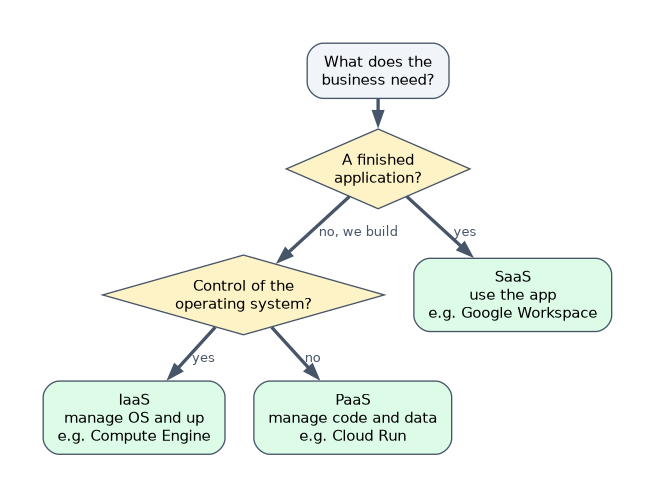 The models differ in who manages what. The more the provider manages, the less operational work you do, and the less control you have.
| Layer | On premises | IaaS | PaaS | SaaS |
|---|---|---|---|---|
| Application | You | You | You | Provider |
| Data | You | You | You | You (your content) |
| Runtime and middleware | You | You | Provider | Provider |
| Operating system | You | You | Provider | Provider |
| Virtualization, servers, storage, network | You | Provider | Provider | Provider |
Benefits and tradeoffs
| Model | Benefits | Tradeoffs | Google Cloud example |
|---|---|---|---|
| IaaS | Most control and flexibility; familiar for lift and shift | You patch and run the operating system and software | Compute Engine virtual machines |
| PaaS | No servers or OS to manage; developers focus on code | Less control; you work within the platform's options | Cloud Run, App Engine |
| SaaS | Ready to use; no development or infrastructure work | Least control and customization | Google Workspace (Gmail, Docs) |
A useful way to remember it: IaaS rents you the building blocks, PaaS rents you a platform to build on, and SaaS rents you the finished product.
Shared responsibility
In every model the provider secures the physical infrastructure, and the customer always remains responsible for its data and for who has access. As you move from IaaS toward SaaS, the provider takes on more of the rest. This idea comes back in the security section.
A worked scenario
A bank must keep its core transaction database in its own data center for regulatory reasons but wants to run its new mobile app backend in Google Cloud. That is a hybrid cloud. For the app backend, the developers do not want to manage servers, so a PaaS such as Cloud Run fits. For email and documents the bank adopts Google Workspace, which is SaaS.
How the exam asks about this
- "The organization must keep some data on premises but use cloud for new applications." Hybrid cloud.
- "The organization uses two public cloud providers." Multicloud.
- "Developers want to deploy code without managing servers." PaaS (or serverless).
- "The company needs full control of the operating system." IaaS.
- "Staff need an email application with no management." SaaS.
What to remember for the exam
- Private: one organization. Hybrid: on premises plus public cloud. Multicloud: several public clouds.
- IaaS gives most control and most management work; SaaS gives least of both.
- PaaS lets developers focus on code and data.
- The customer always owns its data and access decisions.
- Google examples: Compute Engine (IaaS), Cloud Run and App Engine (PaaS), Google Workspace (SaaS).
Do not equate PaaS with "no responsibility". You still own your code, data and access settings.
Common mistakes
Calling any mix of clouds "hybrid". Two public clouds without on premises is multicloud.
Choosing SaaS when the company needs to build its own app. SaaS is a finished application; building needs IaaS or PaaS.
Assuming IaaS is always cheaper. It can cost more in staff time because you manage more.
Check yourself
A company runs workloads on Google Cloud and another public cloud, with nothing on premises. What architecture is this?
Multicloud.
Which service model gives the most control over the operating system?
Infrastructure as a Service (IaaS), such as Compute Engine.
What does the customer remain responsible for in every service model?
Its own data and who is allowed to access it.
Topic 3 of 4 in Digital Transformation with Google Cloud
Test yourself on Digital Transformation with Google Cloud
The full Google Cloud Digital Leader question bank has 512 questions, with timed practice exams and an explanation for every answer.
This study guide is independent and is not affiliated with, endorsed by, or sponsored by Google Cloud. Vendor names, certification names and exam codes are trademarks of their respective owners and are used for identification only.