Multi-Agent and Long-Horizon Task Design · Topic 1 of 2
Shared Context and Dispatch in Multi-Agent Systems
Context Engineer exam: diagnose multi-agent failures from missing shared context, fix dispatch with a compressed trace summary and propagate decisions.
- 6 min
- Includes a diagram
- Sub-agents see only their dispatch; missing shared context causes inconsistency, conflicts and unreliable results.
- The named root cause is task messages without the coordinator's trace at dispatch time.
- The fix within the window constraint is a compressed trace summary, not the full raw trace.
What it is
In a multi-agent system, a coordinating agent splits a task and dispatches sub-agents, each with its own context window. That isolation is the point: each sub-agent works in a clean window focused on its subtask.
The cost is that a sub-agent knows only what it was sent. If the dispatch carries just the subtask and not the decisions, constraints and updated facts the coordinator holds, sub-agents work from different or outdated assumptions.
How it works
Failure modes caused by insufficient shared context
| Failure mode | What you see | Typical missing context |
|---|---|---|
| Inconsistent outputs | Sub-agents use different units, date ranges, definitions or formats | Shared conventions and definitions |
| Conflicting decisions | Two sub-agents choose incompatible options for the same system | Each other's decisions, or the coordinator's chosen direction |
| Degraded reliability | Results vary from run to run or ignore an update | The coordinator's current understanding of the task |
All three have the same root: each sub-agent is right about its own context, but the contexts differ.
Task messages versus the coordinator's trace
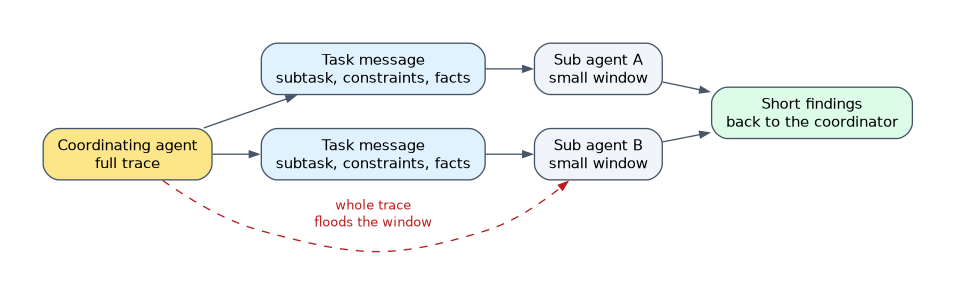 The exam's named root cause is that sub-agents receive individual task messages rather than the agent trace at dispatch time. The coordinator may have read new data, settled a design choice or learned a user constraint, and none of that reaches the sub-agent.
Pasting the full raw trace into every dispatch would fix visibility but expand each sub-agent's window and bring in context confusion from irrelevant steps. The fix that meets the constraint is a compressed trace summary attached to each dispatch.
| Dispatch option | Shared context | Sub-agent window |
|---|---|---|
| Task message only | Missing | Small |
| Task message plus full raw trace | Complete | Large, noisy |
| Task message plus compressed trace summary | The decisions, constraints and current facts that matter | Small |
A good summary carries the overall goal, decisions made so far, user constraints, the current figures or versions, and how the result should be returned.
A worked number: the coordinator's trace is 60,000 tokens and five sub-agents run. Full traces add 300,000 input tokens per round, while a 1,500 token summary adds 7,500 and keeps each window close to its original size.
Telling a dispatch gap from a data problem
Missing shared context is not the only reason sub-agents use stale figures.
| Evidence | Likely cause | Fix |
|---|---|---|
| Coordinator knows the update; sub-agents never received it in the dispatch | Dispatch carries task messages only | Attach a compressed trace summary |
| Sub-agents retrieve old documents from a TRIGGERED Databricks AI Search index | Index not synced after the source table changed | Sync the index after the update |
| Sub-agents query a table that no longer gets updates | Data source configuration | Point the tool at the current table |
MLflow 3 tracing shows what each sub-agent received and retrieved, which separates these cases quickly.
Context propagation changes that prevent conflicts
When two sub-agents produce conflicting outputs, the fix is to make the deciding context shared rather than private.
| Situation | Propagation change |
|---|---|
| Both sub-agents make the same kind of decision independently | Decide once in the coordinator and send that decision to both |
| Agent B depends on what agent A chose | Run A first and pass A's decision into B's dispatch |
| Many agents need the same, changing facts | Keep them in one shared store, such as a Lakebase or Delta table, that every agent reads |
| Conventions differ across outputs | Put units, definitions and output schema in every dispatch |
How the exam asks about this
- "Sub-agents retrieve current data but ignore a scope change the coordinator settled earlier, and their dispatch messages hold only the subtask." The dispatch carries task messages only; attach a compressed trace summary. If the retrieved context itself is stale, sync the index instead.
- "Two sub-agents pick different data retention rules for the same pipeline." Decide once in the coordinator, or sequence the agents and propagate the first decision.
- "Resolve the failure without expanding each sub-agent's context window." Choose the summary, not the full trace or a larger model.
What to remember for the exam
- Sub-agents see only their dispatch; missing shared context causes inconsistency, conflicts and unreliable results.
- The named root cause is task messages without the coordinator's trace at dispatch time.
- The fix within the window constraint is a compressed trace summary, not the full raw trace.
- Before blaming the dispatch, rule out a stale index or a wrong data source with MLflow traces.
- Prevent conflicts by deciding shared choices once and propagating them, or by a shared store every agent reads.
- Put shared conventions, such as units and output schema, in every dispatch.
"Send the full agent trace to every sub-agent" sounds like the direct fix for missing context. It expands every window, raises cost and adds irrelevant steps, so it fails the usual "without expanding the context window" constraint.
Common mistakes
Blaming the model. When sub-agents disagree, a stronger model looks like a fix. It cannot reconcile facts it never received, so the change belongs in what is sent, not who receives it.
Treating every stale answer as a dispatch problem. If the coordinator never saw the update either, or sub-agents retrieve from an unsynced index, a trace summary changes nothing. Find the source of the stale value first.
Letting each sub-agent decide shared questions. Independent decisions on the same question will eventually disagree. Shared decisions belong in one place and travel to every agent that needs them.
Check yourself
Which three failure modes point to insufficient shared context?
Inconsistent outputs, conflicting decisions and degraded reliability, all caused by sub-agents working from different or outdated context.
How do you give sub-agents the coordinator's current understanding without enlarging their windows?
Attach a compressed summary of the coordinator's trace, with decisions, constraints and current facts, to each dispatched task message.
Two sub-agents choose incompatible schemas for the same table; what propagation change helps?
Make the schema decision once, in the coordinator or the first agent, and pass it into every dependent dispatch so all agents work from the same choice.
Topic 1 of 2 in Multi-Agent and Long-Horizon Task Design
Test yourself on Multi-Agent and Long-Horizon Task Design
The full Databricks Context Engineer Associate question bank has 600 questions, with timed practice exams and an explanation for every answer.
This study guide is independent and is not affiliated with, endorsed by, or sponsored by Databricks. Vendor names, certification names and exam codes are trademarks of their respective owners and are used for identification only.