Security Architecture · Topic 10 of 12
Zero Trust Architecture
Apply Zero Trust principles with policy decision and enforcement points, microsegmentation, ZTNA, device posture, continuous checks and phased adoption.
- 5 min
- Includes a diagram
- Zero Trust removes implicit trust based on network location.
- Every request is authenticated, authorized and evaluated against current context.
- The policy engine and policy administrator form the policy decision point, and the enforcement point applies the decision.
What it is
Zero Trust is a security model that gives no implicit trust to a user, device or network location. Every request is verified and authorized, and access is limited to what is needed. The slogan is never trust, always verify.
It assumes that attackers may already be inside, so a position on the corporate network earns no special rights. The model is described in National Institute of Standards and Technology (NIST) Special Publication 800-207, and exam questions test the ideas more than the product names.
How it works
Core principles
- Verify explicitly: authenticate and authorize using all available data, such as identity, device health, location and behavior.
- Least privilege: grant minimum access, often just in time, per session.
- Assume breach: design to contain an intruder through segmentation and monitoring.
- Treat every resource as needing protection, whatever its network location.
- Continuous evaluation: trust is recalculated during a session, not given once at login.
Logical components
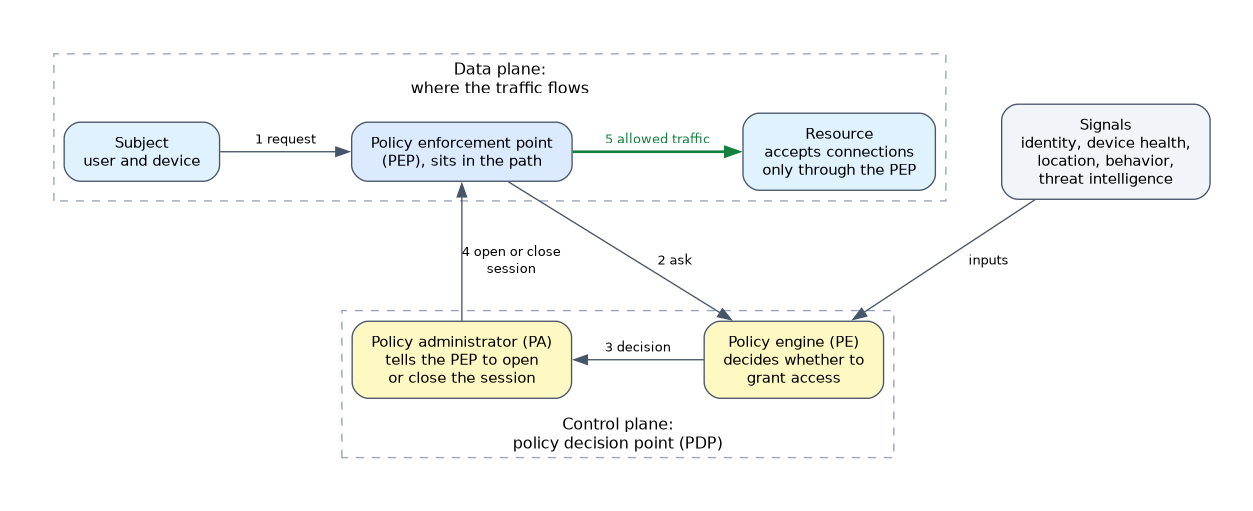
| Component | Role |
|---|---|
| Policy engine (PE) | Decides whether to grant access, using policy and signals |
| Policy administrator (PA) | Tells the enforcement point to open or close the session |
| Policy enforcement point (PEP) | Sits in the path and allows or blocks the connection |
| Policy decision point (PDP) | The combination of policy engine and policy administrator |
| Control plane | Where decisions are made |
| Data plane | Where the actual traffic flows |
The resource accepts connections only through the enforcement point. Separating the control plane from the data plane lets policy change quickly without rebuilding the network.
Signals the decision uses
Signals include user identity and strength of authentication, device identity and health (patch level, encryption, endpoint protection), the sensitivity of the resource, time, location, threat intelligence and behavior analytics. Feeding in more signals gives better decisions, but needs reliable inventories and integrations.
Zero Trust network access and microsegmentation
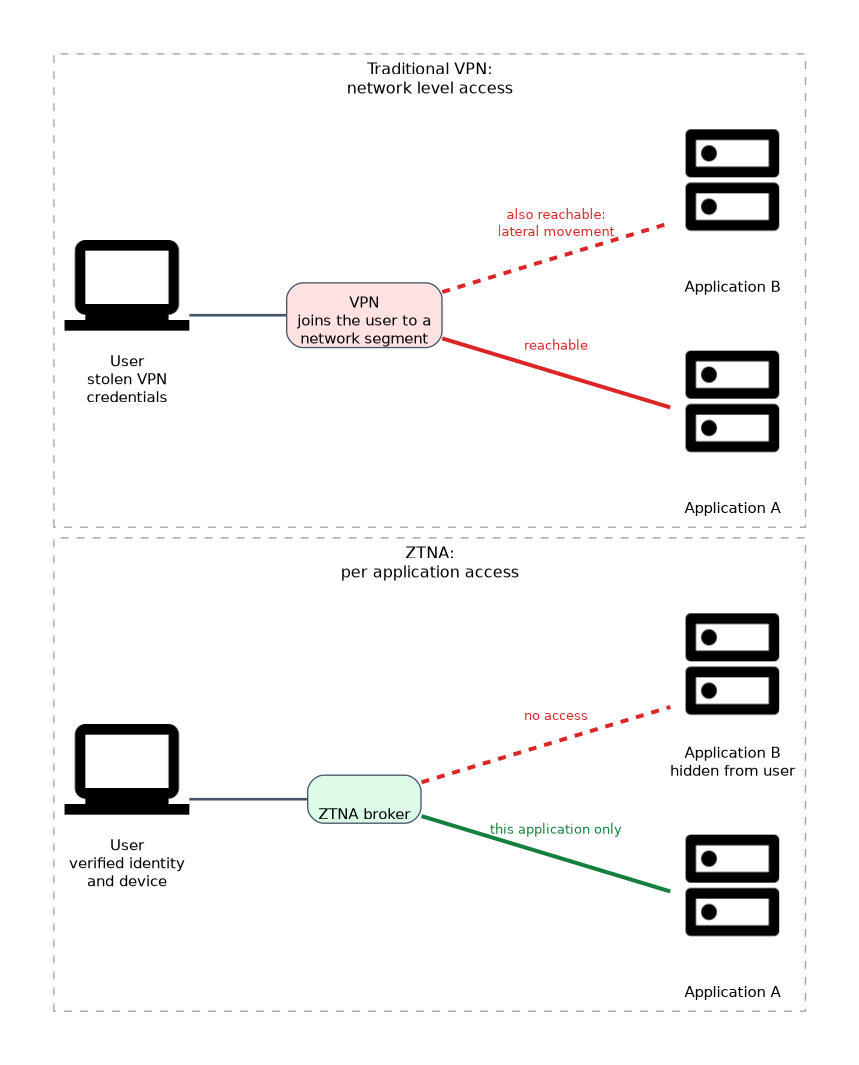 Zero trust network access (ZTNA) gives a user access to a specific application after verification, without placing them on the whole network. A traditional virtual private network (VPN) usually joins the user to a network segment, which allows broad lateral movement. ZTNA hides applications from unauthorized users, so they cannot even scan them.
Microsegmentation divides the network into very small zones, down to the workload, with policy on traffic between them. It limits east west movement if one workload is compromised.
Pillars and visibility
A common maturity model organizes Zero Trust into identity, devices, networks, applications and workloads, and data. Visibility and analytics, automation and orchestration, and governance support all of them. Moving from traditional toward optimal means more automation, more contextual policy and less standing trust.
Zero Trust in practice
- Identity: strong multi factor authentication (MFA), conditional access, least privilege and just in time elevation.
- Device: managed or attested devices, with posture checks before access.
- Network: encrypt traffic internally, segment and microsegment.
- Application: per application authorization and an identity aware proxy in front of applications.
- Data: classify, encrypt and apply access policy based on sensitivity.
- Monitoring: log all decisions and feed analytics to detect anomalies.
Adoption and trade offs
Adoption is a journey. Start by inventorying users, devices, applications and data flows, then protect the most critical assets first, and expand in phases. Challenges include legacy systems that cannot support modern authentication, user friction from frequent prompts, and the cost of integrating many data sources.
The policy decision point becomes critical infrastructure. It must be highly available, because a failure either blocks everyone or, if it fails open, removes protection.
What to remember for the exam
- Zero Trust removes implicit trust based on network location.
- Every request is authenticated, authorized and evaluated against current context.
- The policy engine and policy administrator form the policy decision point, and the enforcement point applies the decision.
- The control plane makes decisions and the data plane carries traffic.
- ZTNA grants per application access, whereas a VPN usually grants network level access.
- Microsegmentation limits lateral movement between workloads.
- Device posture, identity strength and behavior all feed access decisions.
- Adoption is phased and starts with critical assets, and legacy systems are a major obstacle.
When a scenario asks how to stop an attacker who stole VPN credentials from reaching every server, choose per application access with device checks, such as ZTNA.
Common mistakes
Treating Zero Trust as a product. It is an architecture and strategy, supported by many tools.
Assuming MFA alone is Zero Trust. Strong authentication is needed, but devices, segmentation, least privilege and continuous monitoring are also required.
Trusting the internal network. An internal address earns no trust, and internal traffic should still be authenticated and encrypted.
Forgetting availability. The decision point is a dependency for access, so design it for resilience.
Do not choose a perimeter firewall upgrade as the answer to a Zero Trust question. The focus is identity, device, and per request decisions.
Check yourself
Work through these three questions.
What makes up the policy decision point?
The policy engine, which decides, and the policy administrator, which instructs the enforcement point.
How does ZTNA differ from a traditional VPN?
ZTNA grants access to specific applications after verification, while a VPN usually places the user on a network segment.
Why is Zero Trust phased in over time?
It needs inventories, integrations and policy tuning, and legacy systems and user friction slow a full change.
Topic 10 of 12 in Security Architecture
Test yourself on Security Architecture
The full CompTIA SecurityX CAS-005 question bank has 654 questions, with timed practice exams and an explanation for every answer.
This study guide is independent and is not affiliated with, endorsed by, or sponsored by CompTIA. Vendor names, certification names and exam codes are trademarks of their respective owners and are used for identification only.