Governance, Risk, and Compliance · Topic 4 of 7
Business Impact and Third Party Risk
Use business impact analysis with MTD, RTO, RPO, MTBF and MTTR, and manage vendor and supply chain risk with due diligence, contracts, SLAs and SOC 2.
- 6 min
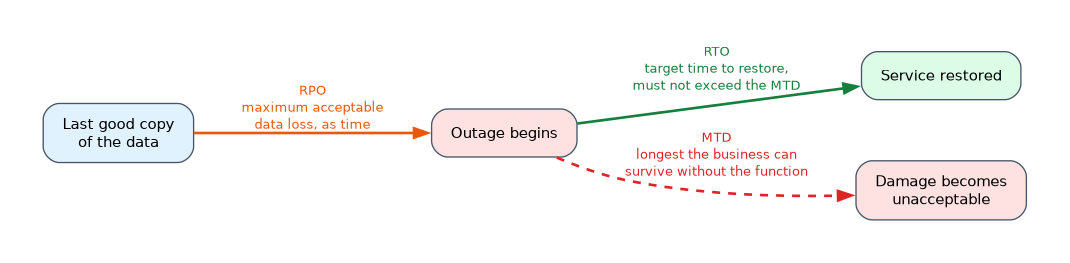
- Includes a diagram
- The RTO must be less than or equal to the MTD, and the RPO sets how much data you can lose.
- A shorter RTO or RPO means higher cost and more redundancy.
- MTBF measures reliability between failures, while MTTR measures how quickly you repair.
What it is
A business impact analysis (BIA) finds which business functions matter most and what an outage costs over time. It turns vague worry into recovery targets that drive architecture and budget.
Third party risk covers the exposure that comes from vendors, cloud providers, partners and software suppliers. You cannot outsource accountability, so these relationships need the same discipline as internal systems.
How it works
Business impact analysis
A BIA lists critical processes, the systems and people they depend on, and the damage as downtime grows. Impact is not only financial.
It can be safety, legal penalties, lost customers or reputation. The output ranks processes so that the most critical ones get the fastest recovery.
Recovery and reliability metrics
| Metric | Meaning |
|---|---|
| Maximum tolerable downtime (MTD) | The longest the business can survive without the function before damage becomes unacceptable |
| Recovery time objective (RTO) | The target time to restore the function, which must not exceed the MTD |
| Recovery point objective (RPO) | The maximum acceptable data loss, measured as time back to the last good copy |
| Mean time between failures (MTBF) | Average operating time between failures of a repairable item |
| Mean time to repair (MTTR) | Average time to fix and restore a failed item |
An RPO of one hour means backups or replication must capture data at least hourly. A shorter RTO or RPO costs more, so the BIA justifies the spend. Higher MTBF and lower MTTR both raise availability.
The business continuity plan (BCP) keeps critical operations running during a disruption. The disaster recovery plan (DRP) restores technology after it. The next chapter shows how backups and recovery sites meet these targets.
Third party risk
Vendors fail in ways your own team cannot see. A breach at a supplier can expose your data, and a failure at a cloud provider can stop your service.
Typical controls include the following.
- Due diligence before signing: security questionnaires, review of independent assurance reports, financial health and reference checks.
- Contract terms: security requirements, breach notification timelines, a right to audit, data handling and return, and subcontractor rules.
- Service level agreement (SLA): measurable targets such as availability and response time, with remedies if missed.
- Ongoing monitoring: periodic reassessment, since a vendor that passed last year may not today.
- Exit planning: how to retrieve and delete data and move to another supplier.
Independent assurance helps. A System and Organization Controls (SOC) 2 report is an auditor's opinion on a service provider's controls. A Type I report covers design at a point in time, while a Type II report tests operation over a period, so Type II gives stronger evidence.
Supply chain and concentration risk
The supply chain includes hardware, software components, service providers and their own suppliers (fourth parties). Dependency management means knowing what you rely on, directly and indirectly. Concentration risk appears when many critical services depend on one provider, region or component, so one failure hits everything.
Mitigations include a second source, multi region design, escrow arrangements for critical software, and contract clauses that flow security duties down to subcontractors.
Risk monitoring and reporting
Risk work does not end at treatment. Key risk indicators, audit results and incident trends are reported to management on a schedule, with clear ownership and trends rather than raw counts. Reports should tie risk to business terms so leaders can choose treatments.
Crisis management
A crisis is a serious event that threatens the whole organization, such as a major breach or a prolonged outage, and it needs business decisions as well as technical work. A crisis team of senior leaders, with named alternates and clear decision authority, decides on spending, shutting services down, and notifying others.
A communications plan sets who speaks to staff, customers, media and regulators, with one approved spokesperson and prepared holding statements. Silence or conflicting messages do more damage than the incident itself.
The team coordinates the other plans. Incident response handles the technical fight, the business continuity plan keeps critical functions running, and the disaster recovery plan restores systems. Practice the roles in tabletop exercises before they are needed.
What to remember for the exam
- The RTO must be less than or equal to the MTD, and the RPO sets how much data you can lose.
- A shorter RTO or RPO means higher cost and more redundancy.
- MTBF measures reliability between failures, while MTTR measures how quickly you repair.
- A BIA ranks functions by impact so the most critical are recovered first.
- Accountability for data stays with you when a vendor processes it.
- A SOC 2 Type II report tests controls over time and is stronger than Type I.
- Contracts should include breach notification, right to audit and subcontractor requirements.
- Concentration risk is reduced by diversity of providers, regions or components.
If a scenario gives an RTO shorter than any manual restore could meet, the answer needs automated failover, not better backups.
Common mistakes
Mixing up RTO and RPO. RTO is about time to restore service. RPO is about how much data can be lost.
Assuming the vendor owns the risk. The contract can assign cost and duties, but the organization still answers to regulators and customers.
Trusting a one time review. A questionnaire at onboarding does not show how the vendor behaves later, so monitor and reassess.
Ignoring fourth parties. Your vendor's subcontractors can be the weak link, so require visibility through the contract.
Setting targets without a BIA. Targets picked without business input either waste money or fail to protect critical processes.
An RPO of zero needs synchronous replication or an equivalent design, so a nightly backup cannot meet it.
Check yourself
Work through these three questions.
How do RTO and MTD relate?
The RTO must not exceed the MTD, so recovery completes before the damage becomes unacceptable.
Why is a SOC 2 Type II report stronger than Type I?
It tests whether controls operated effectively over a period, not only whether they were designed correctly at one point in time.
What does concentration risk describe?
Dependence of many critical services on one provider, region or component, so a single failure causes wide impact.
Topic 4 of 7 in Governance, Risk, and Compliance
Test yourself on Governance, Risk, and Compliance
The full CompTIA SecurityX CAS-005 question bank has 654 questions, with timed practice exams and an explanation for every answer.
This study guide is independent and is not affiliated with, endorsed by, or sponsored by CompTIA. Vendor names, certification names and exam codes are trademarks of their respective owners and are used for identification only.