Threats, Vulnerabilities, and Attacks · Topic 9 of 10
Network, Application and Credential Attacks
Security+ attacks: DDoS, downgrade, rogue devices, spoofing, on-path, DNS cache poisoning, injection, forgery, traversal, spraying and MFA bypass.
- 5 min
- Includes a diagram
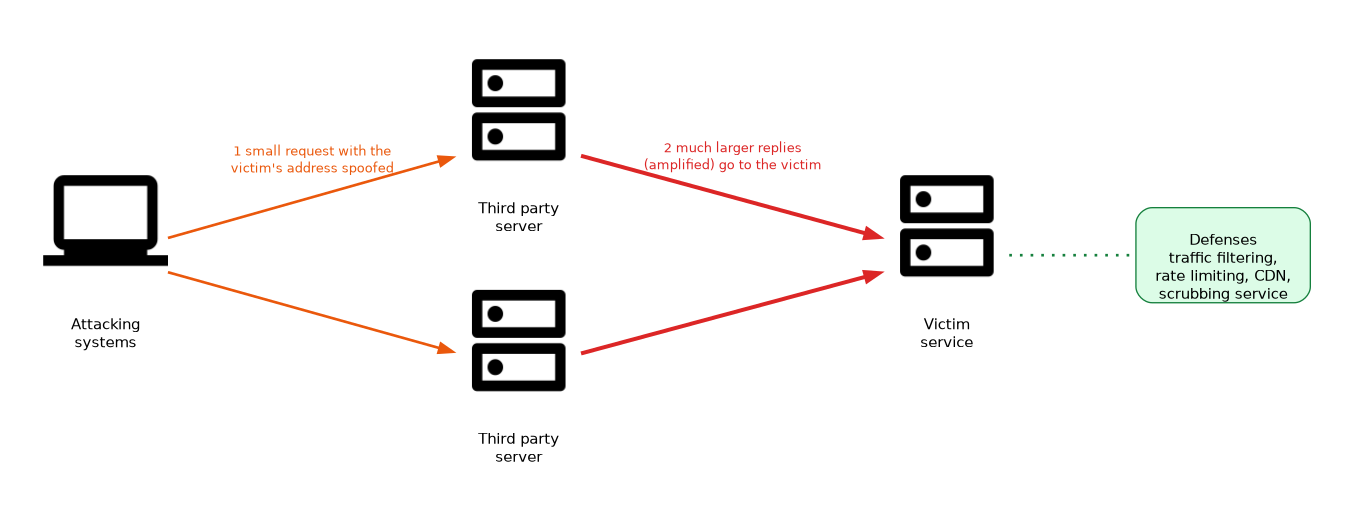
- DDoS harms availability. Amplified and reflected attacks use third parties to enlarge or hide traffic.
- A downgrade forces a weaker protocol. Disable old versions.
- Rogue devices include evil twin access points. Sniffing reads traffic, and spoofing fakes an identity.
What it is
Network attacks target the traffic and services that connect systems. Application attacks abuse how software handles input, sessions and permissions. Credential attacks target the logins that guard accounts.
You will be asked to name the attack from a short description or a log excerpt, and to choose the control that stops it.
How it works
Network attacks
| Attack | Description | Key defense |
|---|---|---|
| Distributed denial of service (DDoS) | Many systems flood a target so real users cannot reach it | Filtering, rate limiting, a scrubbing service |
| Protocol downgrade | Forcing a connection to use an older, weaker protocol version | Disable old versions on servers and clients |
| Rogue | An unauthorized access point, server or device, such as an evil twin copying a real network name | Wireless scanning, network access control |
| Sniffing | Capturing traffic to read it | Encryption of traffic |
| Spoofing | Faking an address or identity, such as an IP or MAC address or an email sender | Authentication, filtering |
| On-path | Sitting between two parties to read or change traffic | Transport Layer Security (TLS) with certificate checks |
| Domain Name System (DNS) attacks | Abusing name resolution, such as hijacking a domain registration or hiding data in DNS queries | Registrar locks, DNS monitoring |
| Cache poisoning | Placing false entries in a DNS or ARP cache so traffic goes to the attacker | DNS Security Extensions (DNSSEC), dynamic ARP inspection |
DDoS attacks are often amplified, where a small request triggers a much larger response, or reflected, where spoofed requests make third parties send replies to the victim. Both harm availability.
Cache poisoning is a common way to set up an on-path position. DNSSEC uses digital signatures so clients can check that DNS answers are genuine.
Application attacks
| Attack | Description | Key defense |
|---|---|---|
| Injection | Input is treated as a command, as in Structured Query Language (SQL) or operating system command injection | Parameterized queries, input validation |
| Buffer overflow | Data written past a buffer corrupts memory and may run attacker code | Bounds checking, memory protections |
| Replay | Captured valid data, such as a session token, is sent again | Time stamps, one time values, short lived tokens |
| Privilege escalation | Gaining higher rights (vertical) or another user's rights at the same level (horizontal) | Least privilege, patching, access reviews |
| Forgery | Faked requests that appear to come from a trusted party | Anti forgery tokens, allow lists |
| Directory traversal | Path tricks such as ../ reach files outside the intended folder | Validate and normalize paths |
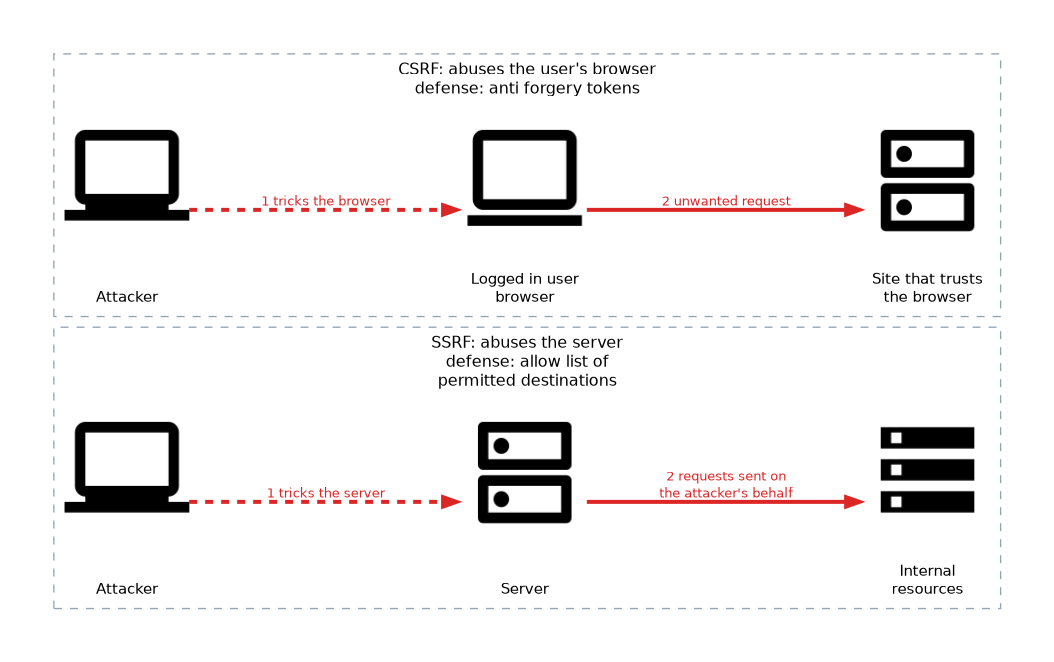
Cross site request forgery (CSRF) tricks a logged in user's browser into sending an unwanted request. Server side request forgery (SSRF) tricks a server into requesting internal resources for the attacker.
GET /download?file=../../etc/passwd
GET /item?id=1' OR '1'='1
The first line is directory traversal and the second is SQL injection. Signs of privilege escalation include a standard user suddenly in an administrative group and new accounts that nobody requested.
Credential attacks
| Attack | Description | Sign in the logs |
|---|---|---|
| Password spraying | A few common passwords tried against many accounts | Failures spread across many accounts, few per account |
| Brute force | Many guesses against one account | Many failures on one account, then lockout |
| User enumeration | Finding valid usernames from different error messages or responses | Many attempts with different usernames |
| Replay | Reusing captured authentication data, such as a hash or token | Valid session from a new device or location |
| MFA bypass | Getting past the second factor | Many push prompts, a SIM change, a session from a new location |
MFA bypass methods include sending repeated push prompts until the user approves (MFA fatigue), taking over the phone number (SIM swapping), and phishing proxies that capture the session cookie after login. Phishing resistant MFA, such as security keys, and number matching on push prompts reduce these.
Online guessing is slowed by lockouts and rate limits. Giving the same error for a wrong username and a wrong password stops user enumeration.
What to remember for the exam
- DDoS harms availability. Amplified and reflected attacks use third parties to enlarge or hide traffic.
- A downgrade forces a weaker protocol. Disable old versions.
- Rogue devices include evil twin access points. Sniffing reads traffic, and spoofing fakes an identity.
- Cache poisoning plants false DNS or ARP entries, often to set up an on-path attack.
- Injection is fixed with input validation and parameterized queries.
- CSRF abuses a user's browser. SSRF abuses the server.
- Spraying is few passwords across many accounts. Brute force is many guesses at one.
- MFA fatigue, SIM swapping and session theft bypass MFA. Phishing resistant MFA resists them.
If many accounts fail to log in with the same one or two passwords and no single account is locked, think password spraying.
Common mistakes
Confusing spraying with brute force. Spraying spreads a few guesses across many accounts to avoid lockout.
Mixing up a rogue access point and an evil twin. A rogue access point is any unauthorized device. An evil twin specifically imitates a legitimate network.
Mixing up CSRF and SSRF. CSRF uses the victim's browser, SSRF uses the server.
Thinking MFA cannot be bypassed. Fatigue attacks and stolen session cookies get around many MFA methods.
Check yourself
What is the purpose of DNSSEC?
It adds digital signatures to DNS data so clients can check that answers are genuine.
What distinguishes password spraying from brute force?
Spraying tries a few common passwords against many accounts, while brute force tries many passwords against one account.
A user receives dozens of push prompts at night and finally approves one. Which attack is this?
An MFA fatigue attack, a form of MFA bypass.
Topic 9 of 10 in Threats, Vulnerabilities, and Attacks
Test yourself on Threats, Vulnerabilities, and Attacks
The full CompTIA Security+ SY0-801 question bank has 998 questions, with timed practice exams and an explanation for every answer.
This study guide is independent and is not affiliated with, endorsed by, or sponsored by CompTIA. Vendor names, certification names and exam codes are trademarks of their respective owners and are used for identification only.