Security Architecture · Topic 7 of 7
Resilience and Recovery Planning
Security+ resilience planning: hot, warm and cold sites, redundancy, power, storage, immutable backups, failover testing, RTO, RPO, MTTR and MTBF.
- 5 min
- Includes a diagram
- Hot, warm and cold sites trade cost against recovery speed.
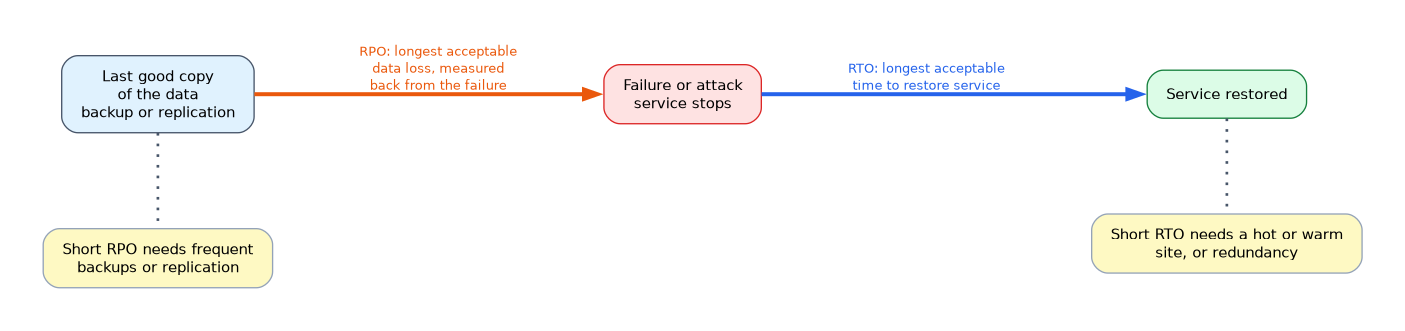
- RTO is how long recovery may take, and RPO is how much data loss is acceptable.
- MTTR is average repair time, and MTBF is average time between failures.
What it is
Resilience is the ability to keep working through a failure or attack. Recovery is the ability to return to normal afterward.
Both depend on planning ahead. The aim is that one failed component, site or provider does not stop the business.
How it works
Redundancy and high availability
High availability (HA) keeps a service running with little or no downtime. It is built from redundant parts, so no single failure stops the service.
| Technique | Description |
|---|---|
| Load balancing | Spreads traffic over several servers, and stops sending to a failed one |
| Clustering | Several servers act as one system and take over from each other |
| Autoscaling | Adds or removes servers automatically as demand changes |
| Multicloud systems | Run workloads across more than one cloud provider, so one provider's outage does not stop everything |
Power
| Device | Role |
|---|---|
| Uninterruptible power supply (UPS) | Battery that bridges short outages and gives time for a clean shutdown or generator start |
| Redundant power supply (RPS) | A second power supply in a device, so it keeps running if one fails |
| Power generator | Supplies power for long outages |
| Surge protector | Protects equipment from voltage spikes |
Storage
Storage redundancy protects data from disk failure. Redundant array of independent disks (RAID) spreads data across several disks. RAID 1 mirrors data on two disks, and RAID 5 stripes data with parity so it survives the loss of one disk.
Replication copies data to another system or site, and snapshots capture a point in time image. Replication also copies mistakes and ransomware, so it does not replace backups.
Backups
| Concept | Meaning |
|---|---|
| Retention | How long each backup is kept before it is deleted |
| Immutability | The backup cannot be changed or deleted for a set period, even by an administrator |
| Scope | What the backup covers, such as full, incremental or differential, and which systems |
| Restoration testing | Restoring from backup on a schedule to prove it works |
A full backup copies all selected data. An incremental copies what changed since the last backup of any kind, and a differential copies what changed since the last full backup.
Keep at least one copy offsite and one copy immutable or offline, so ransomware cannot reach every copy. A backup that has never been restored is an assumption, not a plan.
Site considerations
| Site | State | Recovery speed | Cost |
|---|---|---|---|
| Hot | Fully equipped and running, with current data | Fastest | Highest |
| Warm | Equipment ready, data and setup need work | Moderate | Moderate |
| Cold | Space and power only | Slowest | Lowest |
Environmental considerations decide where a site goes. It should be far enough away that one flood, storm or power failure does not hit both sites, and it needs suitable power and cooling.
Platform diversity
Platform diversity avoids one flaw stopping everything. It can mean using more than one vendor platform, different hardware, or virtualization so workloads can move between hosts. Diversity adds resilience but more systems to manage.
Testing
| Test | What it does |
|---|---|
| Failover | Switches to the standby system to confirm it takes over |
| Simulation | Runs a realistic scenario with real actions, without a real disaster |
| Parallel processing | Runs the recovery system alongside the live one and compares results |
Disaster recovery, continuity and capacity
Business continuity keeps essential functions running during and after a disruption. Disaster recovery is the part that restores IT systems and data after a major event.
Capacity planning checks that people, technology and infrastructure can handle normal growth and the extra load of recovery.
Recovery metrics
| Metric | Meaning |
|---|---|
| Recovery time objective (RTO) | Longest acceptable time to restore a service |
| Recovery point objective (RPO) | Longest acceptable span of data loss, measured back from the failure |
| Mean time to repair (MTTR) | Average time to repair a failed component or system |
| Mean time between failures (MTBF) | Average time a repairable system runs between failures |
RTO and RPO are targets set by the business. MTTR and MTBF are measurements of how systems actually behave.
How the exam asks about this
- "The business can lose no more than 15 minutes of orders." -> An RPO of 15 minutes, so backups or replication at least that often.
- "Ransomware encrypted the backups along with the servers." -> Use immutable or offline backups.
- "The recovery system runs beside production to check its results match." -> Parallel processing.
What to remember for the exam
- Hot, warm and cold sites trade cost against recovery speed.
- RTO is how long recovery may take, and RPO is how much data loss is acceptable.
- MTTR is average repair time, and MTBF is average time between failures.
- Load balancing, clustering and autoscaling support high availability.
- A UPS covers short outages, a generator long ones, and an RPS a failed power supply.
- Immutable backups cannot be altered, which defeats ransomware.
- Restore tests prove that backups work.
- Business continuity keeps the business running, and disaster recovery restores IT.
For an RPO question, ask how much data the business can afford to lose. The answer sets how often to back up or replicate.
Common mistakes
Mixing RTO and RPO. RTO is about time to restore service. RPO is about the age of the data you can recover to.
Mixing RTO and MTTR. RTO is a target set by the business. MTTR is a measured average.
Assuming replication replaces backup. Replication copies deletions and ransomware too.
Never testing the plan. Untested plans often fail because of missing steps or broken backups.
Choosing a hot site for every system. It is the most costly option, and less critical systems can use a warm or cold site.
Check yourself
What does the recovery point objective measure?
The maximum acceptable amount of data loss, expressed as time back from the failure.
What is an immutable backup?
A backup that cannot be changed or deleted for a set period, even by an administrator.
What is the difference between MTBF and MTTR?
MTBF is the average time a system runs between failures, while MTTR is the average time taken to repair it.
Topic 7 of 7 in Security Architecture
Test yourself on Security Architecture
The full CompTIA Security+ SY0-801 question bank has 998 questions, with timed practice exams and an explanation for every answer.
This study guide is independent and is not affiliated with, endorsed by, or sponsored by CompTIA. Vendor names, certification names and exam codes are trademarks of their respective owners and are used for identification only.