Security Architecture · Topic 2 of 6
Specialized Systems and Design Factors
Security+ guide to IoT, ICS, SCADA, embedded and real time systems, and the design trade offs of availability, cost, scalability and patching.
- 4 min
- Includes a diagram
- IoT devices often have default credentials and weak update paths.
- ICS runs industrial processes, and SCADA is an ICS design that monitors widely spread sites.
- In industrial systems, safety and availability usually take priority.
What it is
Some systems do not behave like ordinary computers. Internet of Things (IoT) devices, industrial control systems and embedded devices often have limited resources, long lifetimes and few options for updates.
Security+ asks you to understand why these systems are hard to secure and what to weigh when choosing an architecture.
How it works
Specialized system types
| Type | What it is | Security concern |
|---|---|---|
| Internet of Things (IoT) | Small connected devices such as sensors, cameras and smart appliances | Default passwords, weak updates, many devices |
| Industrial control system (ICS) | Systems that run physical processes in factories and utilities | Safety and availability come first, patching is hard |
| Supervisory control and data acquisition (SCADA) | An ICS design that monitors and controls sites spread over a large area | Remote links and legacy protocols |
| Embedded system | A computer built into a device for a fixed purpose | Little room for security software |
| Real time operating system (RTOS) | An operating system with strict, predictable timing | Few built in security features |
| Facility systems | Building controls such as heating, cooling and door access | Often forgotten and left on flat networks |
A programmable logic controller (PLC) is a common ICS component that runs a physical process. In industrial settings, availability and safety often outweigh confidentiality.
Why these systems are hard to secure
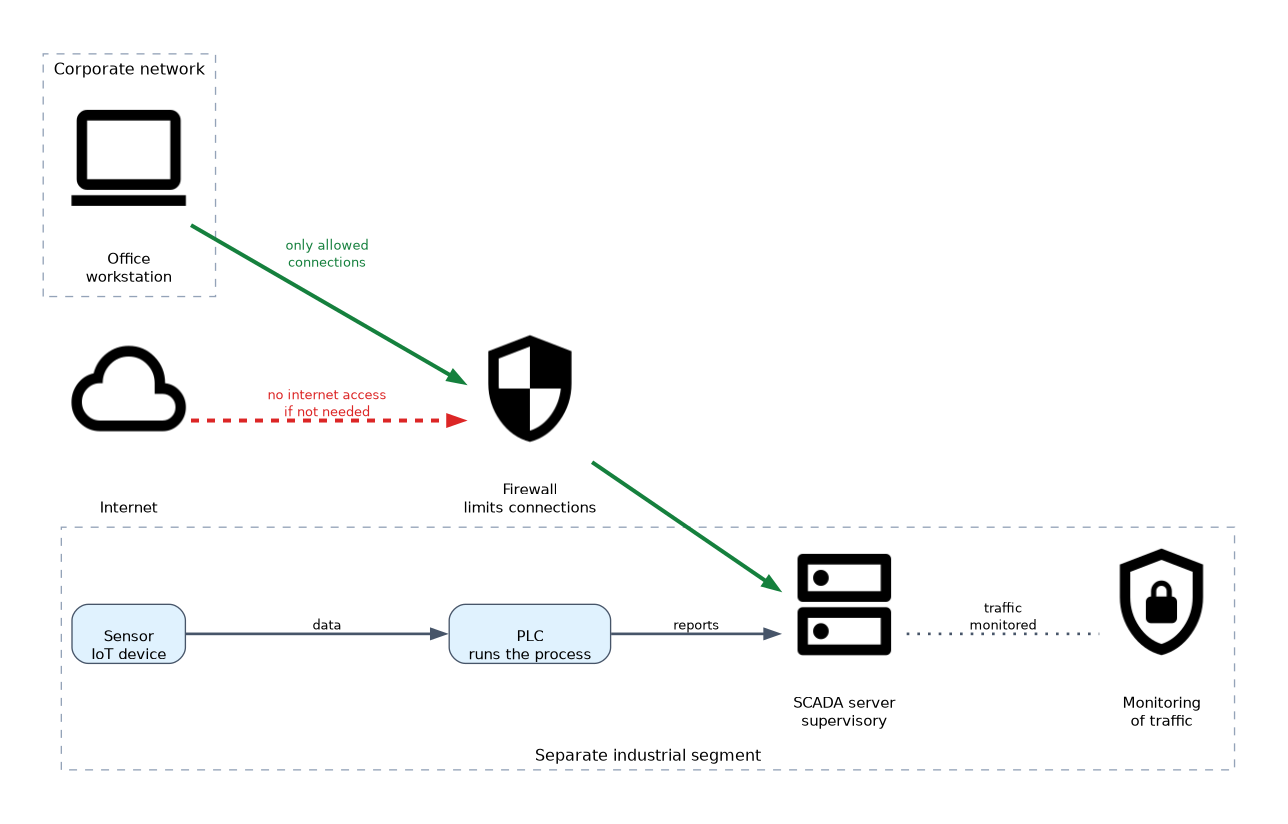 They often cannot be patched, or patching needs downtime that the process cannot accept. They may run old software, use vendor controlled updates and live for many years. Many were designed before networks were a concern.
The usual response is to isolate them. Put them on a separate segment, limit connections with a firewall, monitor traffic and replace them when possible.
Design considerations
When comparing architectures, think about trade offs, not a single best answer.
| Factor | Question to ask |
|---|---|
| Availability | Must the system always be up? |
| Resilience | Can it keep working or recover after failures? |
| Cost | What is the price to build and operate? |
| Responsiveness | How quickly must it react? |
| Scalability | Can it grow or shrink with demand? |
| Ease of deployment | How easy is it to roll out? |
| Risk transference | Can some risk move to a provider or an insurer? |
| Ease of recovery | How quickly can service return after an incident? |
| Patch availability | Will the vendor release updates? |
| Inability to patch | Is a compensating control needed? |
| Power | How much power does it need, and is it backed up? |
| Compute | Is there enough processing capacity? |
Compensating controls for unpatchable systems
When a system cannot be patched, the exam expects layered compensating controls. These include network segmentation, an allow list of permitted connections, extra monitoring and physical protection. Remove internet access if the device does not need it.
What to remember for the exam
- IoT devices often have default credentials and weak update paths.
- ICS runs industrial processes, and SCADA is an ICS design that monitors widely spread sites.
- In industrial systems, safety and availability usually take priority.
- Embedded systems and RTOS devices have limited resources, so extra security software is often not an option.
- When a system cannot be patched, isolate it and add monitoring.
- Architecture choices involve trade offs between cost, availability, resilience and ease of recovery.
- Risk transference moves some risk to another party, as with cloud contracts or insurance.
- Scalability is the ability to adjust capacity as demand changes.
If a scenario describes a legacy controller that cannot be updated, the best answer is almost always network segmentation or isolation, not forcing a patch.
Common mistakes
Applying standard IT rules to industrial systems. Rebooting a controller for a patch may stop a physical process, so change windows and testing are stricter.
Leaving IoT devices on the main network. A weak camera or sensor can become the way into more important systems.
Confusing SCADA and PLC. A PLC controls a local process. SCADA is the supervisory system that gathers data and issues commands across sites.
Thinking risk transference removes risk. It moves part of the financial or operational impact, but the organization stays accountable for its data.
Ignoring power and compute. A device may fail because it lacks backup power or processing capacity, which is a design problem as well as an operational one.
Never assume a legacy device is protected because it is old or obscure. Many have been found with open remote access and default accounts.
Check yourself
What is the best way to protect an industrial controller that cannot be patched?
Isolate it on a separate segment with strict firewall rules and add monitoring.
What does risk transference mean?
Moving some of the impact of a risk to another party, such as through insurance or a service contract.
Why do many IoT devices create risk?
They often ship with default credentials, receive few updates and exist in large numbers that are hard to track.
Topic 2 of 6 in Security Architecture
Test yourself on Security Architecture
The full CompTIA Security+ SY0-701 question bank has 848 questions, with timed practice exams and an explanation for every answer.
This study guide is independent and is not affiliated with, endorsed by, or sponsored by CompTIA. Vendor names, certification names and exam codes are trademarks of their respective owners and are used for identification only.