Networking Concepts · Topic 7 of 11
Topologies and Network Architectures
Compare star, mesh, bus, ring and hub and spoke topologies with three tier, collapsed core and spine and leaf designs, and north south traffic.
- 5 min
- Includes a diagram
- Star is the most common LAN topology. Its central switch is a single point of failure.
- Full mesh gives maximum redundancy at the highest cost. Partial mesh trades some redundancy for cost.
- Hub and spoke connects branch sites to a central site.
What it is
A topology is the layout of a network. The physical topology is how devices and cables are actually placed, and the logical topology is how data flows between them.
An architecture is a larger design pattern for how switches and routers are arranged in a campus or data center. The exam asks you to recognize each layout, its strengths and its weaknesses.
How it works
Common topologies
| Topology | Layout | Strength | Weakness |
|---|---|---|---|
| Star | Every device connects to one central switch | Easy to manage, one failed cable affects one device | The central device is a single point of failure |
| Bus | All devices share one backbone cable | Cheap | A break stops everyone, and it is obsolete |
| Ring | Each device connects to two neighbors in a loop | Orderly data flow | One break can stop the ring unless a second ring exists |
| Full mesh | Every device connects to every other device | Highest redundancy | Many links, high cost |
| Partial mesh | Some devices have multiple links | Balance of cost and redundancy | Less redundant than full mesh |
| Hub and spoke | Remote sites connect to one central site | Simple and cheap for branches | The hub is a bottleneck and a single point of failure |
A full mesh of n devices needs n times (n minus 1) divided by 2 links. For example, 5 devices need 10 links.
A hybrid topology combines two or more of these. Most real networks are a star in the building and a partial mesh on the wide area network (WAN).
Three tier hierarchical model
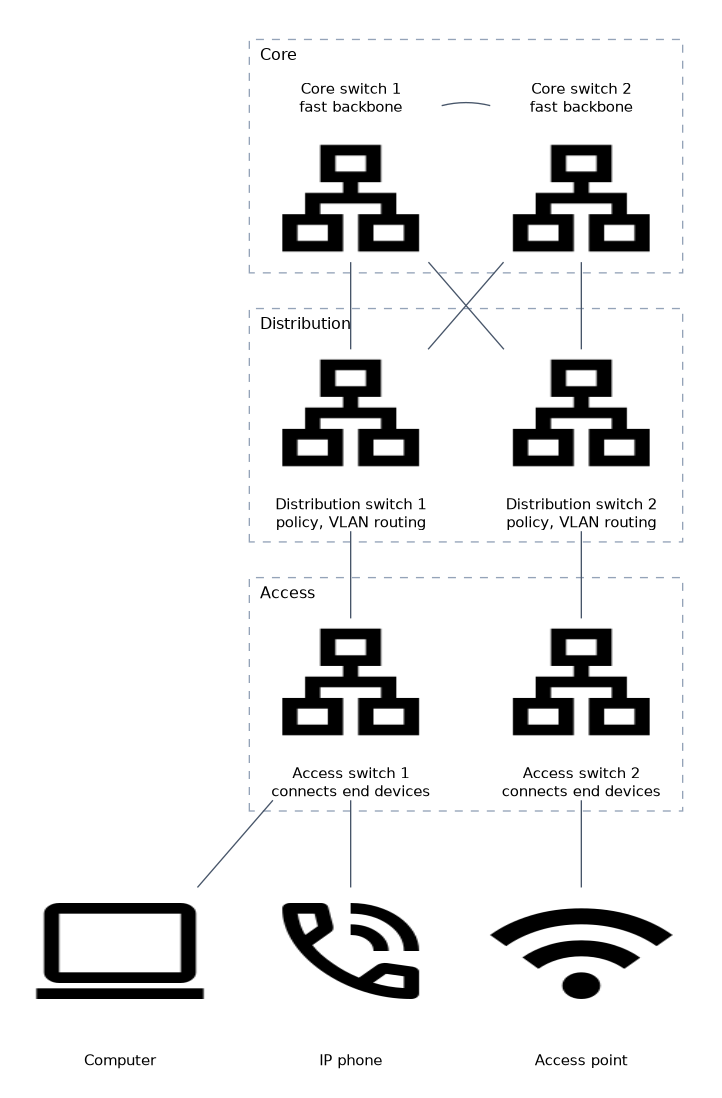 The classic campus design uses three layers.
| Layer | Role |
|---|---|
| Access | Connects end devices such as computers, phones and access points |
| Distribution | Aggregates access switches and applies policy, routing between virtual local area networks (VLANs) and filtering |
| Core | High speed backbone that moves traffic between distribution blocks quickly |
The layers make a large network easier to scale and troubleshoot. Failures stay inside a block.
Collapsed core
A collapsed core design combines the core and distribution layers into one layer of switches. It suits small and medium sites where a separate core would be too costly.
Spine and leaf
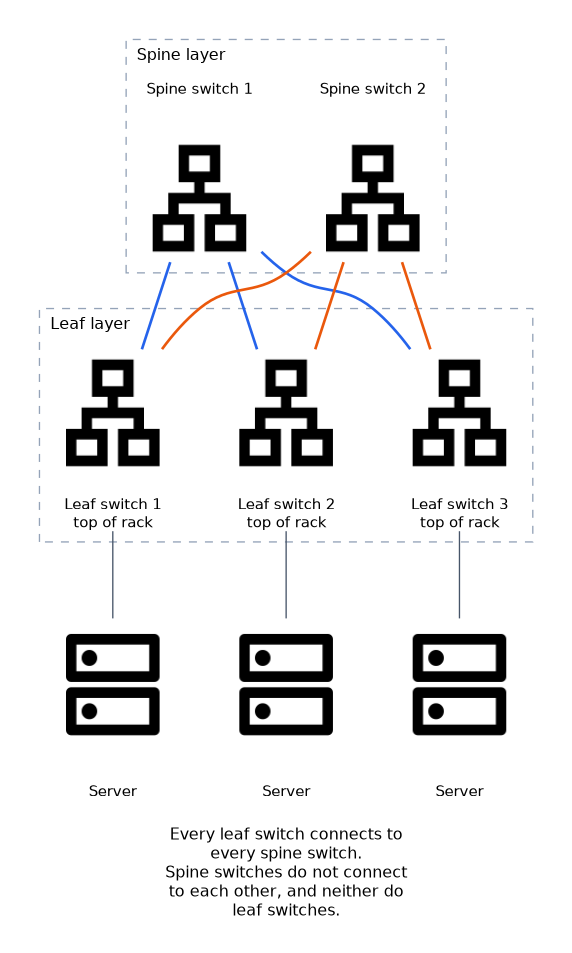 Spine and leaf is a data center design with two layers. Every leaf switch connects to every spine switch, and servers connect to the leaf switches.
Any server is the same number of hops from any other server, so latency is predictable. Capacity grows by adding more spine or leaf switches. Spine switches do not connect to each other, and leaf switches do not connect to each other.
Traffic flows
North south traffic enters or leaves the data center, for example a user reaching a web server. East west traffic moves between servers inside the data center, such as an application server querying a database.
Modern data centers have a large share of east west traffic, which is one reason spine and leaf is often used instead of the three tier model there.
Software defined networking
In software defined networking (SDN), a central controller makes forwarding decisions and programs the devices, separating the control plane from the data plane. This is covered in more detail in the modern use cases page.
What to remember for the exam
- Star is the most common LAN topology. Its central switch is a single point of failure.
- Full mesh gives maximum redundancy at the highest cost. Partial mesh trades some redundancy for cost.
- Hub and spoke connects branch sites to a central site.
- Three tier is core, distribution and access. A collapsed core merges core and distribution.
- Spine and leaf connects every leaf to every spine and is used in data centers.
- East west traffic stays inside the data center. North south enters or leaves it.
- Physical topology is the real layout. Logical topology is how data flows.
- Bus and ring topologies are largely historical on modern Ethernet networks.
If a question asks for the data center design with predictable latency and easy growth, the answer is spine and leaf. If it asks for a small office with limited switches, think collapsed core.
Common mistakes
Confusing physical and logical topology. A network can be wired as a star but behave logically as a bus or ring.
Treating hub and spoke as a mesh. Branches only reach each other through the hub unless extra links are added.
Thinking spine switches connect to each other. In a classic spine and leaf design they connect only to leaf switches.
Mixing up the three tiers. Users plug into the access layer, not the core. The core should not host policy heavy features that slow it down.
Mixing up the two traffic directions. East west is server to server inside, and north south is in and out.
A full mesh link count grows quickly. If an exam asks for the cost problem of a full mesh, the answer is the number of links and ports, not the lack of redundancy.
Check yourself
Answer these three.
Which topology gives the most redundancy, and what is its drawback?
Full mesh, which needs many links and ports and costs the most.
What is the main difference between three tier and collapsed core designs?
A collapsed core combines the core and distribution layers into one.
What does east west traffic mean?
Traffic that moves between servers inside the data center.
Topic 7 of 11 in Networking Concepts
Test yourself on Networking Concepts
The full CompTIA Network+ N10-009 question bank has 910 questions, with timed practice exams and an explanation for every answer.
This study guide is independent and is not affiliated with, endorsed by, or sponsored by CompTIA. Vendor names, certification names and exam codes are trademarks of their respective owners and are used for identification only.