Networking Concepts · Topic 3 of 11
Cloud Concepts and Connectivity
Know cloud deployment and service models, scalability, elasticity, multitenancy, infrastructure as code and the VPN or private link options to the cloud.
- 5 min
- Includes a diagram
- Public cloud is shared, private cloud is dedicated, and hybrid mixes the two.
- SaaS gives the least customer control, IaaS the most, and PaaS sits between them.
- Scalability is the ability to grow. Elasticity is automatic growth and shrinkage with demand.
What it is
Cloud computing delivers computing resources over a network on demand, and the customer pays for what is used. The exam tests the deployment models, the service models and how an organization connects to the provider.
The key idea is shared responsibility. The provider runs the underlying hardware, and the customer is responsible for what it builds and configures on top.
How it works
Deployment models
| Model | Description |
|---|---|
| Public cloud | Resources shared among many customers and run by a provider |
| Private cloud | Resources dedicated to one organization, on site or hosted |
| Hybrid cloud | A mix of private and public resources working together |
A hybrid design keeps sensitive systems on premises while using the public cloud for extra capacity.
Service models
| Model | Customer manages | Provider manages | Example idea |
|---|---|---|---|
| Software as a Service (SaaS) | Data and user settings | Almost everything else | Hosted email or customer relationship tool |
| Platform as a Service (PaaS) | Application and data | Servers, operating system, runtime | A managed place to deploy code |
| Infrastructure as a Service (IaaS) | Operating system, apps, data | Physical hosts, storage, network | Virtual machines rented by the hour |
| Desktop as a Service (DaaS) | Users and desktop images | Hosting of virtual desktops | Remote virtual desktops |
The more the provider manages, the less control and responsibility the customer has. IaaS gives the most control and SaaS gives the least.
Core cloud characteristics
Scalability means the system can grow to handle more load by adding resources. Elasticity means resources are added and removed automatically as demand rises and falls.
Multitenancy means many customers share the same underlying infrastructure while their data stays separate. This lowers cost, but it makes isolation and access control important.
Infrastructure as code
Infrastructure as code (IaC) manages servers and networks with text files that a tool reads, instead of manual clicking. The same file builds the same environment each time.
Common ideas are automation of repeated tasks, reusable templates and playbooks, and a dynamic inventory that tracks devices as they change. IaC also helps detect configuration drift, where a live device no longer matches its intended configuration.
Connecting to the cloud
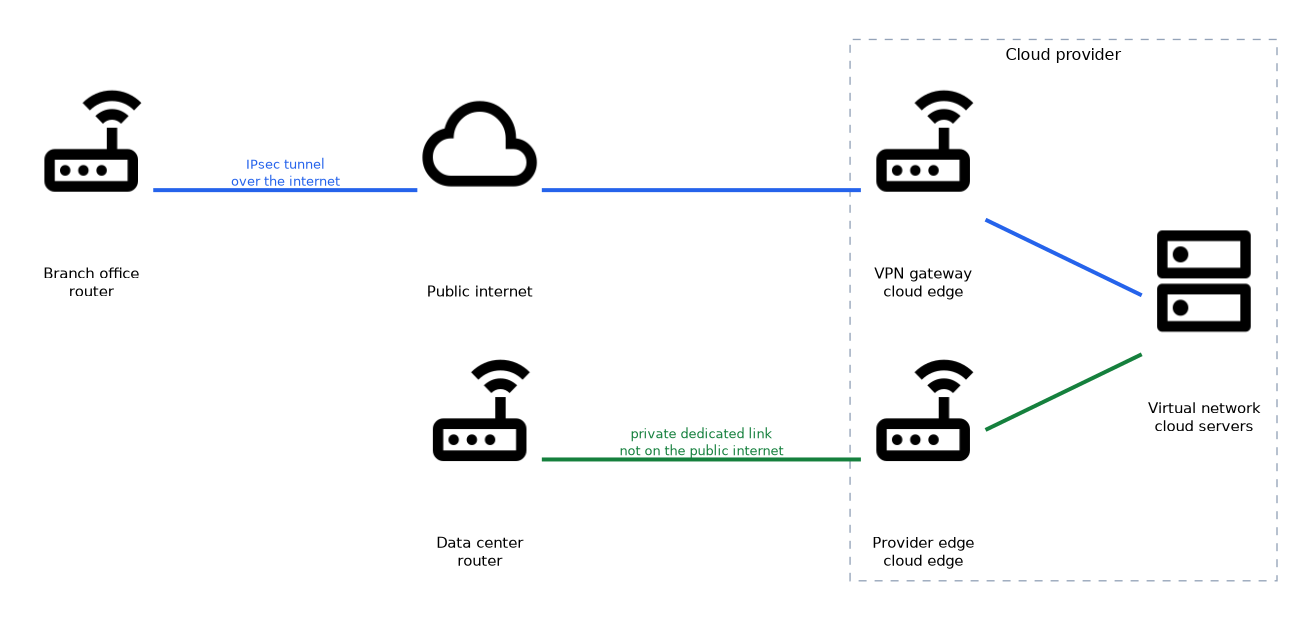
| Option | How it works | Trade off |
|---|---|---|
| Internet with a Virtual Private Network (VPN) | Encrypted tunnel over the public internet | Cheap and fast to set up, but depends on internet quality |
| Private direct connection | A dedicated link between the site and the provider | More predictable latency and bandwidth, but costs more |
A VPN gateway at each end builds an encrypted tunnel, often with Internet Protocol Security (IPsec). A private direct connection does not cross the public internet, which is why it gives steadier performance.
Virtual networks and gateways
A virtual private cloud (VPC) is a logically isolated virtual network inside a public cloud. The customer picks its address range and divides it into subnets, and route tables decide where each subnet sends traffic.
| Component | Role |
|---|---|
| Network security group | Stateful allow rules applied to an instance or its network interface |
| Network security list | Allow and deny rules applied to a whole subnet, typically stateless, so return traffic needs its own rule |
| Internet gateway | Gives a subnet a route to and from the internet, which public IP reachability needs |
| Network Address Translation (NAT) gateway | Lets hosts in a private subnet start outbound connections, while inbound connections from the internet are not allowed |
A private subnet that must download updates but never accept inbound internet traffic points to a NAT gateway. A public web server needs the internet gateway.
Security considerations
Cloud resources are reachable over the network, so identity, encryption and filtering matter. Providers offer virtual firewall rules to control which traffic reaches a resource.
Misconfigured access, such as a storage bucket open to everyone, is a common cause of data exposure. Customers also need to think about where data is stored and which rules apply to it.
What to remember for the exam
- Public cloud is shared, private cloud is dedicated, and hybrid mixes the two.
- SaaS gives the least customer control, IaaS the most, and PaaS sits between them.
- Scalability is the ability to grow. Elasticity is automatic growth and shrinkage with demand.
- Multitenancy means many customers share infrastructure with logical separation.
- Infrastructure as code uses templates and automation, and it helps prevent configuration drift.
- A VPN over the internet is cheaper but less predictable than a private direct connection.
- A private direct connection gives consistent performance because it avoids the public internet.
- The customer is always responsible for its own data and access settings, even in SaaS.
To choose between connection types, look for the requirement. "Low cost and quick" points to a VPN, and "consistent latency and high throughput" points to a private direct connection.
Common mistakes
Mixing scalability and elasticity. Scalability is the capacity to grow. Elasticity adds the automatic return to a smaller size when demand drops.
Thinking the provider secures everything. In every model the customer is responsible for its data, accounts and configuration.
Assuming a private direct connection is encrypted by default. It is private, but encryption is a separate choice, and some designs add a VPN on top.
Confusing PaaS and IaaS. In IaaS you manage the operating system. In PaaS the provider manages it and you only deploy the application.
Believing hybrid means two public clouds. Hybrid means a combination of private and public resources.
Do not call a service SaaS just because it is hosted. If the customer builds and patches the virtual machine, it is IaaS.
Check yourself
Test yourself with these three items.
Which service model leaves the customer to manage the operating system?
Infrastructure as a Service (IaaS).
What is the difference between scalability and elasticity?
Scalability is the ability to grow to meet load, and elasticity adds and removes resources automatically as demand changes.
A company needs steady latency to a cloud provider and will pay for it. What connection fits?
A private direct connection to the provider, rather than a VPN over the internet.
Topic 3 of 11 in Networking Concepts
Test yourself on Networking Concepts
The full CompTIA Network+ N10-009 question bank has 910 questions, with timed practice exams and an explanation for every answer.
This study guide is independent and is not affiliated with, endorsed by, or sponsored by CompTIA. Vendor names, certification names and exam codes are trademarks of their respective owners and are used for identification only.