Network Operations · Topic 5 of 8
Disaster Recovery Concepts
Learn the DR metrics RPO, RTO, MTTR and MTBF, cold, warm and hot sites, active-active and active-passive designs, and the ways DR plans are tested.
- 5 min
- Includes a diagram
- RPO is about data loss. RTO is about downtime.
- MTBF measures reliability. MTTR measures repair time.
- Cold, warm and hot sites trade cost against recovery speed. Hot is fastest and most costly.
What it is
Disaster recovery (DR) is the plan and the resources for restoring information technology (IT) services after a serious failure, such as a fire, flood, major outage or cyberattack. Its goal is to limit data loss and downtime to what the business can accept.
The exam focuses on a few metrics, the kinds of recovery sites and the way DR plans are tested. It also contrasts DR with high availability, which tries to prevent the outage from being noticed at all.
How it works
Recovery metrics
| Metric | Full name | Meaning |
|---|---|---|
| RPO | Recovery point objective | How much data loss is acceptable, measured as time since the last good backup |
| RTO | Recovery time objective | How long a service may be down before the business is badly hurt |
| MTTR | Mean time to repair | Average time needed to fix a failed component and restore service |
| MTBF | Mean time between failures | Average time a component works before it fails |
If the RPO is one hour, backups or replication must run at least every hour. If the RTO is four hours, the recovery process must finish within four hours.
MTBF measures reliability, so a higher number is better. MTTR measures how quickly repairs happen, so a lower number is better.
Recovery sites
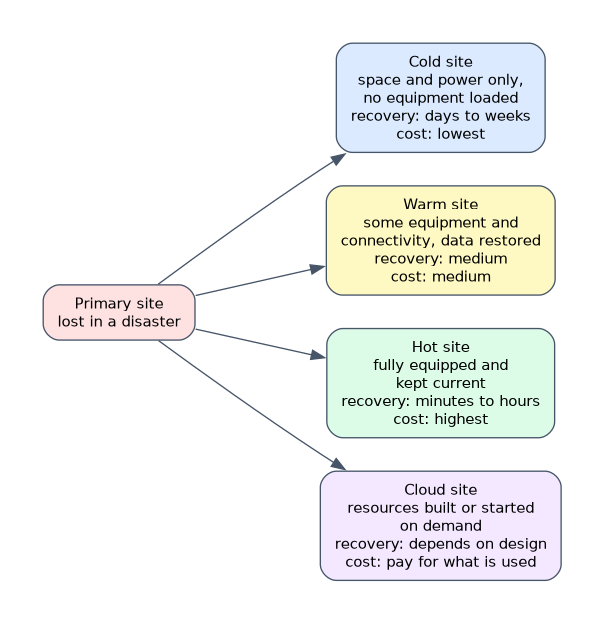
| Site | State | Recovery time | Cost |
|---|---|---|---|
| Cold site | Space and power only, no equipment loaded | Slowest, days to weeks | Lowest |
| Warm site | Some equipment and connectivity, data needs restoring | Medium | Medium |
| Hot site | Fully equipped and kept current, ready to take over | Fastest, minutes to hours | Highest |
| Cloud site | Resources built or started in a cloud provider on demand | Depends on design | Pay for what is used |
A hot site meets a short RTO but costs the most, because it duplicates the production environment. A cold site is cheap but takes the longest to bring up.
High availability designs
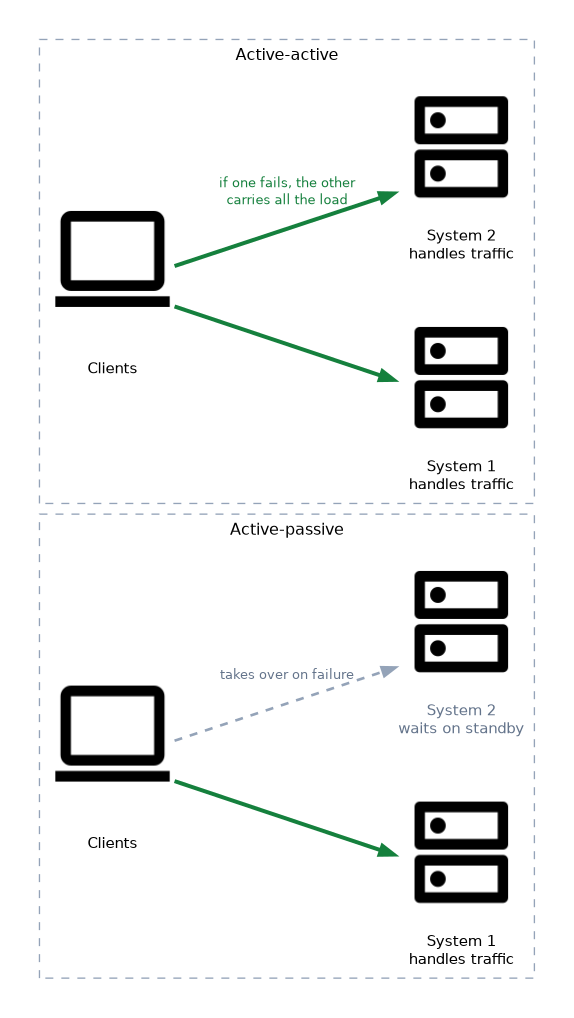 High availability keeps services running through a component failure. It uses redundancy, and the two common designs are active-active and active-passive.
| Design | How it works |
|---|---|
| Active-active | Both systems handle traffic at the same time, and one carries all load if the other fails |
| Active-passive | One system handles traffic while the other waits and takes over on failure |
Active-active uses all the hardware and gives smooth failover, but each system must have enough capacity to carry the whole load. Active-passive is simpler, but the standby capacity sits idle.
Testing the plan
A plan that has never been tested may fail when needed. Two common test types are listed here.
Tabletop exercise: the team talks through a disaster scenario step by step, with no systems touched. It finds gaps in roles, contacts and procedures at low cost.
Validation test: the team performs the real recovery, such as restoring a backup or failing over to a recovery site, to confirm it works and meets the RTO and RPO.
Results of each test should be recorded and used to improve the plan. The plan, contact lists and diagrams should be kept up to date and stored where they are available during an outage.
What to remember for the exam
- RPO is about data loss. RTO is about downtime.
- MTBF measures reliability. MTTR measures repair time.
- Cold, warm and hot sites trade cost against recovery speed. Hot is fastest and most costly.
- A cloud site can be an alternative recovery site that is created or started when needed.
- Active-active uses both systems at once. Active-passive keeps one on standby.
- Redundancy and high availability reduce outages. DR restores service after a major loss.
- A tabletop exercise discusses a scenario. A validation test actually performs the recovery.
- Update and test the DR plan regularly.
To pick a site type, read the RTO. Minutes mean hot, hours or a day mean warm, and several days or longer mean cold.
Common mistakes
Swapping RPO and RTO. RPO is the age of the data you can lose, and RTO is the time you can be down.
Confusing MTBF and MTTR. MTBF is time between failures and MTTR is time to repair.
Assuming backups are a DR plan. Backups are one ingredient. A plan also covers people, sites, connectivity and order of recovery.
Never testing the plan. Untested plans often fail at the first real use.
Thinking active-active needs no spare capacity. If one side fails, the other must carry the whole load.
Keep at least one copy of backups and the DR plan away from the primary site. If both are lost together, recovery may not be possible.
Check yourself
Answer these three.
What does an RPO of four hours mean?
The business can accept losing up to four hours of data, so backups or replication must occur at least that often.
Which recovery site type is fully equipped and ready to take over quickly?
A hot site.
What is the difference between a tabletop exercise and a validation test?
A tabletop exercise is a discussion of a scenario, while a validation test actually carries out the recovery steps.
Topic 5 of 8 in Network Operations
Test yourself on Network Operations
The full CompTIA Network+ N10-009 question bank has 910 questions, with timed practice exams and an explanation for every answer.
This study guide is independent and is not affiliated with, endorsed by, or sponsored by CompTIA. Vendor names, certification names and exam codes are trademarks of their respective owners and are used for identification only.