Vulnerability Management · Topic 1 of 5
Vulnerability Scanning Methods
Choose the right vulnerability scan: credentialed or not, agent or agentless, active or passive, internal or external, with asset discovery and OT care.
- 6 min
- Includes a diagram
- Discover assets first, because unknown systems stay unscanned.
- Credentialed scans see more and give fewer false positives than non credentialed scans.
- Agents suit remote or intermittently connected devices, and agentless scanning suits fixed networks.
What it is
A vulnerability is a weakness that an attacker could use, such as missing software updates or an insecure setting. A vulnerability scan is an automated check that compares systems against a database of known weaknesses and reports what it finds.
Scanning is only useful if it covers the right systems in the right way. The analyst chooses a scan type to match the target, the risk of disruption and the detail needed.
How it works
Start with the asset inventory
You cannot scan or protect what you do not know about. Asset discovery finds hosts, services and software, often with a host discovery scan, and compares the result with the official inventory to expose unmanaged or forgotten systems (shadow IT).
The tool Nmap (Network Mapper) is a common discovery and port scanning tool. In a Linux shell:
nmap -sn 192.0.2.0/24
nmap -sV -p 1-1024 192.0.2.15
The first command is a ping scan that lists live hosts without scanning ports. The second probes ports 1 to 1024 on one host and tries to detect the service versions running.
Two other tools appear for network scanning and mapping.
| Tool | Purpose | What its output shows |
|---|---|---|
| Angry IP Scanner | A graphical sweeper that quickly pings an address range and optionally checks ports | A list of addresses marked alive or dead, with host names and open ports, which can be exported to a file |
| Masscan | A very fast port scanner built for large ranges | Only the open ports it finds, one line per port |
masscan -p80,443 192.0.2.0/24 --rate 1000The -p option picks the ports, and --rate caps the packets sent per second. Masscan trades depth for speed: it does not do the service and version detection or scripting that Nmap does, so a common pattern is to find open ports with Masscan and then examine them with Nmap. A high rate can overload fragile devices and links, so keep it low on production networks.
Choosing a scan type
| Choice | Option A | Option B |
|---|---|---|
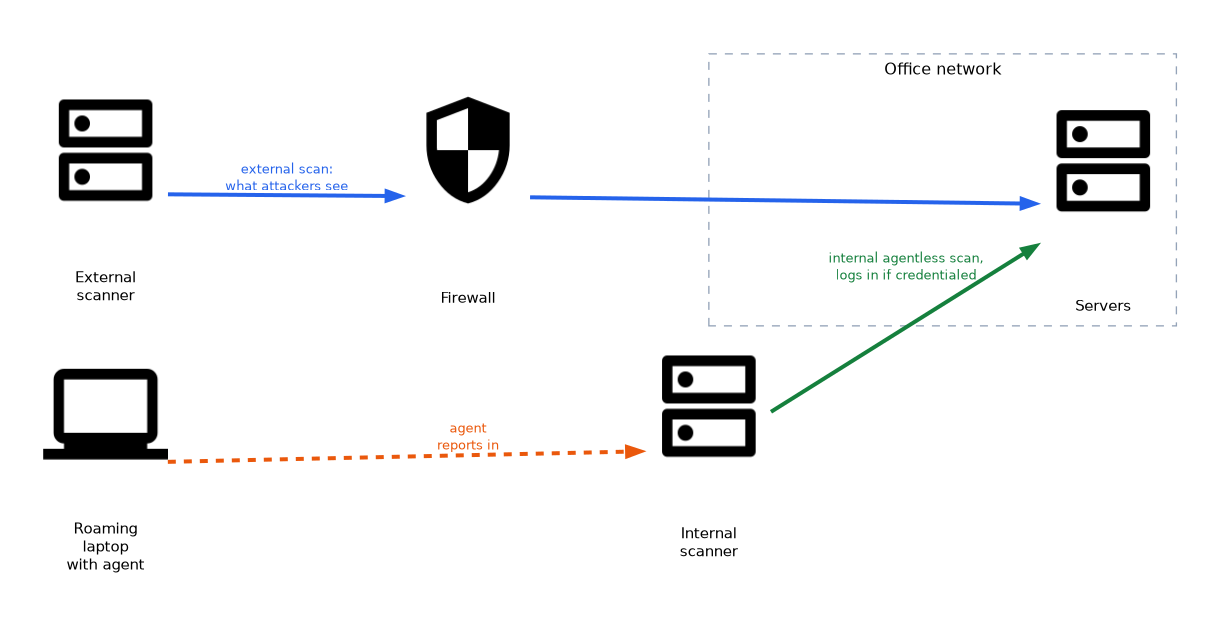
| Access level | Credentialed (authenticated): logs in and sees patch levels, settings and software | Non credentialed: sees only what an outsider sees |
| Deployment | Agent based: software on the host reports in, works for roaming laptops | Agentless: a scanner reaches the host over the network |
| Method | Active: sends probes and may affect fragile systems | Passive: watches traffic and learns about assets without probing |
| Location | Internal: from inside, shows what an insider or compromised host could reach | External: from the internet, shows what attackers can see |
Credentialed scans give more accurate and more complete results with fewer false positives. A non credentialed scan is still valuable because it shows the attacker's view, so many programmes run both.
Scan targets and special cases
- Network and host scans check operating systems, services and patches.
- Web application scans test sites for flaws such as injection or weak session handling. Tools such as the Open Worldwide Application Security Project (OWASP) Zed Attack Proxy (ZAP), Burp Suite and Nikto are examples.
- Database and cloud scans check configuration and exposure, and cloud accounts often need provider approval and permissions.
- Container and image scans look inside images and dependencies before deployment.
- Software analysis includes static application security testing (SAST), which reads source code, dynamic application security testing (DAST), which tests a running app, and software composition analysis (SCA), which checks third party libraries.
Industrial control systems (ICS) and other operational technology (OT) need special care. Active probes can crash old controllers, so use passive monitoring, gentle scan settings or scheduled windows agreed with the operators.
Standards and content
The Security Content Automation Protocol (SCAP) is a set of standards for describing vulnerabilities and checking configuration. Benchmarks such as those from the Center for Internet Security (CIS) define secure settings, and a compliance scan checks systems against them. Scanners use regularly updated plugins or feeds, so keep them current before every run.
Planning a scan
- Scope: which networks, assets and applications, including cloud and remote devices.
- Frequency: driven by risk and by policy or compliance rules, and after major changes.
- Timing: run heavy scans in agreed windows to avoid disrupting business.
- Sensitivity: choose the checks and depth, and whether to include safe checks only.
- Authorisation: get written approval, and warn operations and the security operations team.
- Bandwidth and performance: avoid scanning that overloads slow links or fragile devices.
Scanning has limits. It finds known issues, so it does not detect unknown flaws (zero days) or design weaknesses.
Segmentation and scan reach. A scanner sees only what the network allows it to reach. Firewalls and virtual local area network (VLAN) boundaries can block probes, which hides hosts and produces false negatives.
- Place a scanner, or a remote scan engine, inside each segment that cannot be reached from the central scanner.
- Add firewall allow rules for the scanner address, including the ports that credentialed checks need.
- Use agents on hosts that no scanner can reach, such as roaming laptops or isolated zones.
- Tell the security operations team, because an intrusion prevention system may block or alert on scan traffic.
- Compare the results with the asset inventory to find segments that were never covered.
What to remember for the exam
- Discover assets first, because unknown systems stay unscanned.
- Credentialed scans see more and give fewer false positives than non credentialed scans.
- Agents suit remote or intermittently connected devices, and agentless scanning suits fixed networks.
- Active scanning sends probes and can disturb fragile systems, while passive scanning only listens.
- External scans show the attacker's view, and internal scans show what could be reached from inside.
- Use gentle or passive methods for ICS and OT devices.
- SAST reads code, DAST tests a running application, and SCA checks libraries.
nmap -snlists live hosts, andnmap -sVdetects service versions.- Scanners rely on up to date plugins, and scans need scope, timing and authorisation.
Never scan systems you are not authorised to test. Unapproved scanning can be illegal and can disrupt production services.
Common mistakes
Relying only on non credentialed scans. They miss local issues such as missing patches that are invisible from the network.
Scanning fragile devices like normal servers. Medical, industrial and legacy devices can fail under aggressive probing.
Scanning on a one time basis. New systems and new flaws appear constantly, so scanning must repeat.
Confusing SAST and DAST. Static testing reads code without running it, and dynamic testing attacks a running application.
Ignoring cloud and remote assets. Laptops and cloud workloads outside the office network can be missed unless agents or cloud connectors are used.
Check yourself
Why is a credentialed scan usually more accurate?
It logs in and can read patch levels and settings directly, instead of guessing from the network.
When are agents a better choice than an agentless scan?
For remote or roaming devices that are not always reachable from the scanner.
What is the difference between SAST and DAST?
SAST analyses source code without running it, while DAST tests the running application.
Topic 1 of 5 in Vulnerability Management
Test yourself on Vulnerability Management
The full CompTIA CySA+ CS0-004 question bank has 654 questions, with timed practice exams and an explanation for every answer.
This study guide is independent and is not affiliated with, endorsed by, or sponsored by CompTIA. Vendor names, certification names and exam codes are trademarks of their respective owners and are used for identification only.