Incident Response and Management · Topic 3 of 6
The Incident Response Process
The incident response phases for CySA+: preparation, detection, analysis, containment, eradication, recovery and lessons learned, with plans and roles.
- 5 min
- Includes a diagram
- An incident is an event that harms or threatens security, and many events are not incidents.
- The phase order is preparation, detection, analysis, containment, eradication, recovery and post incident review.
- Preparation includes the plan, team, playbooks, tools, training and a communication plan.
What it is
An event is any observable occurrence in a system or network. An incident is an event, or a set of events, that harms or threatens the confidentiality, integrity or availability of information or systems, or breaks a security policy.
Incident response (IR) is the planned, repeatable way an organisation handles incidents so that damage is limited and normal service returns quickly. Following the same phases every time avoids panic and mistakes.
How it works
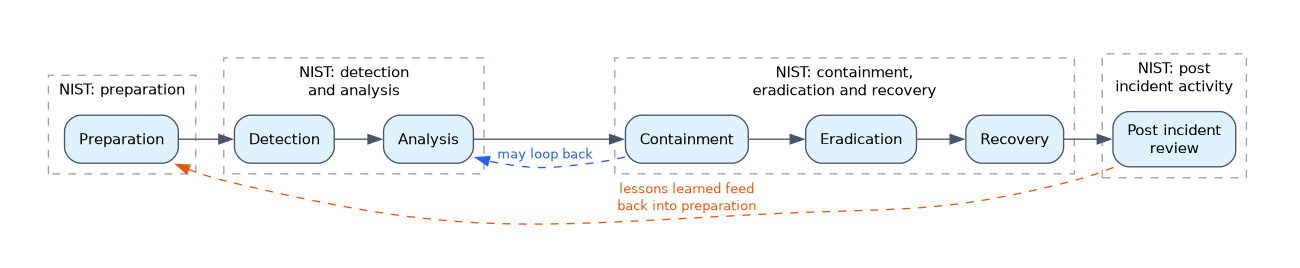 The widely used National Institute of Standards and Technology (NIST) model (Special Publication 800-61 Revision 2) has four phases: preparation, detection and analysis, containment with eradication and recovery, and post incident activity. CySA+ breaks the middle of that model into separate steps: preparation, detection, analysis, containment, eradication and recovery, followed by a post incident review. In practice the phases overlap, and the team may loop back as it learns more.
Preparation
Everything done before an incident happens.
- IR policy and plan: approved by management, giving authority and defining what counts as an incident.
- IR team: often called a computer security incident response team (CSIRT), with defined roles, an incident commander, and contacts for legal, human resources, communications and executives.
- Playbooks: step by step guides for common types such as ransomware or phishing.
- Tools and access: logging, forensic tools, clean communication channels, backups and access to systems.
- Training and exercises: a tabletop exercise talks through a scenario, and simulations test tools and actions in practice.
- Communication plan: who is told what, and how, including out of band methods if email is compromised.
Detection and analysis
Detection is noticing a possible incident from alerts, user reports, threat intelligence or third party notices. Analysis decides whether it is real and what it affects.
- Validate: is it a true incident or a false positive?
- Scope: which systems, accounts and data are involved, and since when?
- Classify: what type is it, such as malware, unauthorised access or data loss?
- Prioritise: based on business impact, the type of information affected and how hard recovery will be.
- Document: keep a time ordered log of observations and actions from the start.
Containment
Containment stops the incident from spreading or causing more harm. Choose a strategy based on the impact on the business, the need to keep evidence, the time and resources needed, and how long the solution will last.
| Approach | Examples | Notes |
|---|---|---|
| Short term | Isolate a host with endpoint detection and response (EDR), block an address, disable an account | Fast, may be temporary |
| Long term | Move systems to a segmented network, apply temporary rules | Keeps business running while a clean fix is prepared |
Isolation (also called quarantine) keeps the system on but cuts its network access, which preserves volatile evidence. Turning a machine off loses memory contents, so avoid it unless there is a reason.
Eradication
Eradication removes the cause and what the attacker left behind: malware, backdoors, rogue accounts and scheduled tasks. It also closes the weakness that let the attacker in, for example by patching, and resets compromised credentials.
For serious compromises, rebuilding from a known good image is safer than cleaning, because hidden persistence is hard to prove gone.
Recovery
Recovery returns systems to normal operation. Restore from known good backups, rebuild, test and bring services back in stages. Monitor closely for signs of the attacker returning, and confirm with business owners that services work.
Post incident activity
After the incident is closed, hold a lessons learned meeting. Review what happened, what worked, what failed and what to change, then update plans, playbooks and controls. A written report records the timeline, impact, cause and actions.
Roles and communication
- Incident commander or manager coordinates the response.
- Analysts and technical leads investigate and contain.
- Legal and compliance advise on notification duties and evidence.
- Communications or public relations handle messages to the public and staff.
- Executives make business decisions on cost and risk.
The first instinct to wipe or reboot an affected machine can destroy evidence. Contain first, preserve what you can, then eradicate.
What to remember for the exam
- An incident is an event that harms or threatens security, and many events are not incidents.
- The phase order is preparation, detection, analysis, containment, eradication, recovery and post incident review.
- Preparation includes the plan, team, playbooks, tools, training and a communication plan.
- Containment comes before eradication, and eradication before recovery.
- Isolating a host preserves volatile evidence better than powering it off.
- Eradication removes malware, persistence and the original weakness.
- Recovery restores service from known good sources and adds monitoring.
- Lessons learned feed back into preparation.
- A tabletop exercise is a discussion based test of the plan.
Common mistakes
Jumping straight to eradication. Removing malware before containing the spread allows the attacker to move or return.
Treating the plan as a document only. Plans that are not exercised often fail under pressure.
Restoring from a backup without checking it. The backup may already hold the compromise, so use a known good copy.
Skipping documentation during the response. A missing timeline makes analysis, reporting and legal work harder later.
Ending at recovery. Without lessons learned, the same incident repeats.
Check yourself
What is the difference between an event and an incident?
An event is any observable occurrence, while an incident is an event or set of events that harms or threatens security or breaks policy.
Why contain before eradicating?
Containment limits the spread and damage, whereas early removal can alert the attacker or miss other affected systems.
What is the purpose of a tabletop exercise?
To walk through a scenario with the team and test the plan, roles and communication without touching production systems.
Topic 3 of 6 in Incident Response and Management
Test yourself on Incident Response and Management
The full CompTIA CySA+ CS0-004 question bank has 654 questions, with timed practice exams and an explanation for every answer.
This study guide is independent and is not affiliated with, endorsed by, or sponsored by CompTIA. Vendor names, certification names and exam codes are trademarks of their respective owners and are used for identification only.