Security Concepts · Topic 5 of 7
Site-to-Site and Remote Access VPN Deployment Types
Compare VPN deployment types: standards based IPsec, virtual tunnel interfaces, SSL VPN, DMVPN, FlexVPN and GETVPN, and know when each one fits.
- 5 min
- Includes a diagram
- A VTI is routed, so routing protocols work. A crypto map is policy based.
- DMVPN uses mGRE, NHRP, IPsec and a routing protocol.
- Phase 3 DMVPN supports spoke to spoke tunnels on demand.
What it is
A VPN builds a protected path across an untrusted network, either between sites or between a user and a site.
A site to site VPN connects two networks, and the users are unaware of it. A remote access VPN connects one user device to the network, usually with client software. Cisco offers several ways to build each, and the exam asks you to choose between them.
How it works
Pick the VPN type by the topology, the scale and whether traffic needs to be routed or encrypted in groups.
Standards based IPsec
Classic IPsec uses IKE to negotiate and ESP to protect traffic. On a crypto map design, a crypto ACL selects the traffic to encrypt, so it is policy based. It works between vendors and is simple for two sites, but it is awkward for routing protocols and many sites.
Virtual tunnel interfaces (VTI)
A VTI is a routed tunnel interface that IPsec protects. Anything routed into the interface is encrypted, so routing protocols and QoS work normally. A static VTI has a fixed peer, and a dynamic VTI creates virtual access interfaces on demand for a hub with many peers.
R1(config)# crypto ikev2 keyring KR
R1(config-ikev2-keyring)# peer SITE-B
R1(config-ikev2-keyring-peer)# address 203.0.113.2
R1(config-ikev2-keyring-peer)# pre-shared-key SECRETKEY
R1(config)# crypto ikev2 profile IKEV2-PROF
R1(config-ikev2-profile)# match identity remote address 203.0.113.2 255.255.255.255
R1(config-ikev2-profile)# authentication local pre-share
R1(config-ikev2-profile)# authentication remote pre-share
R1(config-ikev2-profile)# keyring local KR
R1(config)# crypto ipsec profile IPSEC-PROF
R1(ipsec-profile)# set ikev2-profile IKEV2-PROF
R1(config)# interface Tunnel0
R1(config-if)# tunnel source GigabitEthernet0/0
R1(config-if)# tunnel destination 203.0.113.2
R1(config-if)# tunnel mode ipsec ipv4
R1(config-if)# tunnel protection ipsec profile IPSEC-PROF
This is an IOS XE static VTI outline. A custom transform set can also be attached to the IPsec profile.
SSL VPN
SSL VPN, in current Cisco designs, means remote access using TLS, or DTLS for better performance, from Cisco Secure Client. The headend is usually a Cisco Secure Firewall or ASA. The ASA also offers a clientless mode that gives web based access to some resources without installing software.
SSL VPN passes through most firewalls and NAT, because it looks like web traffic on TCP 443. Remote access can also use IPsec with IKEv2 from the same client.
DMVPN
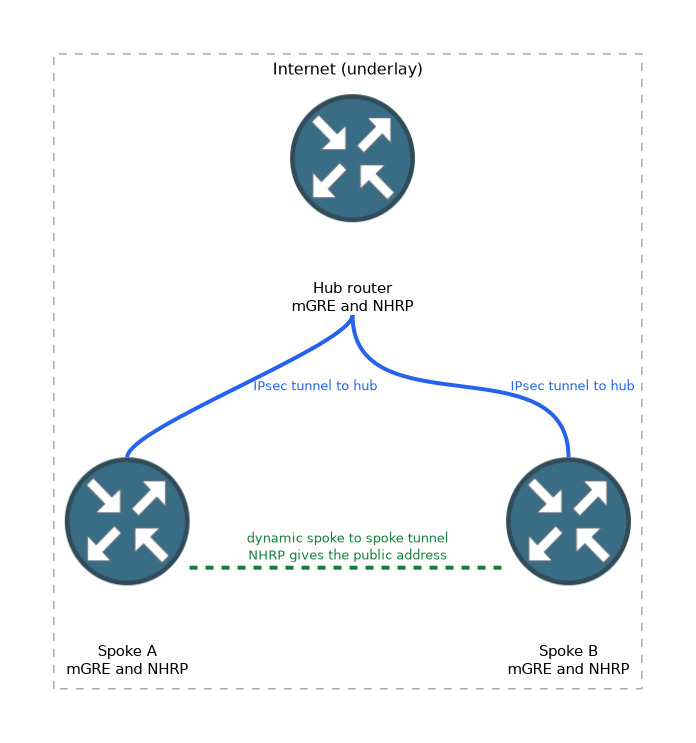 Dynamic Multipoint VPN builds a hub and spoke design that can create spoke to spoke tunnels on demand. It combines four parts.
- mGRE: one tunnel interface that can reach many peers.
- NHRP: maps tunnel addresses to public addresses, so spokes find each other.
- IPsec: protects the tunnels.
- A routing protocol: EIGRP, OSPF or BGP distributes the routes.
DMVPN scales well because the hub needs no per spoke configuration. It runs in phases. Phases 2 and 3 allow spoke to spoke tunnels, and phase 3 also allows route summarisation at the hub.
FlexVPN
FlexVPN is a Cisco framework built on IKEv2. It gives one consistent configuration model for site to site, remote access, hub and spoke and spoke to spoke. It uses smart defaults and supports AAA based authorization, so policy can come from a RADIUS server.
GETVPN
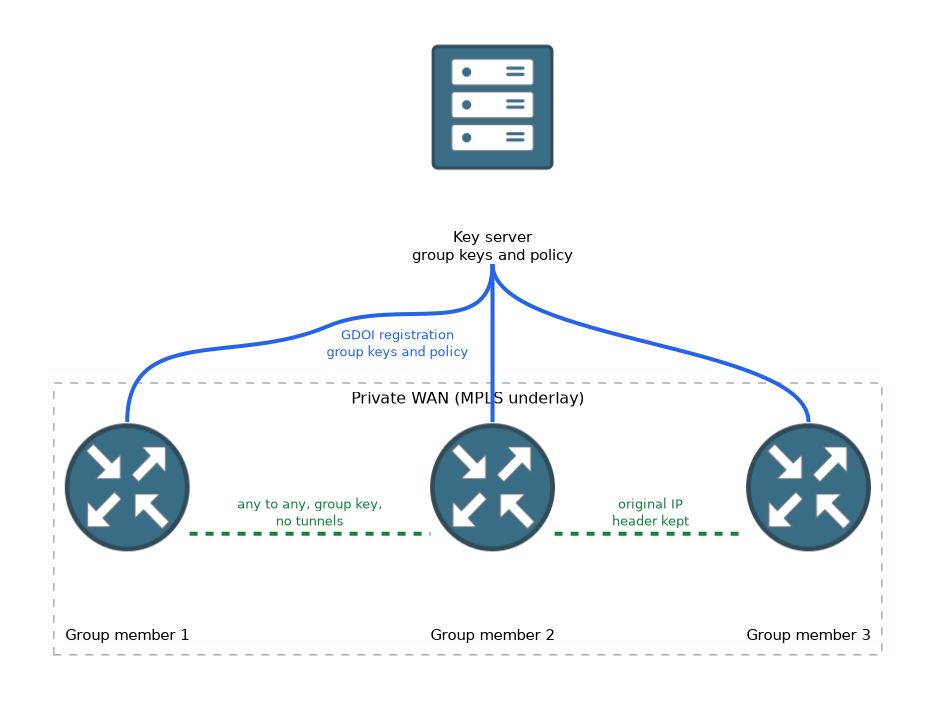 Group Encrypted Transport VPN secures traffic for a group of routers that share a key. It is tunnel-less, so the original IP header is kept and routing and multicast are not changed. It suits private WANs such as MPLS, where the underlay already provides connectivity.
| Component | Role |
|---|---|
| Key server | Creates and distributes the group keys and policy |
| Group member | Router that encrypts and decrypts with the group keys |
| GDOI | The protocol group members use to register with the key server |
Comparison
| Type | Best fit |
|---|---|
| Standards based IPsec | Simple, multi vendor, a few sites |
| VTI | Routed point to point tunnels |
| DMVPN | Many sites, dynamic spoke to spoke |
| FlexVPN | One IKEv2 framework for many designs |
| GETVPN | Any to any encryption over a private WAN |
| SSL VPN | Remote users, works through most networks |
What to remember for the exam
Six facts cover most questions on this topic.
- A VTI is routed, so routing protocols work. A crypto map is policy based.
- DMVPN uses mGRE, NHRP, IPsec and a routing protocol.
- Phase 3 DMVPN supports spoke to spoke tunnels on demand.
- FlexVPN is the IKEv2 based unified framework.
- GETVPN uses a key server and group members and is tunnel-less.
- SSL VPN uses TLS or DTLS and suits remote users behind NAT.
Hub and many spokes with dynamic spoke to spoke traffic points to DMVPN. Encrypting a private WAN without tunnels points to GETVPN.
Common mistakes
These four mistakes appear often.
Calling GETVPN a tunnel technology. It keeps the original header and uses group keys instead of point to point tunnels.
Forgetting NHRP in DMVPN. Without it, spokes cannot learn each other public addresses.
Using crypto maps where routing is needed. A VTI handles routing protocols better.
Mixing up remote access and site to site. Remote access has user client software, and site to site connects whole networks.
Check software release notes before choosing an older VPN type, because feature support differs between IOS XE versions and platforms.
Check yourself
Work through these three questions.
Which four parts make up DMVPN?
mGRE, NHRP, IPsec and a routing protocol such as EIGRP, OSPF or BGP.
What makes GETVPN different from a VTI design?
GETVPN is tunnel-less and uses a key server with group members and shared keys, while a VTI is a point to point routed tunnel.
Why does SSL VPN work well for remote users behind NAT?
It uses TLS or DTLS over web style ports, such as TCP 443, which pass through most firewalls and NAT devices.
Topic 5 of 7 in Security Concepts
Test yourself on Security Concepts
The full Cisco CCNP 350-701 SCOR question bank has 822 questions, with timed practice exams and an explanation for every answer.
This study guide is independent and is not affiliated with, endorsed by, or sponsored by Cisco. Vendor names, certification names and exam codes are trademarks of their respective owners and are used for identification only.