Profiler · Topic 3 of 4
Change of Authorization
Learn how ISE uses RADIUS Change of Authorization to reauthenticate, bounce a port or disconnect a session, and how to configure and troubleshoot CoA.
- 5 min
- Includes a diagram
- CoA lets ISE change a session that is already running.
- It is defined in RFC 5176 as an extension to RADIUS.
- The main types are reauthenticate, port bounce and disconnect.
What it is
Change of Authorization, or CoA, lets ISE change the access of a session that is already running.
Normally the network device asks and ISE answers. CoA turns this round, so ISE sends a message to the device and the device acts on one session.
It is defined in RFC 5176 as an extension to RADIUS.
How it works
The PSN sends a CoA message to the device, which then reauthenticates the session or ends it.
Why CoA is needed
Without CoA, the result from the first authentication stays until the session ends. That is a problem in several flows:
- Profiling: An endpoint starts as unknown, and ISE learns what it is later.
- Guest: The user signs in on a portal after the first authorization.
- Posture: A client passes its compliance check after the first result.
- Block action: An administrator marks an endpoint as blocked.
In each case the first result is out of date, and ISE needs the device to ask again.
CoA types
ISE can send several kinds of CoA. The choice affects how disruptive it is.
| Type | What happens |
|---|---|
| Reauthenticate | The session is authenticated again, and the new result is applied |
| Port bounce | The switch port is shut and then brought up again |
| Disconnect | The session is ended |
Reauthenticate is the gentle one, and it is the usual choice. The port bounce is used when the endpoint has to renew its address, for example after a VLAN change, because a bounce makes the endpoint see a link down and up.
Do not bounce a port that has an IP phone with a PC behind it unless you have to, because both devices lose link.
In the message, the action travels as a Cisco vendor specific attribute. A reauthentication carries a command to reauthenticate, and a port bounce carries a command to bounce the port.
Where the CoA type is set
There are two levels. A global setting under the profiling settings says which CoA type ISE uses when an endpoint changes profile. An individual profiling policy can choose its own, or use the global one.
The authorization flows for guest and posture send a reauthentication by themselves. The type is part of the flow.
Configure the device
The device must allow ISE to send CoA, so the PSN is listed as a client. On IOS XE this uses the dynamic author block.
Switch(config)# aaa server radius dynamic-author
Switch(config-locsvr)# client 10.1.1.11 server-key SECRET
Add an entry for every PSN that may send CoA. If you have several PSNs, a session can be handled by any of them. The device then rejects CoA from a PSN that is not on the list.
On ISE, the network device entry holds the shared secret and, in the RADIUS settings, the CoA port. The CoA port on Cisco devices is UDP 1700 by default, although RFC 5176 names 3799. The key must be the same on both sides.
On a wireless controller the policy profile needs NAC turned on, so that it accepts CoA for the session.
The effect of CoA on a session
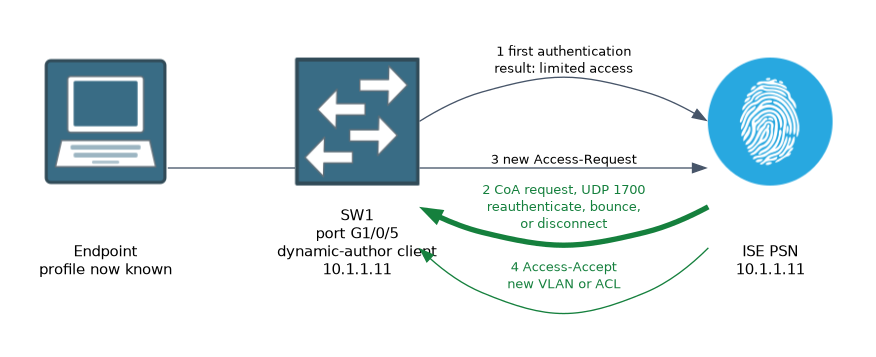 During a reauthentication the device sends a new request, and ISE applies the policy again with the new data. The result may differ from the first. For example, the endpoint gets a new VLAN or ACL.
Be aware of how the VLAN change reaches the endpoint. A VLAN change by reauthentication does not by itself make the endpoint request a new IP address. Many designs avoid VLAN changes after authentication for this reason, and use ACLs instead.
Troubleshooting
Switch# show authentication sessions interface GigabitEthernet1/0/5 details
Switch# debug radius
First check on ISE. The live logs show a CoA event with a status of success or failure, and a failure usually carries a reason.
If ISE shows no CoA sent, look at the policy that should send it. If it shows failure, look at the device.
The common causes of failure are a missing client in the dynamic author block, a wrong shared secret, and a firewall that blocks UDP 1700 between the PSN and the device.
Check the CoA event in the live logs before you change anything else. It tells you whether ISE sent it and how the device replied.
What to remember for the exam
Seven facts cover this topic.
- CoA lets ISE change a session that is already running.
- It is defined in RFC 5176 as an extension to RADIUS.
- The main types are reauthenticate, port bounce and disconnect.
- The device needs
aaa server radius dynamic-authorwith each PSN as a client. - The CoA port is UDP 1700 on Cisco devices by default.
- Profiling, guest, posture and block actions all depend on CoA.
- The live logs show CoA results.
A port bounce drops the link of every device on the port, including a phone and a PC behind it. Prefer reauthentication unless you need an address renewal.
Common mistakes
These four mistakes are common.
Omitting a PSN from the dynamic author block. The device ignores CoA from it.
Shared secret mismatch. CoA fails even though authentication works.
Blocking UDP 1700. The CoA never arrives.
Bouncing ports by default. Users lose connectivity for no reason.
Check yourself
Work through these three questions.
Why is CoA needed in guest and posture flows?
The first authorization is out of date after the user signs in or the client passes the check, so ISE needs the device to authenticate again.
Which command allows a PSN to send CoA to a switch?
aaa server radius dynamic-author, with the PSN added as a client.When is a port bounce used instead of a reauthentication?
When the endpoint has to renew its address, for example after a VLAN change.
Topic 3 of 4 in Profiler
Test yourself on Profiler
The full Cisco CCNP 300-715 SISE question bank has 852 questions, with timed practice exams and an explanation for every answer.
This study guide is independent and is not affiliated with, endorsed by, or sponsored by Cisco. Vendor names, certification names and exam codes are trademarks of their respective owners and are used for identification only.