Cisco Platforms and Development · Topic 2 of 8
Cisco Network Management Platforms and APIs
Learn what Meraki, Catalyst Center, ACI, Catalyst SD-WAN and NSO do, how each is managed through its API, and how to pick the right platform for a task.
- 5 min
- Includes a diagram
- Meraki is cloud managed and uses the Dashboard REST API with an API key.
- Catalyst Center, formerly DNA Center, is an on premises controller with an Intent API.
- ACI is the Cisco data centre fabric, controlled by the APIC, with an object based policy model.
What it is
Cisco network management platforms are controllers that manage many devices through one point, and each exposes an API for automation.
The five on the outline cover different parts of the network. Meraki and Catalyst Center manage campus and branch networks, ACI manages the data centre, SD-WAN manages the wide area network, and NSO orchestrates multi vendor configuration.
Learn each platform in terms of what it manages, how it is deployed and what its API gives you.
How it works
Each platform keeps the desired state centrally and pushes it to devices, which is the benefit of controller based management.
Cisco Meraki
Meraki is a cloud managed platform for wireless, switching, security appliances, cameras and more. The devices connect to the Meraki cloud, and administrators use the Dashboard.
The Dashboard API is a REST API with JSON. It covers organisations, networks, devices, clients and settings.
Requests carry an API key. Beyond the Dashboard API, Meraki also offers webhooks that send alerts to your endpoint.
Cisco Catalyst Center
Catalyst Center was formerly called Cisco DNA Center. It is an on premises controller for campus, branch and wireless networks built on Catalyst devices.
Its features include device inventory, Assurance for network health, software image management, Plug and Play for new devices, and templates for configuration. The REST API groups these as the Intent API. It also has integration features such as events and webhooks that can link to other systems.
Cisco ACI
ACI, or Application Centric Infrastructure, is the Cisco data centre fabric built on Nexus 9000 switches. The controller is the APIC, the Application Policy Infrastructure Controller.
ACI is policy driven. You describe the intent with objects, and the APIC pushes it to the fabric.
| ACI object | Role |
|---|---|
| Tenant | A container for policy and isolation |
| VRF | A routing context |
| Bridge domain | A Layer 2 forwarding domain |
| Endpoint group (EPG) | A group of endpoints with the same policy |
| Contract | Rules that say which EPGs may talk |
The APIC has a REST API that reads and writes this object model, using JSON or XML. Everything in the fabric is a managed object in a tree, which you can query by class or by its place in the tree. Cobra is a Python SDK for the APIC.
Cisco Catalyst SD-WAN
Catalyst SD-WAN, formerly called Cisco SD-WAN, connects branches and sites over any transport. It separates control from data.
Its parts are the manager, which was called vManage, the controllers, the validators, and the WAN edge routers. The manager gives the GUI and a REST API for templates, policies, devices and monitoring.
Cisco NSO
NSO, the Network Services Orchestrator, automates configuration across many devices and across vendors. It is model driven and uses YANG for both device models and service models.
Network element drivers, or NEDs, let NSO talk to each device type. A service model describes the service once, and NSO works out the device configuration.
Changes are transactional, so a failed change can be rolled back. NSO offers RESTCONF and NETCONF interfaces for automation.
Comparing the platforms
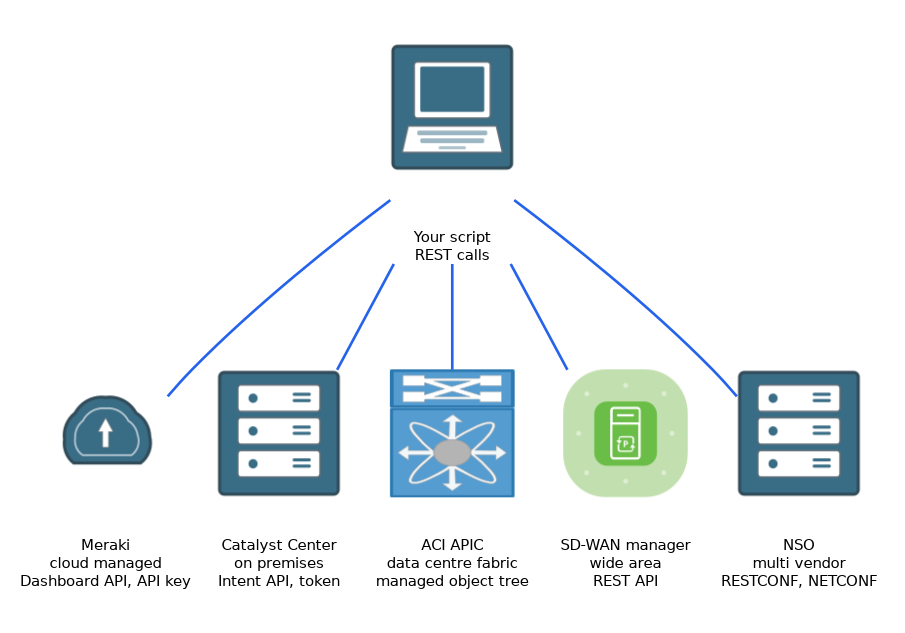
| Platform | Main domain | Deployment | API highlights |
|---|---|---|---|
| Meraki | Cloud managed campus and branch | Cloud | Dashboard REST API with API key |
| Catalyst Center | Campus and branch with Catalyst | On premises | Intent REST API with token |
| ACI | Data centre fabric | On premises APIC | REST API on the managed object tree |
| SD-WAN | Wide area | Manager, controllers and edges | Manager REST API |
| NSO | Multi vendor orchestration | Software you run | RESTCONF and NETCONF on YANG models |
Typical API tasks
- List devices and clients, and read their status.
- Create or change a network, a policy or a template.
- Push configuration to many devices at once.
- Read health and fault data for monitoring.
Match the platform to the domain. Cloud managed branch points to Meraki, Catalyst campus points to Catalyst Center, data centre points to ACI, WAN points to SD-WAN, and multi vendor orchestration points to NSO.
What to remember for the exam
Six facts cover this topic.
- Meraki is cloud managed and uses the Dashboard REST API with an API key.
- Catalyst Center, formerly DNA Center, is an on premises controller with an Intent API.
- ACI is the Cisco data centre fabric, controlled by the APIC, with an object based policy model.
- Catalyst SD-WAN manages the wide area, and its manager has a REST API.
- NSO orchestrates multi vendor networks using YANG models and NEDs.
- A controller offers one place to manage many devices and one API for automation.
Common mistakes
Four mistakes are typical.
Putting Meraki on premises. Meraki is managed from the cloud, even though the devices are on site.
Forgetting the old names. Catalyst Center was DNA Center, and the SD-WAN manager was vManage. Exam material can use either.
Treating NSO as a device controller for one vendor only. It is designed for multi vendor networks.
Assuming ACI is configured box by box. You describe policy on the APIC, which applies it to the fabric.
Do not assume that every platform authenticates the same way. Meraki uses an API key, while Catalyst Center uses a token from a login call.
Check yourself
Work through these three questions.
Which of the five platforms is managed from the cloud and uses an API key?
Meraki, through the Dashboard API.
What controller manages Cisco ACI?
The APIC, the Application Policy Infrastructure Controller.
What makes NSO different from a controller for a single product line?
It orchestrates multi vendor networks using YANG models and NEDs.
Topic 2 of 8 in Cisco Platforms and Development
Test yourself on Cisco Platforms and Development
The full Cisco CCNA 200-901 DEVASC question bank has 808 questions, with timed practice exams and an explanation for every answer.
This study guide is independent and is not affiliated with, endorsed by, or sponsored by Cisco. Vendor names, certification names and exam codes are trademarks of their respective owners and are used for identification only.