Data Protection · Topic 2 of 7
Hybrid Connectivity Encryption
Encrypt traffic between on premises and AWS with Site to Site VPN, Client VPN, and Direct Connect with MACsec or VPN, plus encryption between instances.
- 6 min
- Includes a diagram
- Site to Site VPN uses IPsec, has two tunnels per connection, and can end on a virtual private gateway or Transit Gateway.
- Direct Connect is private but not encrypted by default.
- Encrypt Direct Connect with an IPsec VPN over it, with MACsec on supported dedicated connections, or with application TLS.
What it is
Traffic between a data centre and AWS crosses networks you do not control. Encryption in transit for hybrid links means choosing a connection type and adding encryption where the connection does not provide it.
The exam tests which options encrypt by default, which do not, and how to add encryption without losing bandwidth.
How it works
AWS Site to Site VPN
Site to Site VPN builds IPsec (Internet Protocol Security) tunnels between your customer gateway device and AWS. Each VPN connection has two tunnels for redundancy, in different Availability Zones. It ends on a virtual private gateway for one VPC, or on a Transit Gateway for many VPCs.
- Traffic is encrypted and authenticated by IPsec, and it crosses the public internet by default.
- Routing can be static or dynamic with BGP (Border Gateway Protocol), and dynamic routing is preferred for failover.
- Accelerated VPN uses AWS Global Accelerator to carry the tunnel over the AWS backbone sooner, for better performance. It is available on Transit Gateway attachments.
- Throughput per tunnel is limited, so large needs use equal cost multi path (ECMP) over multiple tunnels on a Transit Gateway.
AWS Direct Connect
Direct Connect provides a dedicated private network connection from your site to AWS. It gives consistent latency and bandwidth, but it is not encrypted by default. Data on a Direct Connect link is private only in the sense that it does not use the public internet.
To encrypt, choose one of these approaches.
| Option | How it encrypts | Notes |
|---|---|---|
| IPsec VPN over Direct Connect | Site to Site VPN tunnels carried over a public or transit virtual interface | Adds encryption at layer 3, with VPN throughput limits per tunnel |
| MACsec | IEEE 802.1AE encryption at layer 2 between your device and the Direct Connect location | Available on supported dedicated connections, a point to point link only |
| Application layer TLS | The application encrypts the data | Works on any path, and protects end to end |
Choose MACsec when you need line rate encryption on a dedicated connection and your equipment supports it. Choose VPN over Direct Connect when you need IPsec and the bandwidth is within tunnel limits. Choose application TLS when only certain flows need protection.
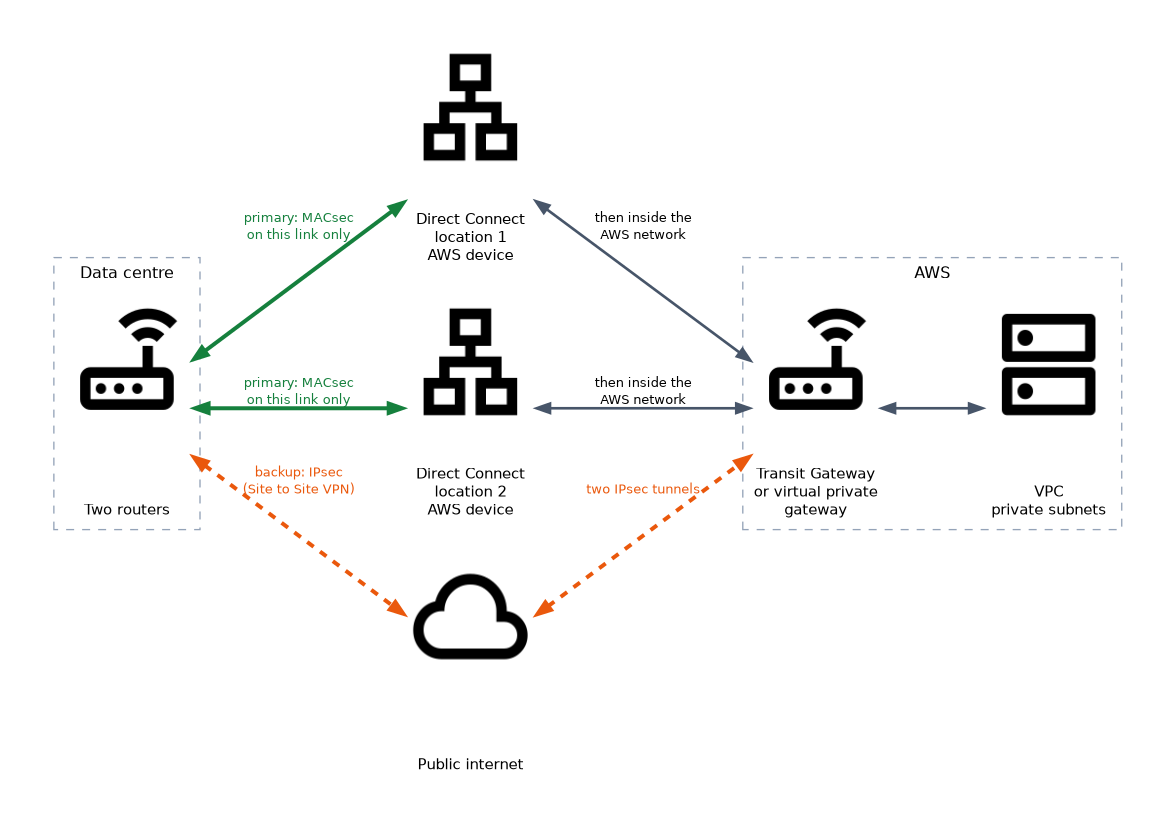
MACsec protects only the leg between your device and the AWS device at the Direct Connect location. After that, traffic travels inside the AWS network, which is not visible to others.
AWS Client VPN
Client VPN is a managed, OpenVPN based service for individual users to reach VPC and on premises resources. It uses TLS, and supports these authentication methods.
- Mutual authentication with client certificates, which can come from ACM or Private CA.
- Active Directory authentication through AWS Directory Service.
- SAML based federation for single sign on.
Authorization rules control which networks each user group can reach, and security groups on the endpoint's network interfaces add another layer. Split tunnel mode sends only the VPC traffic through the VPN and the rest directly to the internet.
Encryption inside AWS
- Between Nitro instances. Traffic between supported instance types within a VPC, or in peered VPCs in the same Region, is automatically encrypted at the hardware level on the network. It does not replace TLS to the application, but adds a protective layer.
- Between Regions. AWS encrypts inter Region traffic on its backbone for VPC peering and Transit Gateway peering. Use application TLS for sensitive flows regardless.
- PrivateLink and endpoints. Connections to AWS APIs use TLS even when they travel through a private endpoint.
- Service to service. Each service has an option, such as in transit encryption for Amazon MSK, ElastiCache and EMR.
Choosing
| Requirement | Choose |
|---|---|
| Quick, encrypted link over the internet | Site to Site VPN |
| Encrypted link with more bandwidth and lower variability | VPN over Direct Connect or MACsec |
| Individual remote workers reach private resources | Client VPN |
| Encrypt a database connection | TLS in the database client with certificate validation |
| Highest assurance for a specific flow | Application layer encryption |
Resilience and security together
!A data centre with two routers connects over two Direct Connect locations with MACsec on the link to each AWS device and then inside the AWS network, with a Site to Site VPN of two IPsec tunnels over the public internet as backup, all ending at a Transit Gateway or virtual private gateway and the VPC. A single Direct Connect link is a single point of failure. A common design uses two Direct Connect connections at different locations, plus a Site to Site VPN as a backup path. This is cost effective, and the VPN keeps the encryption path available if both private links fail.
Operational controls
Restrict who can create virtual interfaces and gateways with IAM. Use security groups and network ACLs to allow only on premises ranges. Monitor tunnel state with CloudWatch metrics and alarms, and log VPN activity.
What to remember for the exam
- Site to Site VPN uses IPsec, has two tunnels per connection, and can end on a virtual private gateway or Transit Gateway.
- Direct Connect is private but not encrypted by default.
- Encrypt Direct Connect with an IPsec VPN over it, with MACsec on supported dedicated connections, or with application TLS.
- MACsec protects the layer 2 link only between your device and the AWS device.
- Client VPN gives user level remote access, with certificate, Active Directory or SAML authentication.
- Traffic between supported Nitro instances is encrypted in transit automatically.
- A Site to Site VPN is a common backup for a Direct Connect link.
- Dynamic BGP routing gives faster failover than static routes.
When a scenario needs "private, consistent bandwidth with encryption", look for Direct Connect combined with VPN or MACsec, not Direct Connect alone.
Common mistakes
Assuming Direct Connect is encrypted. It is private, but not encrypted unless you add MACsec, VPN or TLS.
Expecting MACsec to protect end to end. It covers only the link to the AWS device.
Using only one VPN tunnel. The second tunnel provides redundancy during AWS maintenance.
Relying on static routes. Failover is manual, while BGP moves traffic automatically.
IPsec VPN throughput over a single tunnel is limited, so a design that needs high bandwidth should use multiple tunnels with ECMP on a Transit Gateway or a different method.
Check yourself
Is Direct Connect traffic encrypted by default?
No, it is private but unencrypted, so add MACsec, an IPsec VPN or application TLS.
What are the authentication options for Client VPN?
Mutual certificate authentication, Active Directory and SAML federation.
How many tunnels does a Site to Site VPN connection have?
Two, for redundancy.
Topic 2 of 7 in Data Protection
Test yourself on Data Protection
The full AWS SCS-C03 question bank has 858 questions, with timed practice exams and an explanation for every answer.
This study guide is independent and is not affiliated with, endorsed by, or sponsored by AWS. Vendor names, certification names and exam codes are trademarks of their respective owners and are used for identification only.