Snowflake Gen AI Functions · Topic 9 of 26
VECTOR Data Type and Similarity Functions - Inner Product, L1, L2 and Cosine
Understand the VECTOR type and the four vector similarity functions. Know which are higher is closer or lower is closer, plus return types and precision.
- 4 min
- Includes a diagram
VECTOR(INT or FLOAT, dimension), with a maximum dimension of 4096.- Cosine similarity is a
FLOATfrom -1 to 1; inner product is larger for similar vectors. - L1 and L2 are distances: smaller means closer, and L2 of 0 means identical.
What it is
Snowflake has a VECTOR data type for embeddings and a family of vector functions that work on it. Four of them compare two vectors: VECTOR_INNER_PRODUCT, VECTOR_L1_DISTANCE, VECTOR_L2_DISTANCE and VECTOR_COSINE_SIMILARITY. You use them for semantic search, recommendations and duplicate detection on embeddings created by AI_EMBED.
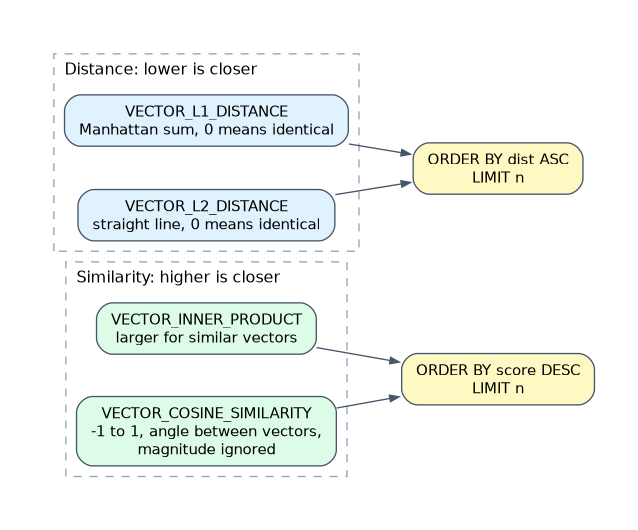
The most important exam skill is knowing which direction is "closer". Similarity functions give larger numbers for closer vectors. Distance functions give smaller numbers for closer vectors.
How it works
The VECTOR type
The syntax is VECTOR(<type>, <dimension>). The element type is INT (32 bit integers) or FLOAT (32 bit floating point). The dimension is a positive integer with a maximum of 4096.
CREATE TABLE docs (id INT, embedding VECTOR(FLOAT, 1024));
SELECT [0.1, 0.2, 0.3]::VECTOR(FLOAT, 3);
Important rules:
- An array can be explicitly cast to
VECTORif its element count equals the dimension and its element type matches. AVECTORcan be cast back to an array. VECTORcolumns cannot be loaded or unloaded directly. Unload as an array and cast back after loading.- A
VECTORcannot be stored in aVARIANTcolumn or used as a clustering key. - Direct comparisons such as
v1 < v2are byte wise and are not numeric, so use the similarity functions to compare vectors.
The four comparison functions
| Function | Returns | Closer vectors give | Notes |
|---|---|---|---|
VECTOR_COSINE_SIMILARITY | FLOAT from -1 to 1 | Higher value | Angle between vectors; magnitude ignored |
VECTOR_INNER_PRODUCT | REAL | Higher value | Larger for similar vectors |
VECTOR_L2_DISTANCE | FLOAT, 0 or more | Lower value | Straight line distance; 0 means identical |
VECTOR_L1_DISTANCE | FLOAT, 0 or more | Lower value | Sum of absolute differences (Manhattan); 0 means identical |
All four take two VECTOR arguments of the same element type and dimension.
SELECT id,
       VECTOR_COSINE_SIMILARITY(embedding, q.vec) AS sim
FROM docs, (SELECT AI_EMBED('snowflake-arctic-embed-l-v2.0', 'reset password')::VECTOR(FLOAT, 1024) AS vec) q
ORDER BY sim DESC
LIMIT 5;
With cosine similarity, identical vectors return 1, orthogonal vectors return 0 and opposite vectors return -1. With distances, you sort ascending (ORDER BY dist ASC) to get the nearest rows.
Choosing a function
| Scenario | Best fit |
|---|---|
| Embeddings where direction matters more than length | VECTOR_COSINE_SIMILARITY |
| Vectors that were normalized first | VECTOR_INNER_PRODUCT or cosine, which then agree on ranking |
| A true distance in space, with 0 as identical | VECTOR_L2_DISTANCE |
| A distance that is less sensitive to one large difference in one dimension | VECTOR_L1_DISTANCE |
When a question says "highest score is best", the answer is cosine similarity or inner product. When it says "lowest value is best", the answer is L1 or L2 distance.
Precision
Vector functions are optimized in a way that can reduce floating point precision. Results can have a margin of error up to 1e-4, so do not test two scores for exact equality.
VECTOR_COSINE_SIMILARITY is not supported in the Snowpark API. In Snowpark, use SQL for that function.
Where embeddings come from
AI_EMBED produces VECTOR values. Search at scale is better done by a Cortex Search service, but the vector functions are what you use when you manage the embedding column yourself.
Common mistakes
Sorting a distance descending. The largest distance is the farthest row.
Sorting a similarity ascending. The smallest similarity is the least relevant row.
Comparing vectors of different dimensions or element types. Both inputs must match.
Using < or = on vectors to compare them. That is a byte comparison, not a numeric one.
Expecting exact scores. Results have a margin of error up to 1e-4.
What to remember for the exam
VECTOR(INT or FLOAT, dimension), with a maximum dimension of 4096.- Cosine similarity is a
FLOATfrom -1 to 1; inner product is larger for similar vectors. - L1 and L2 are distances: smaller means closer, and L2 of 0 means identical.
- All take two vectors of equal type and dimension.
- Margin of error is up to 1e-4.
VECTOR_COSINE_SIMILARITYis not available in the Snowpark API.
Check yourself
Which functions return larger numbers for more similar vectors?
VECTOR_COSINE_SIMILARITYandVECTOR_INNER_PRODUCT.What does an L2 distance of 0 mean?
The two vectors are identical.
What is the largest dimension of a
VECTOR?4096.
Topic 9 of 26 in Snowflake Gen AI Functions
Test yourself on Snowflake Gen AI Functions
The full Snowflake GES-C02 question bank has 585 questions, with timed practice exams and an explanation for every answer.
This study guide is independent and is not affiliated with, endorsed by, or sponsored by Snowflake. Vendor names, certification names and exam codes are trademarks of their respective owners and are used for identification only.