Data Governance · Topic 5 of 7
Row Access and Aggregation Policies
Secure Snowflake rows with row access policies, mapping tables and secure views, and limit small group results with aggregation policies and group size.
- 4 min
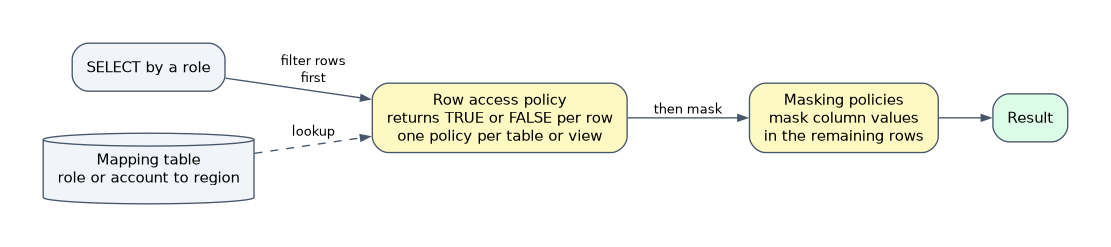
- Includes a diagram
- Row-level options: row access policy (preferred), secure view with
CURRENT_ROLE(), secure view with a mapping table. CREATE ROW ACCESS POLICY ... RETURNS BOOLEAN, attached withADD ROW ACCESS POLICY ... ON (col); one per table or view.- Row access policies run before masking policies.
What it is
Row-level security decides which rows a user can see. Two users run the same query on the same table, and each gets only their permitted rows. An aggregation policy goes a different way. It allows queries only if they combine enough rows, so no single person can be singled out.
How it works
Options for row-level security
| Option | How it works | Fit |
|---|---|---|
| Row access policy | A policy attached to a table or view returns TRUE for rows a user may see | The standard answer, centrally managed |
| Secure view with a role filter | A secure view uses WHERE region = ... driven by CURRENT_ROLE() | Older approach, more objects to manage |
| Secure view with a mapping table | The view joins a table that maps roles or users to allowed values | Flexible, but access must be through the view |
| Secure share views | Views for consumers that filter by the consumer account | Data sharing |
A row access policy is preferred because it protects the table itself, so there is no unprotected path around it, and one policy can be reused.
Row access policies
CREATE ROW ACCESS POLICY region_policy AS (region_val VARCHAR)
RETURNS BOOLEAN ->
  CURRENT_ROLE() = 'ADMIN_ROLE'
  OR EXISTS (
    SELECT 1 FROM governance.maps.role_region m
    WHERE m.role_name = CURRENT_ROLE()
      AND m.region    = region_val
  );

ALTER TABLE sales ADD ROW ACCESS POLICY region_policy ON (region);- The policy takes one or more columns as input, listed in the
ON (...)clause. - It returns TRUE to allow the row and FALSE to hide it.
- The policy runs at query time, and a user who cannot see rows gets no error. The rows simply are not there.
- A table or view can have only one row access policy at a time.
- The policy applies to
SELECTand also limits which rowsUPDATE,DELETEandMERGEcan touch. - Row access policies are evaluated before column masking policies.
- It needs Enterprise edition or higher.
Use a mapping table so access changes by inserting a row, not by rewriting the policy.
| role_name | region |
|---|---|
| EMEA_ANALYST | EMEA |
| APAC_ANALYST | APAC |
| GLOBAL_ANALYST | EMEA |
| GLOBAL_ANALYST | APAC |
Row access policies work on views and tables, and a secure view can still sit on top for extra column control. Policy evaluation is part of the query, so keep the body simple and the mapping table small to avoid slow queries.
Aggregation policies
An aggregation policy requires that a query returns groups of at least N rows. Rows in groups that are too small are not shown individually.
CREATE AGGREGATION POLICY min_five AS ()
  RETURNS AGGREGATION_CONSTRAINT ->
  CASE WHEN CURRENT_ROLE() = 'DATA_OWNER'
       THEN NO_AGGREGATION_CONSTRAINT()
       ELSE AGGREGATION_CONSTRAINT(MIN_GROUP_SIZE => 5)
  END;

ALTER TABLE patients SET AGGREGATION POLICY min_five;- Users with the constraint must aggregate, for example with
COUNT,SUMorAVGandGROUP BY. A query that selects raw rows is blocked. - Groups smaller than
MIN_GROUP_SIZEare combined into a leftover group, so individuals cannot be picked out. NO_AGGREGATION_CONSTRAINT()lets chosen roles run unrestricted queries.- The policy sits on a table or view, not on a column.
- An optional entity key,
ENTITY KEY (patient_id), tells Snowflake what counts as an entity, so a group size means distinct people and not rows.
| Row access policy | Aggregation policy | |
|---|---|---|
| Question answered | Which rows can this user see | Can this user see only summaries |
| Applied to | Table or view | Table or view |
| Result | Fewer rows, still row level | Aggregated rows with groups of at least N |
| Typical case | Regional sales teams | Healthcare or clean room analytics |
An aggregation policy limits how data can be queried. It does not hide columns. Pair it with masking or projection policies if some columns must never appear.
Common mistakes
Adding two row access policies to one table. Only one is allowed. Combine the logic in one policy.
Expecting an error when rows are hidden. The query succeeds with fewer rows.
Using an aggregation policy as column protection. It controls group size, not columns.
Forgetting views. A row access policy on a base table also applies to views built on it.
What to remember for the exam
- Row-level options: row access policy (preferred), secure view with
CURRENT_ROLE(), secure view with a mapping table. CREATE ROW ACCESS POLICY ... RETURNS BOOLEAN, attached withADD ROW ACCESS POLICY ... ON (col); one per table or view.- Row access policies run before masking policies.
AGGREGATION_CONSTRAINT(MIN_GROUP_SIZE => n)forces summary queries;NO_AGGREGATION_CONSTRAINT()exempts a role.
Check yourself
How many row access policies can a table have?
One at a time, so combine rules in a single policy.
What does a row access policy return for rows a user must not see?
FALSE, so those rows are silently left out of the results.
What does MIN_GROUP_SIZE control?
The minimum number of rows in a group before results can be shown, which stops queries from identifying individuals.
Topic 5 of 7 in Data Governance
Test yourself on Data Governance
The full Snowflake DEA-C02 question bank has 709 questions, with timed practice exams and an explanation for every answer.
This study guide is independent and is not affiliated with, endorsed by, or sponsored by Snowflake. Vendor names, certification names and exam codes are trademarks of their respective owners and are used for identification only.