Data Collaboration · Topic 3 of 5
Secure Data Sharing - Providers, Consumers and Reader Accounts
How Snowflake Secure Data Sharing works without copying data: provider and consumer accounts, who pays, imported databases and reader accounts.
- 5 min
- Includes a diagram
- Secure Data Sharing copies no data; consumers read live, read-only data with their own compute.
- Provider pays storage; consumer pays compute; for reader accounts the provider pays compute too.
- ACCOUNTADMIN or the CREATE SHARE privilege is needed to create shares.
What it is
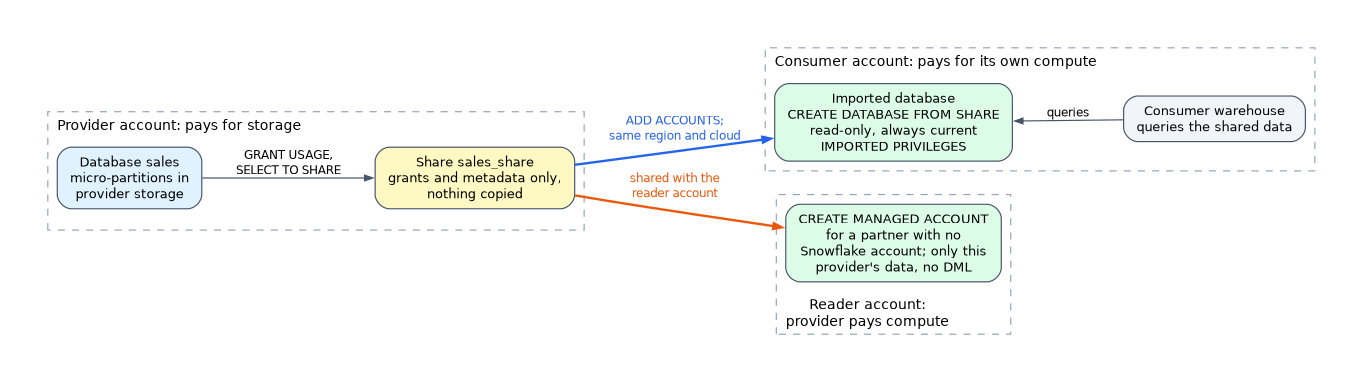
Secure Data Sharing lets one Snowflake account give another account live, read-only access to selected objects. No data is copied or moved. The consumer queries the provider's micro-partitions directly through Snowflake's services layer, so it always sees current data.
Every sharing scenario has two sides. The provider owns the data and creates the share. The consumer receives it. A reader account is a special consumer the provider creates for someone who has no Snowflake account.
How it works
Why nothing is copied
Snowflake separates storage from compute. A share holds only grants and metadata, pointing at objects in the provider's storage. When a consumer queries, its own virtual warehouse reads the provider's micro-partitions.
This gives the key properties the exam tests:
- No copy, no ETL: data is available the moment it is granted.
- Always current: provider changes are visible right away.
- Read-only: consumers cannot insert, update, delete or create objects in shared data.
- Revocable: the provider removes access by revoking grants or removing the account from the share.
Who pays for what
| Cost | Normal consumer | Reader account |
|---|---|---|
| Storage of shared data | Provider | Provider |
| Compute to query the data | Consumer (its own warehouse) | Provider (owns the reader account) |
| Storage in the consumer account | None for shared data | None for shared data |
The provider side
Creating shares requires the ACCOUNTADMIN role or a role with the global CREATE SHARE privilege. The provider grants privileges on the database, schema and objects to the share, then adds consumer accounts.
CREATE SHARE sales_share;
GRANT USAGE ON DATABASE sales TO SHARE sales_share;
GRANT USAGE ON SCHEMA sales.public TO SHARE sales_share;
GRANT SELECT ON TABLE sales.public.orders TO SHARE sales_share;
ALTER SHARE sales_share ADD ACCOUNTS = myorg.partner_acct;
Shared objects include databases, tables, dynamic tables, external tables, Apache Iceberg tables, secure views (regular views only when the share is created with SECURE_OBJECTS_ONLY = FALSE), secure materialized views and UDFs. Secure objects hide their definitions from the consumer. The next page covers these features in detail.
The consumer side
The consumer sees inbound shares and creates one database from each share. A share can be consumed only once per account, and the result is an imported database.
CREATE DATABASE partner_sales FROM SHARE provider_org.provider_acct.sales_share;
GRANT IMPORTED PRIVILEGES ON DATABASE partner_sales TO ROLE analyst;
Access to an imported database is granted with IMPORTED PRIVILEGES, not with object-by-object grants. If the provider organized objects with database roles, the consumer grants those database roles to its account roles instead.
Imported databases have firm limits:
- They are read-only.
- They cannot be cloned, and Time Travel cannot be used on them.
- They cannot be replicated.
Reader accounts
A reader account (a managed account) lets a provider share with a party that is not a Snowflake customer.
CREATE MANAGED ACCOUNT partner_reader
ADMIN_NAME = reader_admin, ADMIN_PASSWORD = '<password>', TYPE = READER;| Property | Full consumer account | Reader account |
|---|---|---|
| Who owns and pays | The consumer | The provider |
| Data it can query | Shares from any provider, plus its own data | Only data shared by the provider that created it |
| Load or modify data (DML) | Yes, in its own databases | No |
| Typical use | Partner who is a Snowflake customer | Partner with no Snowflake account |
"The partner does not have a Snowflake account" points to a reader account. "The provider must not pay for the partner's queries" points to a full consumer account instead.
Region rule
A direct share works only between accounts in the same region and cloud platform. Cross-region and cross-cloud sharing uses replication or a listing with Cross-Cloud Auto-Fulfillment.
Common mistakes
Thinking sharing copies data. Shares contain grants, not data. That is why access is instant and the consumer uses no storage for shared data.
Assigning compute cost to the provider for normal consumers. Normal consumers pay for their own warehouses. Only reader accounts make the provider pay for compute.
Granting SELECT on objects in an imported database. Consumers grant IMPORTED PRIVILEGES on the whole imported database, or the provider's database roles.
Expecting reader accounts to load data. Reader accounts can query shared data but cannot load, insert or update data.
Sharing directly across regions. A direct share cannot reach another region; replicate first or use a listing.
What to remember for the exam
- Secure Data Sharing copies no data; consumers read live, read-only data with their own compute.
- Provider pays storage; consumer pays compute; for reader accounts the provider pays compute too.
- ACCOUNTADMIN or the CREATE SHARE privilege is needed to create shares.
- Consumers create one database per share and grant IMPORTED PRIVILEGES to roles.
- Imported databases cannot be modified, cloned, time traveled or replicated.
- Reader accounts are created with CREATE MANAGED ACCOUNT ... TYPE = READER, belong to the provider and can only query that provider's shares.
- Direct shares are same-region only.
A consumer that drops its imported database does not affect the provider's data. The provider's data and share are unchanged, and the consumer can create the database from the share again.
Check yourself
Who pays for compute when a reader account queries shared data?
The provider, because it creates and owns the reader account.
How does a consumer let its analyst role query an imported database?
GRANT IMPORTED PRIVILEGES ON DATABASE to that role, or grant the provider's database roles to it.
Why does a consumer see a provider's update immediately?
The share points to the provider's live micro-partitions, so no copy exists that could be out of date.
Topic 3 of 5 in Data Collaboration
Test yourself on Data Collaboration
The full Snowflake SnowPro Core COF-C03 question bank has 845 questions, with timed practice exams and an explanation for every answer.
This study guide is independent and is not affiliated with, endorsed by, or sponsored by Snowflake. Vendor names, certification names and exam codes are trademarks of their respective owners and are used for identification only.