Snowflake Security, RBAC, and User Administration · Topic 1 of 16
Administrative Roles - ORGADMIN, ACCOUNTADMIN and System Role Hierarchy
Manage Snowflake administrative roles: ORGADMIN and ACCOUNTADMIN use cases, system role hierarchy, securing ACCOUNTADMIN and creating extra administrators.
- 5 min
- Includes a diagram
- USERADMIN manages users and roles; SECURITYADMIN manages grants and inherits USERADMIN; SYSADMIN creates objects; ACCOUNTADMIN encapsulates SYSADMIN and SECURITYADMIN.
- GLOBALORGADMIN is the recommended organization role; ORGADMIN is being phased out for multi account organizations.
- At least two ACCOUNTADMIN users, MFA, business email, never a default role, no object creation, no scripts.
What it is
An administrator on the exam is the person who decides which administrative role does a job, and who keeps the most powerful roles safe. Snowflake ships with system-defined roles in a fixed hierarchy. Each role has a narrow purpose, and the questions test whether you pick the narrowest role that can do the task.
The organization level sits above the accounts. It is handled by ORGADMIN and, in the organization account, by GLOBALORGADMIN. The account level is handled by ACCOUNTADMIN and the roles below it.
How it works
System-defined roles and their hierarchy
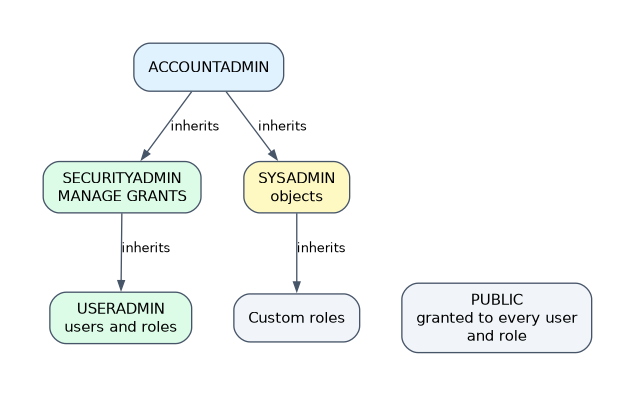
| Role | Use it for |
|---|---|
| ORGADMIN | Organization tasks such as managing accounts and viewing organization usage. The docs say it is being phased out for multi account organizations in favor of GLOBALORGADMIN |
| GLOBALORGADMIN | The recommended organization role; it exists in the organization account |
| ACCOUNTADMIN | Top account role; encapsulates SYSADMIN and SECURITYADMIN |
| SECURITYADMIN | Holds MANAGE GRANTS; manages grants on any object; inherits USERADMIN |
| USERADMIN | Holds CREATE USER and CREATE ROLE; user and role management only |
| SYSADMIN | Creates warehouses, databases and other objects |
| PUBLIC | Granted to every user and role automatically |
The docs state that there is no super role in Snowflake that bypasses authorization checks, not even ACCOUNTADMIN. It simply sits at the top of the hierarchy and so inherits a lot.
ORGADMIN and ACCOUNTADMIN use cases
- ORGADMIN or GLOBALORGADMIN: manage the accounts of the organization and read organization level usage and billing views. Describe the change only as the docs do: GLOBALORGADMIN is the recommended role and ORGADMIN is being phased out for multi account organizations, with at least three months notice.
- ORGADMIN in an account: the first account of an organization has it enabled. It can enable it in another account with
ALTER ACCOUNT <name> SET IS_ORG_ADMIN = TRUE. - ACCOUNTADMIN: account level settings such as account parameters, resource monitors and billing visibility.
CREATE INTEGRATIONandCREATE ACCOUNT(reader accounts) must be granted by ACCOUNTADMIN. - Not for daily work: do not create objects or run scripts as ACCOUNTADMIN. Use SYSADMIN or lower roles for databases and warehouses.
Impact of organization level changes on account objects
Organization level actions act on whole accounts, not on the objects inside them. Enabling ORGADMIN in an account, creating an account, or changing which account holds the role does not move or change databases, roles or grants in other accounts. Each account keeps its own users, roles and objects, so access must be set up again in a new account (or provisioned through replication, covered in the replication chapter).
Securing ACCOUNTADMIN
The docs list these practices:
- Grant it to a limited number of people.
- Require MFA for every user with the role.
- Assign it to at least two users, because Snowflake's password reset path for these users can take up to two business days.
- Record a current business email for each ACCOUNTADMIN user so Support can reach them.
- Never make it a default role; set another default so the switch is deliberate.
- Do not create objects with it and do not use it for automated scripts.
An object created while using ACCOUNTADMIN is owned by ACCOUNTADMIN, so lower roles cannot manage it unless they hold MANAGE GRANTS. Create objects with SYSADMIN.
Creating additional administrators
Grant the system role rather than building a copy. Use USERADMIN to create the user, then a role with the right privilege to grant the system role.
USE ROLE USERADMIN;
CREATE USER dba_ana PASSWORD = '...' DEFAULT_ROLE = SYSADMIN MUST_CHANGE_PASSWORD = TRUE;
USE ROLE SECURITYADMIN;
GRANT ROLE SYSADMIN TO USER dba_ana;
For a narrower administrator, create a custom role with only the privileges needed (for example MANAGE WAREHOUSES) and grant it to the user and up to SYSADMIN. Snowflake recommends not mixing account management privileges with entity specific privileges in one role.
When a question needs a second ACCOUNTADMIN, the answer is a named user with MFA, a business email and a non ACCOUNTADMIN default role.
Common mistakes
Using ACCOUNTADMIN as the default role. One wrong statement then runs with maximum power.
Giving SECURITYADMIN object creation work. MANAGE GRANTS does not create objects by itself; SYSADMIN owns objects.
Assuming organization changes alter account content. They do not; account objects stay inside their account.
Using one shared ACCOUNTADMIN login. It breaks auditing and MFA.
What to remember for the exam
- USERADMIN manages users and roles; SECURITYADMIN manages grants and inherits USERADMIN; SYSADMIN creates objects; ACCOUNTADMIN encapsulates SYSADMIN and SECURITYADMIN.
- GLOBALORGADMIN is the recommended organization role; ORGADMIN is being phased out for multi account organizations.
- At least two ACCOUNTADMIN users, MFA, business email, never a default role, no object creation, no scripts.
- Custom roles should roll up to SYSADMIN.
- Extra administrators get system roles or least privilege custom roles through grants.
Check yourself
Which role should own databases and warehouses?
SYSADMIN, with custom roles granted to it so the tree stays manageable.
Why keep at least two ACCOUNTADMIN users?
Password resets for these users can take up to two business days, and a second administrator can reset a colleague.
Does creating a new account change objects in other accounts?
No, organization level actions do not change account level objects in other accounts.
Topic 1 of 16 in Snowflake Security, RBAC, and User Administration
Test yourself on Snowflake Security, RBAC, and User Administration
The full Snowflake ADA-C02 question bank has 814 questions, with timed practice exams and an explanation for every answer.
This study guide is independent and is not affiliated with, endorsed by, or sponsored by Snowflake. Vendor names, certification names and exam codes are trademarks of their respective owners and are used for identification only.