Configuration · Topic 2 of 2
The IRE and CMDB 360
The IRE and CMDB 360 for the CIS-DF exam: identification rules, reconciliation and data refresh rules, data source rules, and multisource CMDB.
- 6 min
- Includes a diagram
- Identify first, reconcile second; reconciliation applies only to updates.
- One identification rule per class, inherited down the hierarchy; identifier entries are tried in priority order.
- Dependent identification needs the hosting or containment relationship in the payload.
What it is
The Identification and Reconciliation Engine (IRE) is the gatekeeper for CMDB data. Every source that writes CIs should send its data through it. The IRE first identifies the CI (is this a CI we already have?), then reconciles it (is this source allowed to update these attributes?).
CMDB 360, which absorbed the older Multisource CMDB feature, adds a record of what every source reported for every attribute. The CI still shows one value, but you can see and compare all the values behind it.
How it works
Identification rules
Each class has one identification rule, inherited from its parent unless the class has its own. A rule holds identifier entries, each a set of criterion attributes with a priority. The IRE tries the entries in priority order until one finds a match.
Criterion attributes can sit on the class table, on a lookup table such as serial numbers or network adapters, or both. Lookup tables let one CI be matched on any of several values.
| Rule type | How the CI is identified | Typical classes |
|---|---|---|
| Independent | By its own attributes alone | Servers, network gear |
| Dependent | By its attributes plus a dependent relationship to a parent CI | Applications or databases hosted on a server |
A dependent CI cannot be identified without its parent. If the payload does not include the hosting or containment relationship, the IRE cannot place it.
Identification inclusion rules narrow which existing CIs the IRE compares against, so only CIs that meet a condition you set are considered as matches.
Reconciliation and data refresh rules
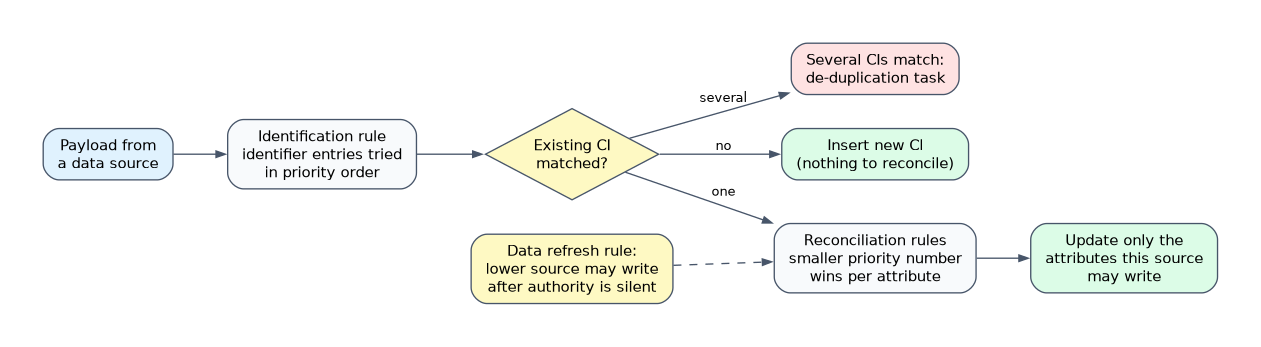 Reconciliation rules say which discovery source is authoritative for which attributes of a class. Each rule names a source and a priority, and a smaller number means a higher priority. A rule for specific attributes takes precedence over a rule set to apply to all attributes.
Once a source has set an attribute, a lower-priority source cannot overwrite it. Reconciliation only applies to updates; when the IRE inserts a new CI, there is nothing to reconcile yet.
A data refresh rule handles the silent authority. If the authoritative source has not updated the CI's attributes within the rule's effective duration, the CI is stale for that source and a lower-priority source may update it.
Other IRE controls
- Data source rules stop a source from inserting new CIs of a class while still letting it update existing ones.
- De-duplication tasks are created when identification finds duplicate CIs, so they can be reviewed and fixed.
- Reclassification handles a CI whose class changes; reclassification tasks appear only when automatic reclassification is turned off.
Integrations reach the IRE through its APIs, through IntegrationHub ETL and Service Graph Connectors, or through import sets that call CMDBTransformUtil. A plain transform map or a direct insert skips the IRE and creates duplicates.
CMDB 360 (multisource CMDB)
Without CMDB 360, the CMDB keeps only the winning value. With it, each source's reported values are stored as well, which lets you:
- Compare what each source says about a CI in the CMDB 360 view of CMDB Workspace.
- Use dynamic reconciliation rules, which choose a value from the stored source values (for example last reported or most reported) rather than by source priority. They need CMDB 360, and they take precedence over a static rule on the same attribute.
- Recompute CI attribute values after changing reconciliation rules, so existing CIs reflect the new rules.
- Query across sources, for example to find CIs reported by one source but not another.
It is enabled with the system property glide.identification_engine.multisource_enabled, which is false by default. Roles include cmdb_ms_editor (create and run queries, no recompute) and cmdb_ms_admin (also changes CMDB 360 properties).
How the exam asks about this
- "Two tools report the same server and a duplicate appears each night." One tool bypasses the IRE or the identification rule lacks a shared identifier; send both through the IRE and check the rule.
- "The asset tool keeps overwriting the operating system that Discovery reports." Add a reconciliation rule for that attribute that gives Discovery a smaller priority number than the asset tool.
- "The team must see which source reported which value before changing reconciliation rules." Enable CMDB 360 and compare sources, then recompute after the change.
What to remember for the exam
- Identify first, reconcile second; reconciliation applies only to updates.
- One identification rule per class, inherited down the hierarchy; identifier entries are tried in priority order.
- Dependent identification needs the hosting or containment relationship in the payload.
- Reconciliation priority: smaller number wins; attribute-specific rules beat apply-to-all rules.
- Data refresh rules let a lower-priority source update a CI after the authoritative source goes silent.
- CMDB 360 keeps every source's values and is required for dynamic reconciliation rules and recompute.
A direct GlideRecord insert or a transform map that does not call the IRE skips identification entirely. That is the most common root cause of duplicate CIs in an exam scenario.
Common mistakes
Reading priority backwards. In reconciliation rules a priority of 10 beats a priority of 100. Give each source that writes to the class its own rule.
Expecting reconciliation to stop inserts. Reconciliation decides who updates attributes. To stop a source creating new CIs of a class, use a data source rule.
Enabling CMDB 360 to fix duplicates. CMDB 360 stores source values; it does not identify CIs. Duplicates are fixed through identification rules and by routing data through the IRE.
Check yourself
What two questions does the IRE answer for every payload?
Identification asks whether the CI already exists, using the class's identification rule. Reconciliation then decides which attributes this source may update.
When can a lower-priority source update an attribute owned by a higher-priority source?
When a data refresh rule finds the CI stale because the authoritative source has not updated it within the effective duration, or when no higher-priority source has updated that attribute yet.
What does CMDB 360 add that standard reconciliation does not?
It stores the values every source reported, so you can compare sources, use dynamic reconciliation rules and recompute CI values after rule changes.
Topic 2 of 2 in Configuration
Test yourself on Configuration
The full ServiceNow CIS-DF question bank has 769 questions, with timed practice exams and an explanation for every answer.
This study guide is independent and is not affiliated with, endorsed by, or sponsored by ServiceNow. Vendor names, certification names and exam codes are trademarks of their respective owners and are used for identification only.