Firewall Filter, NAT and Mangle · Topic 3 of 6
NAT Chains, Actions and Conditions
Learn RouterOS NAT: the dstnat and srcnat chains, custom chains, every NAT action such as masquerade, dst-nat, redirect and netmap, and common conditions.
- 5 min
- Includes a diagram
- NAT has two default chains: dstnat and srcnat.
- Only the first packet of a connection is checked against the NAT table.
- Replies are translated back through the tracked connection, so no reply rule is needed.
What it is
NAT rewrites the addresses or ports of packets as they pass through the router.
The usual reason is address shortage. Private LAN addresses cannot be routed on the internet, so the router replaces them with its public address on the way out. In the other direction, NAT can send incoming connections to a server inside the LAN.
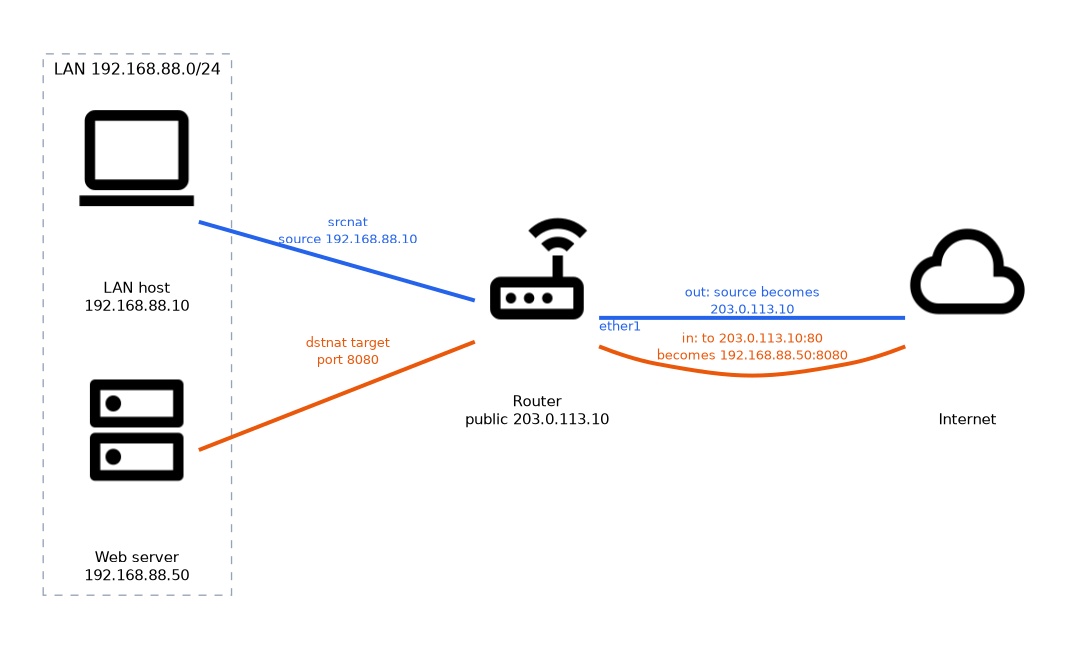
RouterOS has two kinds of NAT: source NAT changes the source, and destination NAT changes the destination. The rules are in /ip firewall nat.
How it works
NAT depends on connection tracking, and only the first packet of a connection is checked against the NAT rules.
The chains
| Chain | Runs | Changes |
|---|---|---|
| dstnat | In prerouting, before the routing decision | The destination address or port |
| srcnat | In postrouting, after the routing decision | The source address or port |
Custom chains work as in the filter table. A rule with action=jump and a jump-target sends the packet to the custom chain, and return goes back.
Only the first packet of a connection is compared with the NAT table. The result is stored in the tracked connection, and every later packet and every reply follows that stored result. This is why you never write a rule for the reply direction.
NAT actions
| Action | Effect |
|---|---|
| src-nat | Replace the source with a fixed address, given in to-addresses, and optionally to-ports |
| masquerade | Replace the source with the address of the outgoing interface |
| dst-nat | Replace the destination with to-addresses and optionally to-ports |
| redirect | Send the packet to the router itself, with an optional to-ports |
| netmap | Map one network onto another, address for address |
| same | Give each client the same address from a range every time (not present in every version) |
| accept | Skip further NAT rules for this packet |
| jump, return | Move into or out of a custom chain |
| passthrough | Count the packet and move on |
| log | Write a log entry and move on |
| add-src-to-address-list, add-dst-to-address-list | Store the address in a list |
Masquerade versus src-nat
Both change the source address, and both work in srcnat. The difference is how they pick the new address.
/ip firewall nat add chain=srcnat out-interface=ether1 action=masquerade
/ip firewall nat add chain=srcnat src-address=192.168.88.0/24 out-interface=ether1 action=src-nat to-addresses=203.0.113.10
Masquerade reads the address from the outgoing interface, so it suits a WAN address that changes, such as one from DHCP. When the interface address changes or the link goes down, the related connections are removed. Src-nat uses a fixed address, so it suits a static public address.
Destination NAT and redirect
Dstnat publishes an inside server. Redirect is a special case where the target is the router itself, for example to push all web requests to a local service.
/ip firewall nat add chain=dstnat dst-address=203.0.113.10 protocol=tcp dst-port=80 action=dst-nat to-addresses=192.168.88.50 to-ports=8080
/ip firewall nat add chain=dstnat in-interface=ether2 protocol=udp dst-port=53 action=redirect to-ports=53A dstnat rule does not open the firewall. A forward filter rule must still allow the translated traffic.
Netmap and same
Netmap translates a whole network to another of the same size, keeping the host part. It is used for one to one mappings. The same action picks an address from a range and keeps using it for the same client, which helps services that dislike changing source addresses.
Common conditions
The conditions are the same style as in filter. The most useful ones for NAT are src-address, dst-address, protocol, src-port, dst-port, in-interface, out-interface and dst-address-type.
Srcnat rules use out-interface because the output is known after routing. Dstnat rules use in-interface because the input is known at the start. The condition dst-address-type=local matches addresses that belong to the router, which suits dstnat rules on a WAN with a changing address.
Use out-interface in srcnat rules and in-interface in dstnat rules, so the rule matches only on the correct side of the router.
What to remember for the exam
Eight facts cover most questions on this topic.
- NAT has two default chains: dstnat and srcnat.
- Only the first packet of a connection is checked against the NAT table.
- Replies are translated back through the tracked connection, so no reply rule is needed.
masqueradetakes the address of the outgoing interface.src-natusesto-addresses.dst-natpublishes an internal server withto-addressesandto-ports.redirectsends the packet to the router itself.netmapmaps one network onto another.- A dstnat rule needs a matching forward filter rule if the firewall drops by default.
Masquerade removes connections when the outgoing interface address changes. Do not use it where long connections must survive an address change.
Common mistakes
These four mistakes appear often.
Choosing masquerade without an out-interface. The rule then matches traffic on every interface.
Forgetting the filter rule. A dstnat rule alone does not allow the translated traffic through the forward chain.
Using srcnat for incoming traffic. Publishing a server needs dstnat, because the destination must change.
Writing a rule for the reply. Connection tracking handles it, so a second rule is extra work.
Check yourself
Work through these three questions.
Which NAT action suits a WAN interface whose address changes?
masquerade, because it takes the address from the outgoing interface.Why is no NAT rule needed for reply packets?
Only the first packet is checked, and the stored result in connection tracking translates later packets and replies.
Which action sends traffic to the router itself?
redirect, optionally withto-ports.
Topic 3 of 6 in Firewall Filter, NAT and Mangle
Test yourself on Firewall Filter, NAT and Mangle
The full MikroTik MTCTCE question bank has 479 questions, with timed practice exams and an explanation for every answer.
This study guide is independent and is not affiliated with, endorsed by, or sponsored by MikroTik. Vendor names, certification names and exam codes are trademarks of their respective owners and are used for identification only.