Design business continuity solutions · Topic 1 of 4
Recovery Objectives and Azure Site Recovery
AZ-305 disaster recovery: turn RTO and RPO into a design, use Azure Site Recovery with recovery plans and test failover, and trim DR cost.
- 5 min
- Includes a diagram
- RTO is downtime allowed. RPO is data loss allowed. Tighter objectives cost more.
- ASR crash consistent points are every 5 minutes (fixed). App consistent points are at least one hour apart.
- Failover option Latest has the lowest RPO but higher RTO. Latest processed has low RTO.
What it is
Recovery objectives state what the business needs after a disaster. RTO (recovery time objective) is how long the system may be down. RPO (recovery point objective) is how much data, measured in time, may be lost. Azure Site Recovery (ASR) replicates workloads to another region or site and orchestrates failover, so you can meet tight objectives for Azure VMs and hybrid servers.
How it works
From objectives to a design
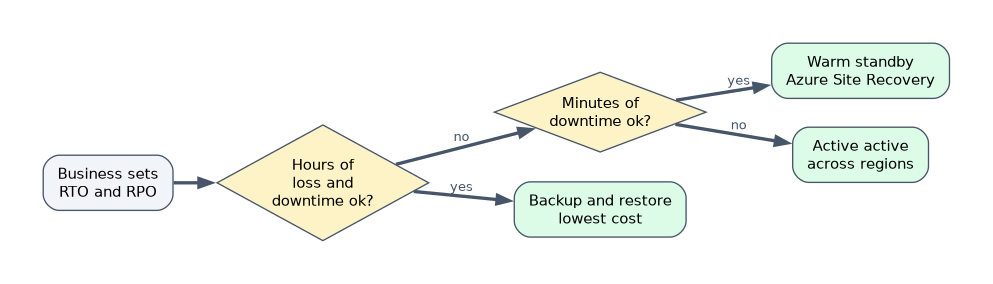
| RTO / RPO | Typical design |
|---|---|
| Days and hours of loss | Backup and restore (cheapest) |
| Hours and minutes | Pilot light or warm standby with replication, such as ASR |
| Minutes and near zero | Active active across regions with global load balancing and geo replicated data |
Tighter objectives cost more. Work with the business to define tiers of criticality, and give each application the cheapest design that still meets its objectives. Remember to account for dependencies: the app tier, database, identity, DNS and network must recover together.
Azure Site Recovery
ASR provides replication, failover and failback for:
- Azure VMs between regions (or between zones).
- VMware VMs and physical servers to Azure.
- Hyper-V VMs to Azure.
Key facts for Azure VM to Azure disaster recovery:
| Item | Detail |
|---|---|
| Replication | Continuous, asynchronous, to a target region, through a Recovery Services vault in the target |
| Crash consistent recovery point | Created automatically every 5 minutes. The interval cannot be changed |
| App consistent recovery point | Minimum frequency one hour (VSS on Windows). Capture only when needed because it can affect performance |
| Recovery point retention | Configurable. Longer retention costs more storage |
| Failover options | Latest (lowest RPO but longer processing, so higher RTO), Latest processed (low RTO), Latest app consistent, or a custom recovery point |
| Recovery plans | Group VMs into ordered groups with manual steps and Azure Automation scripts, so multi tier apps start in sequence |
| Test failover | Run a drill without affecting production or ongoing replication, in an isolated network. Test at least every six months |
| Failback | Reprotect and return to the primary region after recovery |
ASR does not replace backup. It protects against site failure, but a corrupted or deleted VM is replicated too. Use Azure Backup as well.
Meeting RTO and RPO with ASR
- A realistic RPO for Azure VMs is minutes, set by the replication lag, not by a guarantee of 5 minutes.
- RTO depends on the processing option, VM boot time, scripts in the recovery plan and DNS or load balancer changes. Use recovery plans and Traffic Manager or Front Door to redirect traffic.
- For databases, use the service's own replication (failover groups, Always On) rather than replicating the database VM with ASR when RPO must be near zero.
- Plan network in the target: virtual networks, subnets, NSGs and IP addresses. Use network mapping so replicated VMs land in the right networks.
Reducing DR cost
| Technique | Effect |
|---|---|
| Lower recovery point retention to what auditors need | Less storage for recovery points |
| Exclude disks that can be rebuilt, such as scratch or cache disks | Less replication data and storage |
| Protect only critical tiers with ASR, back up the rest | Lower cost, with a longer RTO for the rest |
| Use cache storage accounts and managed disks efficiently | Lower storage and transaction cost |
| Right size the target at failover | Pay for DR compute only during a failover |
Do not reduce protection in a way that breaks the RTO. For example, replacing ASR with daily backup cannot meet a one hour RTO.
Other disaster recovery options
- Azure paired regions and availability zones give structured geo and local separation.
- Azure Backup cross region restore gives a slower, cheaper regional recovery.
- Geo replication in storage, SQL and Cosmos DB covers data.
- Azure Arc and ASR extend recovery to on premises and other clouds.
A worked scenario
A bank's payments system needs an RTO of 1 hour and an RPO of 15 minutes, with two tiers (web and database VMs) that must start in order. The architect uses ASR replication to the paired region, with crash consistent points every 5 minutes, a recovery plan that starts the database VMs first, then web servers, then updates a Traffic Manager profile. The team runs a quarterly test failover in an isolated network and cuts cost by excluding the scratch disks and reducing retention to 24 hours.
What to remember for the exam
- RTO is downtime allowed. RPO is data loss allowed. Tighter objectives cost more.
- ASR crash consistent points are every 5 minutes (fixed). App consistent points are at least one hour apart.
- Failover option Latest has the lowest RPO but higher RTO. Latest processed has low RTO.
- Recovery plans order multi tier recovery. Test failover is safe and uses an isolated network.
- ASR protects against site loss, not corruption or deletion. Use Backup too.
"Fail over in the right order, with scripts" means a recovery plan. "Validate without impact" means test failover.
How the exam asks about this
- "Replicate Azure VMs to another region with an RTO of one hour." Azure Site Recovery with a recovery plan.
- "Rehearse DR without disrupting production." A test failover in an isolated network.
- "Reduce DR cost without lengthening the RTO." Exclude rebuildable disks and shorten retention.
- "Database RPO must be near zero." Database native replication such as a failover group.
Common mistakes
Relying on ASR as backup. Corruption replicates.
Replacing replication with daily backup when the RTO is one hour.
Skipping drills. Untested plans fail.
Forgetting target networks and DNS.
Check yourself
How often does ASR create crash consistent recovery points?
Every 5 minutes.
What orders the startup of a multi tier app at failover?
A recovery plan.
Which failover option has the lowest RPO but higher RTO?
Latest.
Topic 1 of 4 in Design business continuity solutions
Test yourself on Design business continuity solutions
The full Microsoft AZ-305 question bank has 755 questions, with timed practice exams and an explanation for every answer.
This study guide is independent and is not affiliated with, endorsed by, or sponsored by Microsoft. Vendor names, certification names and exam codes are trademarks of their respective owners and are used for identification only.