Cloud Security Operations · Topic 5 of 6
Supporting Digital Forensics in the Cloud
CCSP cloud forensics: data collection methods, evidence management, collecting, acquiring and preserving digital evidence, and provider cooperation.
- 5 min
- Includes a diagram
- Follow order of volatility: memory and running state before disk.
- Isolate a suspect instance; do not terminate it.
- Hash everything at acquisition and work only on copies.
What it is
Digital forensics collects and analyses digital evidence so that it can explain an incident and, if needed, stand up in court or before a regulator. In the cloud the investigator usually cannot seize a disk or touch a server. Evidence lives on shared infrastructure, may be spread across jurisdictions and may disappear with an ephemeral instance.
Supporting forensics means planning for this before an incident: knowing what evidence exists, how to collect it, and what the provider will do.
How it works
Forensic data collection methodologies
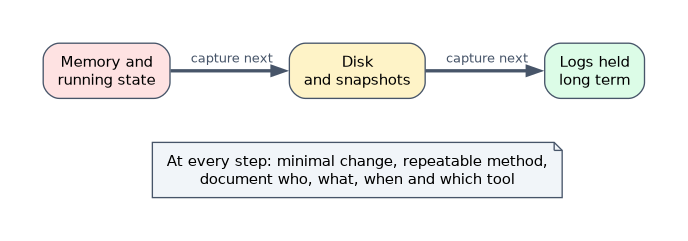 Collection follows recognized methods, such as the ISO/IEC 27037 guidance on identifying, collecting, acquiring and preserving digital evidence. Key principles:
- Order of volatility: capture the most volatile data first: memory and running state before disk, disk before logs held long term.
- Minimal change: use methods that alter the evidence as little as possible and document any unavoidable change.
- Repeatability: another examiner using the same method should get the same result.
- Documentation: record who did what, when, with which tools.
What evidence looks like by service category
| Category | Evidence the customer can collect | Depends on provider |
|---|---|---|
| IaaS | Disk snapshots, memory captures through tools in the guest, guest logs, flow logs, management plane logs | Hypervisor and physical host data |
| PaaS | Application logs, platform logs exposed by the service, configuration history | Underlying OS and runtime data |
| SaaS | Audit logs and exports the application provides | Almost everything else |
The less the customer controls, the more it relies on the provider. Contracts should state what logs are kept, for how long, and what help the provider gives during an investigation.
Collecting and acquiring evidence in IaaS
- Do not terminate a suspect instance; termination can destroy ephemeral storage and memory.
- Isolate it by changing security group rules to cut network access, keeping it running.
- Capture memory with a trusted tool, then snapshot attached volumes.
- Copy snapshots to a dedicated, locked down forensic account.
- Hash every acquired image and record the values.
- Preserve management plane logs and flow logs for the relevant period.
Analysis is done on copies, never on the originals.
Preserving digital evidence
- Integrity: hashes at acquisition and before each analysis show nothing changed; write once storage helps.
- Access control: only named investigators can reach the forensic account.
- Retention: keep evidence as long as legal counsel requires, with legal hold on related data.
- Time: record time zones and synchronized time sources so timelines are accurate.
Evidence management and chain of custody
The chain of custody records every person who handled each item, when, why and where it was stored. In the cloud it also records which account and region the evidence came from, which API calls created the copies, and the hashes.
| Field | Example |
|---|---|
| Item | Snapshot of volume, web server 3 |
| Source | Production account, EU region |
| Collected by | Named incident responder |
| Date and time | 20/10/2026 09:42 UTC |
| Hash | SHA-256 value of the image |
| Transfers | Copied to forensic account; accessed by analyst, with date and purpose |
A gap in the chain lets the other side argue the evidence was altered.
Cloud specific challenges
- Multi-tenancy: the provider cannot hand over shared hardware or other tenants' data.
- Jurisdiction: evidence stored in another country may need legal process there.
- Volatility: auto scaling may terminate instances before anyone looks at them.
- Provider cooperation: some data can only be obtained from the provider, on its timeline.
- Log availability: logs that were never enabled or were kept too briefly cannot be recovered.
ISO/IEC 27041, 27042 and 27043 support the process with guidance on validating methods, analysis and interpretation, and investigation principles; the legal side is in Domain 6.
Forensic readiness
Prepare before an incident: enable and centralize logs with adequate retention, build forensic tooling and an isolated forensic account, write run books for each service category, agree provider support in the contract, and train responders.
A worked example
A security alert shows an IaaS web server making connections to a known command and control address. An engineer's first instinct is to terminate the instance and redeploy.
The incident lead stops this. The instance is isolated by replacing its security group, memory is captured, and its volumes are snapshotted and copied to the forensic account. Every image is hashed and logged on the chain of custody form, management plane logs for the past 90 days are preserved, and only then is a clean replacement deployed.
How the exam asks about this
- "A compromised IaaS instance must be investigated. What should be done FIRST?" Isolate it without shutting it down, then capture volatile data.
- "What proves a forensic image has not changed since acquisition?" Matching hash values recorded in the chain of custody.
- "In which service category does the customer depend MOST on the provider for forensic data?" SaaS.
What to remember for the exam
- Follow order of volatility: memory and running state before disk.
- Isolate a suspect instance; do not terminate it.
- Hash everything at acquisition and work only on copies.
- Chain of custody records every handling, transfer and storage location.
- Forensic readiness needs logs, tooling, run books and provider terms agreed in advance.
Auto scaling and self-healing can destroy evidence automatically. Suspend scaling actions or protect the instance before the platform replaces it.
Common mistakes
Terminating and redeploying immediately. Service returns, but memory, ephemeral storage and the evidence of the attack are lost.
Analyzing the original. Every examination should use a verified copy.
Expecting the provider to hand over hardware. Multi-tenancy makes physical seizure impractical; plan for logical acquisition.
Check yourself
Why is memory captured before disks?
Memory is more volatile and is lost when the instance stops, and it can hold running processes, network connections and encryption keys.
What is the purpose of a separate forensic account?
It holds copies of evidence under tight access control, away from the compromised environment.
What does ISO/IEC 27037 cover?
Guidelines for identifying, collecting, acquiring and preserving digital evidence.
Topic 5 of 6 in Cloud Security Operations
Test yourself on Cloud Security Operations
The full ISC2 CCSP question bank has 900 questions, with timed practice exams and an explanation for every answer.
This study guide is independent and is not affiliated with, endorsed by, or sponsored by ISC2. Vendor names, certification names and exam codes are trademarks of their respective owners and are used for identification only.